
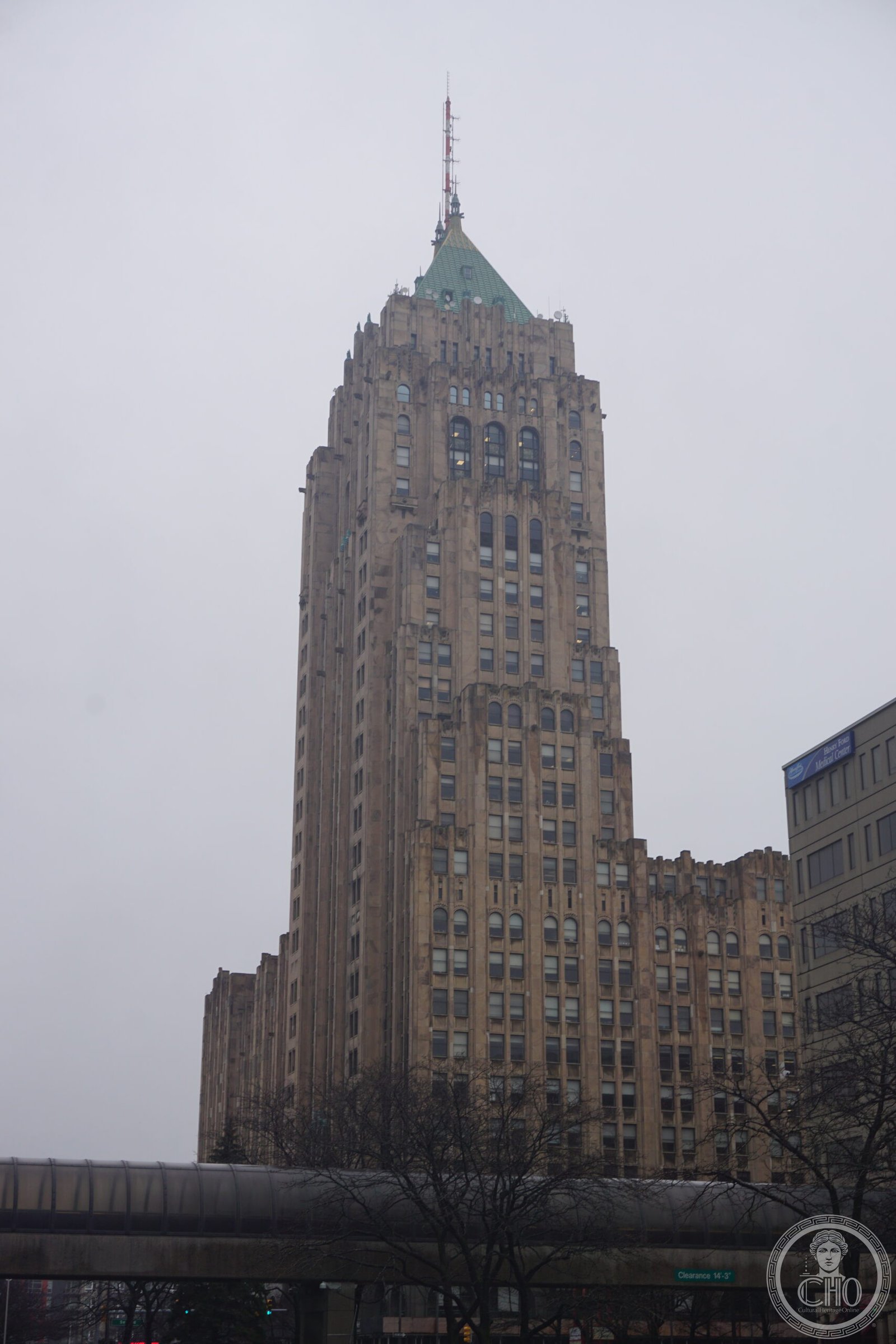
Albert Kahn’s supreme gesture in gold and polished stone — a 30-storey Art Deco tower whose barrel-vaulted lobby arcade has no equal in the American Midwest.
At a glance
The Fisher Building rose in 1928 as the centrepiece of New Center, a secondary commercial district north of downtown Detroit that the seven Fisher Brothers intended as a rival to the city’s original commercial core. The brothers had recently completed the sale of their automobile-body manufacturing company to General Motors, and they commissioned Albert Kahn — the industrial architect behind Ford’s Highland Park plant — to produce a monument. What he delivered was a 30-storey limestone tower with a four-storey internal arcade, The Great Arcade, paved in marble from three continents and roofed with a barrel-vaulted ceiling covered in polychrome mosaic tile.
Key facts
- Address: 3011 W Grand Blvd, Detroit, MI 48202
- Architect: Albert Kahn (Albert Kahn Associates)
- Completed: 1928
- Style: Art Deco
- Height: 444 feet (135 m); 30 floors
- Commissioners: The seven Fisher Brothers — Fred, Charles, Lawrence, William, Edward, Alfred and Howard
- Status: National Historic Landmark (1989)
- GPS: 42.3660°N, 83.0759°W
History
The Fisher Brothers founded the Fisher Body Company in Detroit in 1908, manufacturing wooden carriage bodies at a moment when the automobile was still a novelty. They moved to Detroit, pivoted to enclosed automobile bodies, and by the early 1920s supplied coachwork for Cadillac, Buick and Oldsmobile. When General Motors acquired the company through the mid-1920s the brothers emerged as some of the wealthiest industrialists in America. Their answer to that wealth was an eight-block development north of downtown they called New Center — and at its heart they placed the building that bore their name.
Albert Kahn was the natural choice. He had spent two decades designing factories for Ford, Packard and General Motors: buildings celebrated for their structural logic but not for their grandeur. The Fisher commission was different. Kahn was asked to produce a monument, and he produced one. The tower is faced in light limestone above a dark granite base, with a four-storey arcade running its full length that he called The Great Arcade. The lobby programme was a controlled exercise in excess — vault after vault of polychrome mosaic, bronze fixtures, marble sourced from Algeria, Greece and Italy, and forty-three varieties of stone and tile in all.
The Fisher Brothers originally planned three towers of descending height arranged along Grand Boulevard. The Great Depression, arriving a year after the building opened, killed the companion towers before ground was broken. The single building that survived became both statement and monument — the largest piece of evidence that early twentieth-century Detroit was a city with ambitions matching any on the Eastern Seaboard.
What you see
The exterior setbacks give the Fisher Building a stepped silhouette that reads as clean and modern from a distance, but resolves on approach into bands of ornament — stylised botanical forms, geometric friezes, bronze canopy work over the entrance that is among the most refined metalwork in the city. The limestone cladding lightens as the tower rises, so that the upper storeys appear almost to dematerialise against a bright sky.
Inside The Great Arcade the scale shifts. The barrel vault rises four storeys above the floor, its surface covered in a mosaic programme of gold, blue and ochre that catches light through the skylights and diffuses it into a warm glow. Retail shopfronts occupy the ground-floor bays — a continuous commercial gallery that once drew comparison with the Galleria Vittorio Emanuele II in Milan. The marble floor has worn to a polish that records nearly a century of foot traffic, and the bronze shopfront framing retains almost all its original patina.
Practical information
- The Great Arcade: open during business hours on weekdays; ground-floor retail accessible to the public
- Tours: guided architectural tours available seasonally through Preservation Detroit
- Time needed: 30–45 minutes for the arcade and lobby; longer if attending a tour
- Best light: mid-morning, when skylights illuminate the mosaic vault
Getting there
The Fisher Building stands at 3011 W Grand Blvd in New Center, roughly two miles north of downtown Detroit. Detroit Metropolitan Wayne County Airport (DTW) is approximately 25 miles southwest; the Woodward Avenue QLine streetcar connects New Center to Midtown and downtown, with a stop at Grand Boulevard. By car, parking is available in the New Center One garage adjacent to the building.
Nearby
- Motown Museum (Hitsville U.S.A.) — The original Motown recording studio at 2648 W Grand Blvd, three blocks east of the Fisher Building toward downtown.
- Charles H. Wright Museum of African American History — The largest museum dedicated to African American history in the world, two miles south in Midtown.
- Detroit Institute of Arts — Beaux-Arts building (1927) housing Diego Rivera’s Detroit Industry Murals (1932–33), one mile south.
- New Center One (1981) — The modernist office tower by Minoru Yamasaki adjacent to the Fisher Building; a useful comparison of two architectural eras on the same corner.
Sources
- National Historic Landmark nomination, Fisher Building, US National Park Service, 1989
- Albert Kahn Associates records, Burton Historical Collection, Detroit Public Library
- National Register of Historic Places Inventory–Nomination Form: Fisher Building, Michigan
- Preservation Detroit, architectural survey notes
- American Institute of Architects, Michigan Chapter historical citations
Find it on the map
See this place and what’s around it →Record researched and written by Luigi De Marchi for Cultural Heritage Online, 2026.
📷 Become a Cultural Heritage Online photographer
Share your photos of places: they stay published under your name as the author. The more they're seen, the more you get noticed — and soon a contest will reward the most appreciated photos.
Log in or sign up free to add a photoIs this page about you?
This page is read by travellers and heritage enthusiasts who find it on Google. Tell us how you are connected to this place and we will take it from there.