
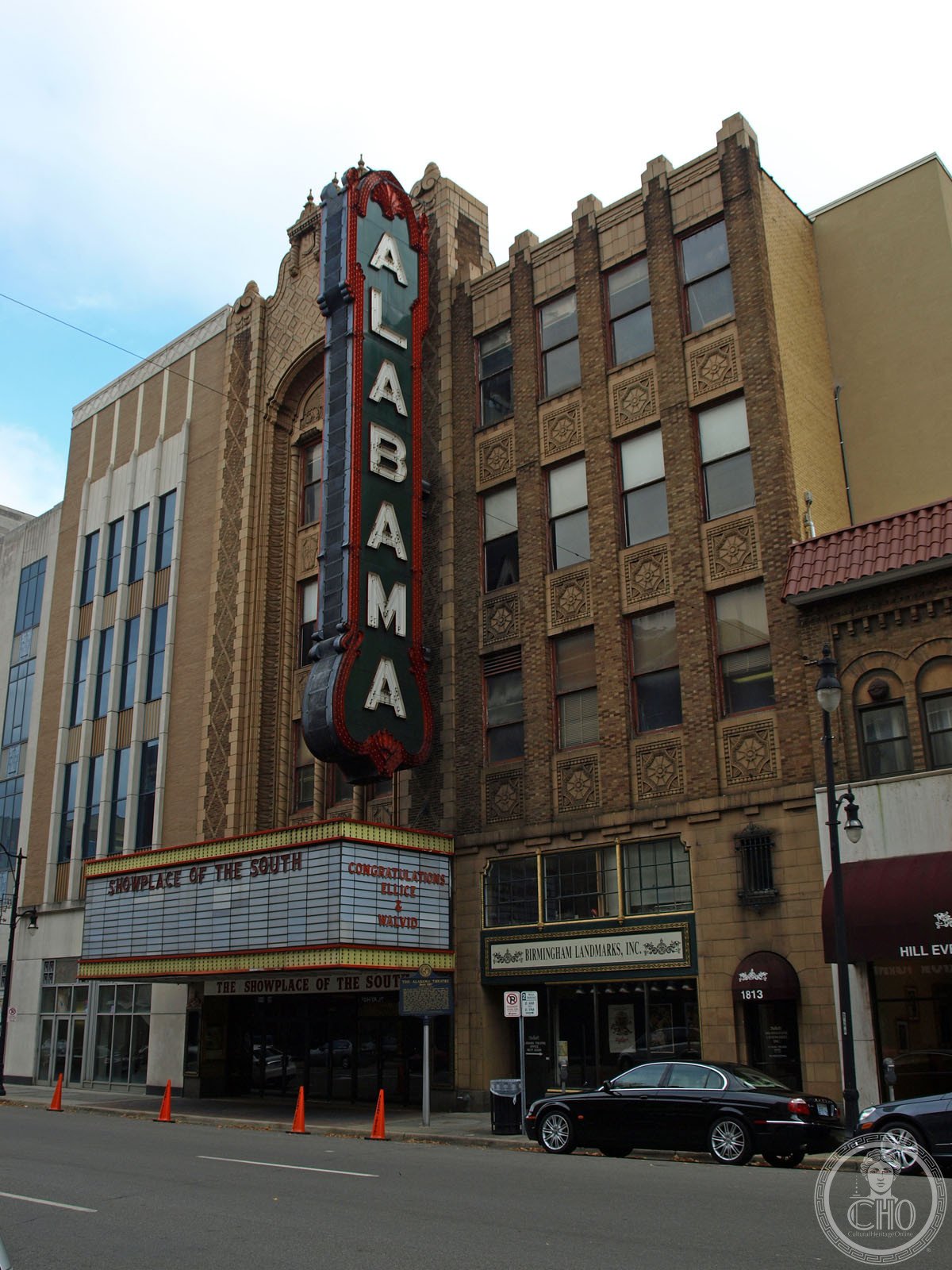
Alabama Theatre
The Alabama Theatre on 3rd Avenue North in Birmingham — with its Moorish atmospheric interior of horseshoe arches, starry ceiling, and ornamental plasterwork suggesting an open-air Andalusian courtyard — is the finest surviving example of the Atmospheric cinema style in the American South and one of the largest working theatres in Alabama.
At a glance
The Alabama Theatre at 1817 3rd Avenue North in Birmingham, Alabama, was opened in December 1927 as the flagship Paramount Pictures house in the Southeast. Built in the Atmospheric style — in which the interior simulates an open-air setting under a night sky, creating the impression that the audience is seated in an exotic courtyard rather than an enclosed hall — the Alabama presents its Moorish vocabulary through horseshoe arches, ornamental tile patterns, and a ceiling painted and lit to suggest stars and drifting clouds. The theatre has been listed on the National Register of Historic Places and remains in active use for film screenings, concerts, and live events, managed by the Birmingham Landmarks organization.
Key facts
- Location: 1817 3rd Avenue North, downtown Birmingham, Alabama
- Opened: December 1927
- Style: Atmospheric / Moorish Revival cinema
- Capacity: Over 2,500 seats
- Organ: Wurlitzer “Mighty Alabama” pipe organ, restored and in use
- Status: National Register of Historic Places; managed by Birmingham Landmarks
- Current use: Film screenings, concerts, and live events
History
The Atmospheric cinema style was developed in the 1920s by architect John Eberson, who created entertainment environments that suggested exotic outdoor settings inside enclosed halls. The technique combined plasterwork architecture representing courtyard walls, balconies, and towers with a ceiling lit to simulate the night sky — clouds drifted, stars appeared, and the audience was momentarily transported out of an industrial American city into an imagined Mediterranean or Moorish world. The style was widely adopted by theatre chains in the late 1920s as an alternative to the gilded Baroque interiors of the traditional film palace.
The Alabama Theatre opened in December 1927 as part of the Paramount Pictures exhibition chain. Birmingham in 1927 was a rapidly growing industrial city — the steel-making centre of the American South — whose prosperity in the 1920s supported the investment in a theatre of this scale and ambition. The Moorish architectural theme represented a particular choice within the Atmospheric vocabulary: the horseshoe arches, geometric tile patterns, and polychrome plasterwork of Andalusian and Moroccan architecture translated into the specific romance of the movie house.
The theatre’s “Mighty Alabama” Wurlitzer pipe organ was installed at opening to accompany silent films; it survived the transition to sound and remains one of the best-maintained large theatre organs in the Southeast. When the Paramount circuit consolidated and the building changed hands in subsequent decades, it remained a working cinema. Faced with the threat of demolition in the 1980s, a preservation campaign led to the formation of Birmingham Landmarks and the restoration of the building, which now presents a mixed programme of classic film screenings, live music, and community events.
What you see
The exterior on 3rd Avenue North is a controlled Moorish composition: horseshoe arched windows, geometric ornamental panels, and a marquee that has framed the theatre’s entrance for nearly a century. The exterior gives only a hint of the interior’s ambition; the full Atmospheric effect is experienced inside.
The auditorium is the Alabama Theatre’s defining space. The side walls are constructed and painted to suggest the courtyard of a Moorish palace — towers, archways, and decorative balconies — and the ceiling above is painted midnight blue and studded with electric stars that can be programmed to twinkle. Between the stars, mechanical clouds drift slowly across the simulated sky. The Wurlitzer organ console rises from the orchestra pit on an electrically powered platform. The effect, in the context of the restored plasterwork and the original colour scheme, remains compelling as a total atmospheric environment.
Practical information
- Access: Functioning theatre; the interior is accessible during events and some special tours.
- Programming: Classic film series, live organ concerts, concerts, and community events; check Birmingham Landmarks for the schedule.
- Organ: The “Mighty Alabama” Wurlitzer is demonstrated at some film screenings and concerts — a rare opportunity to hear a restored 1920s theatre organ in its original hall.
- Time needed: 30 minutes for exterior and lobby; full event time for interior experience.
Getting there
The Alabama Theatre is at 1817 3rd Avenue North in downtown Birmingham, two blocks north of the historic 4th Avenue North commercial district. Birmingham’s light rail system (LINK) connects the city’s transit nodes; the theatre is within walking distance of the downtown transit center. By car, the theatre is accessible from I-20/59 (Exit 124A for 17th Street) and from Richard Arrington Jr. Boulevard (US-31) northbound into the city centre. The Birmingham-Shuttlesworth International Airport (BHM) is approximately six miles northeast.
Nearby
- 16th Street Baptist Church (1911) — The church that was bombed by white supremacists in September 1963, killing four young girls; now a civil rights memorial, three blocks west on 16th Street North, is one of the most significant sites of the American civil rights movement.
- Birmingham Civil Rights Institute (1992) — The museum documenting the Birmingham civil rights movement, directly across from the 16th Street Baptist Church on 16th Street and 6th Avenue North.
- Kelly Ingram Park — The public park between the 16th Street Baptist Church and the Birmingham Civil Rights Institute, site of the 1963 demonstrations and now a civil rights memorial landscape.
- Vulcan Park and Museum — The colossal cast-iron statue of Vulcan (1904), the largest iron figure in the world, overlooking Birmingham from Red Mountain two miles south.
Sources
- National Register of Historic Places nomination: Alabama Theatre, Birmingham, Alabama.
- Naylor, David. American Picture Palaces: The Architecture of Fantasy. Van Nostrand Reinhold, 1981.
- Gomery, Douglas. Shared Pleasures: A History of Movie Presentation in the United States. University of Wisconsin Press, 1992.
- Birmingham Landmarks, Inc. The Alabama Theatre: A History. Birmingham: Birmingham Landmarks, 2005.
- Wikipedia, “Alabama Theatre,” https://en.wikipedia.org/wiki/Alabama_Theatre.
Find it on the map
See this place and what’s around it →📷 Diventa un fotografo di Cultural Heritage Online
Condividi le tue foto dei luoghi: restano pubblicate con la tua firma come autore. Più vengono viste, più ti fai conoscere — e presto un concorso premierà le foto più apprezzate.
Accedi o registrati gratis per aggiungere una fotoDo you manage this place?
This page is read by travellers and heritage enthusiasts who find it on Google. Keep it accurate — and make it work for you. Free for non-profit heritage institutions.