

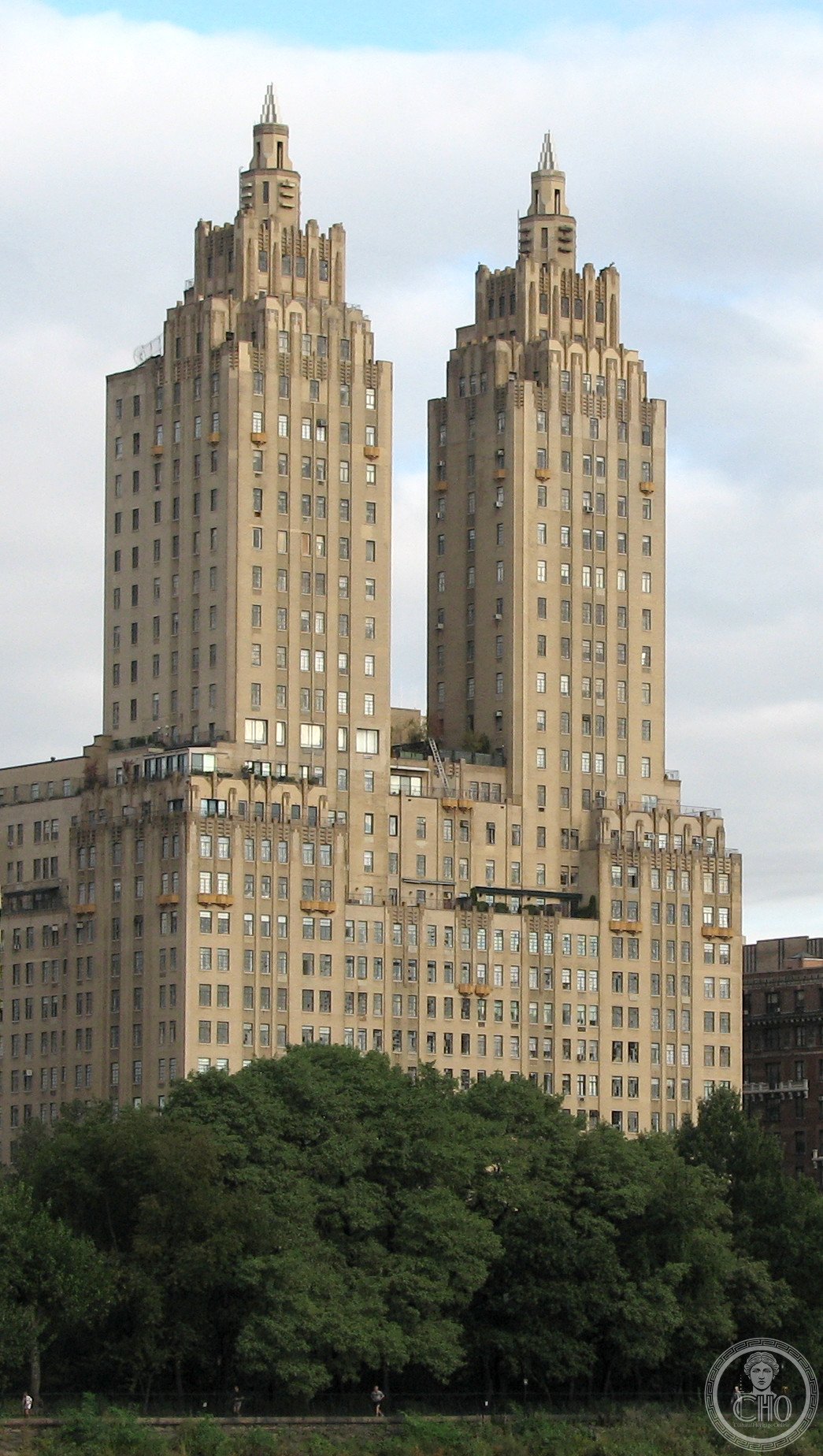
Emery Roth’s twin-towered Eldorado at 300 Central Park West is one of the defining silhouettes of the Upper West Side skyline — an Art Deco monument to the luxury residential market of the 1920s building boom that was finished, against considerable odds, at the onset of the Great Depression.
At a glance
Standing at the corner of Central Park West and 90th Street, the Eldorado Apartments were designed by Emery Roth, the Hungarian-born architect whose mastery of large-scale residential buildings defined the Upper West Side’s character in the interwar years. The building rises 30 stories in twin towers set back from a lower-floor base, its Art Deco ornament concentrated at the crown and at the entrance. Completed in 1931 at the low point of the Depression, it represents both the ambition of New York’s residential market at its late-1920s peak and the tenacity required to complete a luxury project when that market had collapsed. The Eldorado is a New York City Landmark and remains one of the most sought-after addresses on Central Park West.
Key facts
- Address: 300 Central Park West, New York, NY 10024
- Architect: Emery Roth (1871–1948)
- Completed: 1931
- Height: Approximately 30 stories with twin towers
- Style: Art Deco
- Status: New York City Landmark
- Use: Residential cooperative apartments
History
Emery Roth arrived in the United States from Hungary in 1884 and trained under Richard Morris Hunt before establishing his own practice. By the 1920s he had become the pre-eminent designer of luxury apartment buildings in Manhattan, with a portfolio that included the Beresford, the San Remo, and numerous other Central Park West and Upper West Side buildings. The Eldorado was commissioned at the height of the late-1920s apartment boom, with groundbreaking in 1929 just weeks before the stock market crash.
The Depression forced the project through serious financial difficulties. Roth’s original design was completed with modifications, and the building was finished in 1931 — a year when the luxury rental market had essentially ceased to exist. The Eldorado survived through a combination of reduced rents, long-term tenants, and the building’s inherent quality, which continued to attract tenants even in adverse conditions. In subsequent decades it became one of the most consistently desirable addresses in New York, converting from rental to cooperative ownership, a pattern common to Manhattan’s grand prewar buildings.
What you see
The Eldorado’s twin towers rise from a lower base block that occupies most of the West 90th Street frontage on Central Park West. Roth’s Art Deco ornament appears at the transitions between building sections: geometric banding, stylised foliage, and the angular framing of windows and entrance portals. The towers differ slightly from the more classical crown treatment Roth used at the San Remo: instead of columnar temples at the top, the Eldorado’s towers taper to elongated pointed finials that read as spires when seen from the park.
The Central Park West facade is best understood from across the park — Roth composed the silhouette to be seen at a distance, with the twin towers creating a vertical accent against the sky that distinguishes this stretch of Central Park West from both south (the 70s buildings) and north (the 90s-100s blocks). At street level, the limestone base and the entrance surround display Roth’s characteristic layering of Art Deco ornament around the threshold.
Practical information
- Access: Private residential cooperative; the exterior and entrance lobby area are viewable from the street and from Central Park.
- Best view: From Central Park itself, looking west from the path along the East Drive between the 90th Street crossings — the twin towers read clearly against the sky.
- Time needed: 15 minutes to appreciate the exterior from the park and street; combine with a walk along Central Park West to see the San Remo and Beresford to the south.
- Context: Best experienced as part of the Central Park West Art Deco residential tour.
Getting there
The Eldorado stands at 300 Central Park West at 90th Street, on the Upper West Side of Manhattan. The nearest subway station is 86th Street on the 1/2/3 trains (Broadway and 86th Street), approximately five blocks south. The 86th Street station on the C train (Central Park West and 86th Street) is one block east of the building. The Reservoir, one of Central Park’s largest water features, is directly across the park to the east.
Nearby
- San Remo Apartments (1930) — Emery Roth’s earlier twin-tower masterpiece at 145 Central Park West, sixteen blocks south, with its distinctive columnar crowns.
- The Beresford (1929) — Another Emery Roth building at 211 Central Park West, visible from the park.
- American Museum of Natural History — One block west of Central Park West on 79th Street; the museum complex extends west toward Columbus Avenue.
- Central Park Reservoir (Jacqueline Kennedy Onassis Reservoir) — The vast open-water feature of the park is directly visible from the Eldorado’s upper floors, stretching from 86th to 96th Streets.
Sources
- New York City Landmarks Preservation Commission, The Eldorado Designation Report.
- Steven Ruttenbaum, Mansions in the Clouds: The Skyscraper Palazzi of Emery Roth, Balsam Press, 1986.
- Andrew Alpern, New York’s Fabulous Luxury Apartments, Dover Publications, 1975.
- Wikipedia contributors, “Eldorado (apartment building),” Wikipedia, The Free Encyclopedia.
Find it on the map
See this place and what’s around it →📷 Become a Cultural Heritage Online photographer
Share your photos of places: they stay published under your name as the author. The more they're seen, the more you get noticed — and soon a contest will reward the most appreciated photos.
Log in or sign up free to add a photoIs this page about you?
This page is read by travellers and heritage enthusiasts who find it on Google. Tell us how you are connected to this place and we will take it from there.