
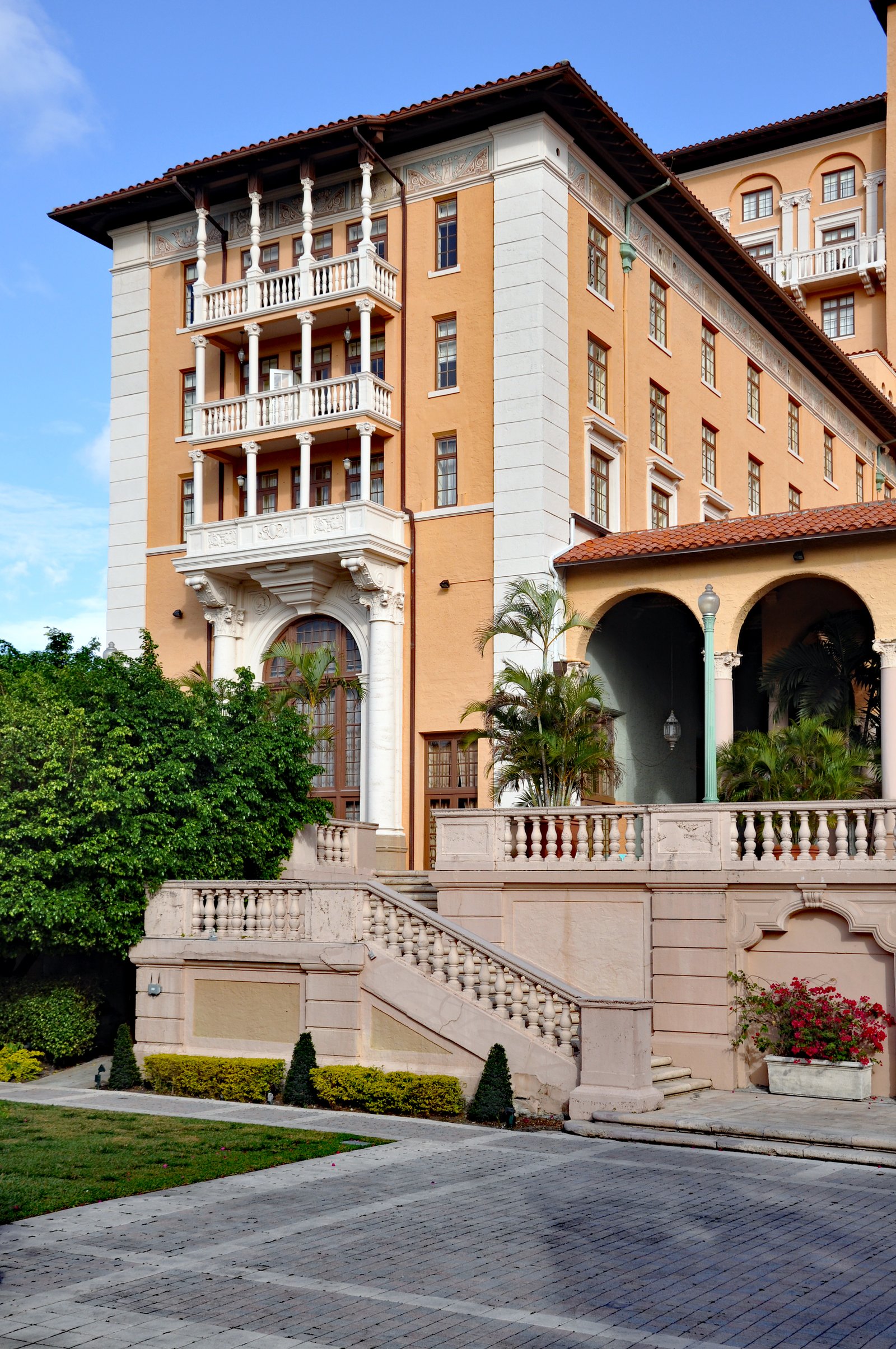
Schultze & Weaver modelled the Biltmore’s campanile on the Giralda of Seville and positioned it as the crown of George Merrick’s master-planned city—a 315-foot tower visible for miles across the flat Florida landscape that signalled Miami’s ambition in the year the land boom peaked.
At a glance
George Merrick founded Coral Gables in 1921 as one of America’s first comprehensively planned cities, prescribing a Mediterranean vocabulary for every building within its boundaries. The Biltmore Hotel, which Merrick commissioned from the New York firm of Schultze & Weaver and opened on January 15, 1926, was the centrepiece of that vision: a 315-foot tower modelled on the Giralda bell tower of Seville Cathedral, flanked by low wings set around courtyards in the Spanish colonial manner. The hotel was among the tallest structures in Florida at the time of its opening. Among its notable guests in the 1920s was Olympic swimmer Johnny Weissmuller, who set world records in the hotel’s large swimming pool.
Key facts
- Address: 1200 Anastasia Avenue, Coral Gables, FL 33134
- Architects: Schultze & Weaver (Leonard Schultze, S. Fullerton Weaver)
- Opened: January 15, 1926
- Style: Mediterranean Revival / Spanish Colonial
- Tower height: 315 feet (96 m)
- Landmark status: National Historic Landmark (1996)
- Current use: Operating luxury hotel and conference center
History
The Biltmore opened during the peak of the 1920s Florida land boom, part of a development frenzy that collapsed within months when a hurricane devastated South Florida in 1926 and bankrupted many of the boom’s promoters, including Merrick himself. The hotel survived under new ownership through the Depression and continued as a luxury destination until the Second World War, when the Army Air Forces requisitioned it as a regional hospital. The Veterans Administration operated it as a hospital until 1968, after which the building stood vacant for nearly two decades.
The City of Coral Gables undertook a major restoration in the 1980s, bringing the building back to its 1926 Mediterranean Revival appearance. The Biltmore reopened in 1987 as a luxury hotel and conference center. Its designation as a National Historic Landmark in 1996 recognized both the architectural significance of the Schultze & Weaver design and the building’s role in the history of Florida tourism and real-estate development.
Schultze & Weaver were among the most prolific hotel architects of the 1920s, also responsible for the Pierre and the Sherry-Netherland in New York. The Biltmore remains one of the finest examples of their Mediterranean Revival work and the most prominent building in Merrick’s original vision for Coral Gables.
What you see
The Giralda-derived campanile dominates the view from Anastasia Avenue: a square tower of stucco-and-tile construction rising through arched openings and a domed lantern to a height that makes it a regional landmark in the literal sense, visible across the flat Everglades coastal plain. The low wings around the courtyard follow Mediterranean Revival convention—arcaded loggias, terracotta-tiled roofs, and stucco walls enlivened with carved stone surrounds—creating a sequence of outdoor rooms that connect the lobby to the pool terrace.
The lobby interior maintains its 1920s proportions: double-height spaces with painted wooden ceilings in the Andalusian tradition, ornamental ironwork throughout, and floors of polished stone that amplify the scale of the entrance sequence. The swimming pool—one of the largest hotel pools in the Southeast—is surrounded by the original loggia arcade and remains the social heart of the property, giving the grounds a scale more typical of a resort complex than a single city hotel.
Practical information
- Open to the public as a hotel and restaurant; advance reservations recommended for dining
- Lobby and public areas accessible to visitors during business hours
- Guided historical tours of the property offered on select weekends
- Swimming pool reserved for hotel guests; non-guests may access with a day pass (seasonal)
- Best season: October–April (South Florida dry season); summer is hot and humid
Getting there
The Biltmore Hotel stands at 1200 Anastasia Avenue in Coral Gables, approximately 7 miles southwest of Miami International Airport (MIA). By car: take the Palmetto Expressway (SR-826) to the Coral Way exit and head west into Coral Gables. The free Coral Gables Trolley runs a circuit that includes stops near the hotel. The University of Miami Metrorail station is approximately 1.5 miles east; bus service connects to the campus area and the broader Miami transit network.
Nearby
- Venetian Pool (1923) — approximately half a mile north on De Soto Boulevard; a public swimming pool carved from a coral rock quarry, listed on the National Register of Historic Places
- Fairchild Tropical Botanic Garden — approximately 3 miles south; 83 acres of rare tropical plants and one of the most significant botanic collections in the Americas
- Pérez Art Museum Miami (PAMM) — approximately 9 miles northeast in downtown Miami; international modern and contemporary art in a waterfront building by Herzog & de Meuron
Sources
- National Historic Landmark designation file, National Park Service, 1996
- Merrick, George E. Coral Gables development records (Florida State Archive)
- Dunlop, Beth. Building a Dream: The Art of Disney Architecture — chapter on Florida hotel design tradition. New York: Abrams, 1996 (cited for Schultze & Weaver context)
- Florida Master Site File: Biltmore Hotel, Coral Gables
Find it on the map
See this place and what’s around it →📷 Become a Cultural Heritage Online photographer
Share your photos of places: they stay published under your name as the author. The more they're seen, the more you get noticed — and soon a contest will reward the most appreciated photos.
Log in or sign up free to add a photoIs this page about you?
This page is read by travellers and heritage enthusiasts who find it on Google. Tell us how you are connected to this place and we will take it from there.