

Flying deer in stone: the most mysterious monuments of the steppe
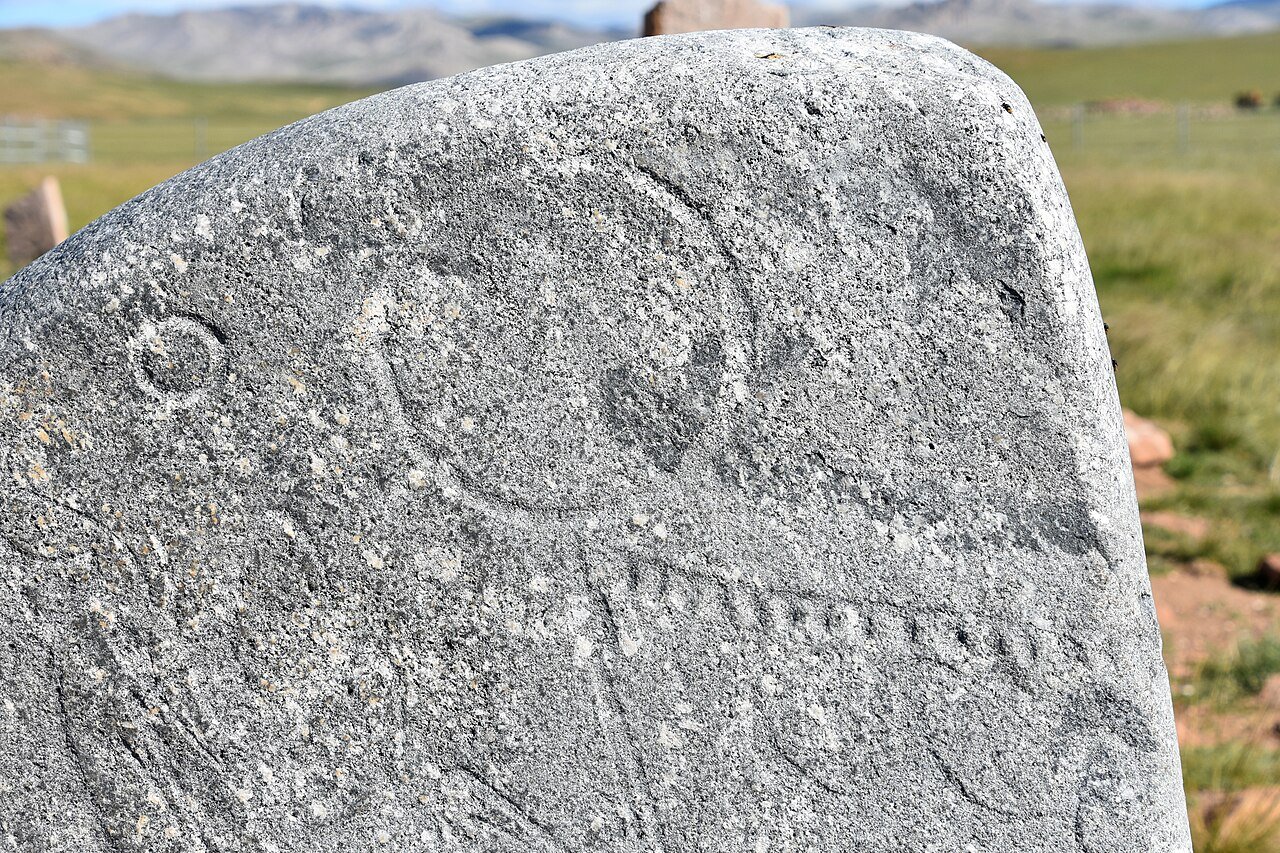
On the rolling grasslands near the town of Moron in northern Mongolia, 14 granite monoliths stand in a field, their surfaces engraved with images of stylised deer in flight — necks stretched, antlers swept back, forelegs and hindlegs extended in a gravity-defying leap. These are deer stones (bugun chuluu in Mongolian), the most distinctive Bronze Age monument of the Eurasian steppe, and Uushigiin Ovor contains the largest and finest concentration in the world. Their purpose, their builders, and the religious system they represent remain among archaeology’s most compelling mysteries.
UNESCO inscription: nomadic art of the Bronze Age steppes
Inscribed in 2023, Uushigiin Ovor and the associated Khirigsuur monuments were recognised by UNESCO as outstanding examples of the prehistoric nomadic cultural landscape of Mongolia. The inscription acknowledges both the artistic quality of the deer stones — among the finest examples of animal-style art from any prehistoric culture — and their significance as evidence of a sophisticated, organised society on the Eurasian steppe 3,000 years ago, long before the empires of the Xiongnu and Mongols brought that world to historical prominence.
What is a deer stone?
Deer stones are standing monoliths — usually granite or schist, 1–4 metres tall — carved with a standardised iconographic programme. On the upper register: a pair of circular “earrings” and three lines representing a necklace. On the middle register: the flying deer in profile, its body covered in spiral ornaments suggesting feathers or flames. On the lower register: a belt from which hang weapons — daggers, axes, and bows. Most deer stones lack a face; a few show schematic features. The deer images are not naturalistic but transformed: the animals fly through the air, combining the qualities of eagle and stag.
Khirigsuurs: the burial mounds that accompany the deer stones
Deer stones are rarely found alone. At Uushigiin Ovor, the 14 monoliths stand in association with dozens of khirigsuurs — large Bronze Age burial mounds surrounded by geometrically arranged stone arrangements. Excavations of khirigsuurs elsewhere in Mongolia have revealed horse skulls arranged around the central burial — evidence of the ritual sacrifice of horses that characterised Bronze Age funerary practice across the steppe. The deer stones may have served as memorial markers, territorial markers, or ritual altars for these sacrifices; the evidence supports all interpretations to some degree.
The flying deer: a shamanistic cosmology
The dominant current interpretation of deer stones connects them to shamanistic belief systems. In the cosmology shared by many steppe peoples, the shaman’s spirit was carried between the human world and the spirit world by a deer that could fly — transcending the boundary between earth and sky. The deer stones may represent these spirit-deer, the vehicles of the shamanic journey, fixed in stone at points on the landscape where the boundary between worlds was considered thin. The weapons on their lower registers suggest that the individuals commemorated were warriors whose spirits were in transition.
A 3,000-year-old question: who made the deer stones?
The deer stones were produced between approximately 1200 and 700 BCE, during the late Bronze Age. Their builders are known only through their material remains: no written records exist, no historical accounts describe them. The culture that made the deer stones was ancestral to or contemporary with the Scythian cultures that would later dominate the steppe — horsemen, herders, and warriors whose animal-style art (the “Scythian animal style”) spread from the Black Sea to China. The deer stone tradition may represent an early stage of this artistic and cultural complex.
Conservation: stone monuments on a changing steppe
The deer stones at Uushigiin Ovor face several threats. The local livestock herding economy brings cattle and horses into the site, eroding the surface around the monoliths. Looting of associated khirigsuur burials has been documented. Climate change is altering the precipitation patterns of the Mongolian steppe, affecting soil stability. The UNESCO inscription in 2023 was partly motivated by the need to secure international support for the site’s management and protection.
Visiting Uushigiin Ovor
The site is 3 km from the city of Moron (Mörön), the capital of Khövsgöl Province in northern Mongolia. Moron is connected to Ulaanbaatar by daily flights (1.5 hours) and by road (800 km, 14–16 hours). The site is open and unfenced; visits require no permit. A guide from Moron can provide archaeological context. The broader Khövsgöl region — home of Lake Khövsgöl, one of the world’s largest freshwater lakes — makes the area a destination for multiple-day exploration. The best visiting months are June–August when the steppe is in flower and the access tracks are passable.
Find it on the map
See this place and what’s around it →📷 Become a Cultural Heritage Online photographer
Share your photos of places: they stay published under your name as the author. The more they're seen, the more you get noticed — and soon a contest will reward the most appreciated photos.
Log in or sign up free to add a photo