

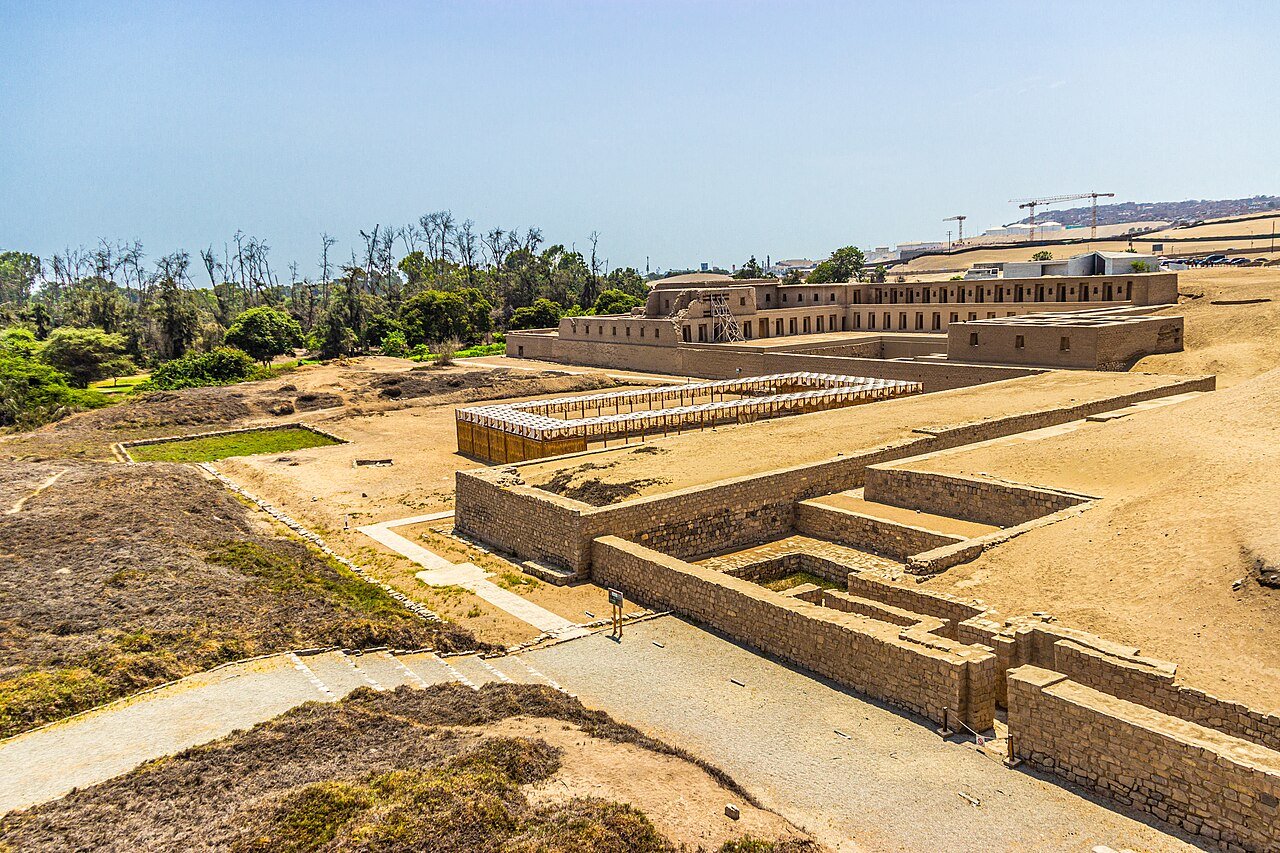
The god who shook the earth: the oracle of Pachacámac
Fifteen kilometres south of central Lima, where the Lurín River meets the Pacific, a complex of adobe pyramids, plazas, and temples rises from the coastal desert — the sacred city of Pachacámac, named for the creator deity Pacha Kamaq (“He Who Animates the World”) who was believed to cause earthquakes when displeased. For over a thousand years before the Spanish conquest, this was the most important oracle sanctuary on the Pacific coast of South America: a place where rulers, merchants, and ordinary people came to consult the god, make offerings, and seek healing.
A millennium of continuous sanctity: Wari, Lima, and Inca
Pachacámac’s urban complex began to take shape around 200 CE under the Lima culture. It was subsequently expanded by the Wari empire (600–900 CE), which added administrative buildings and a distinctive form of pyramid-terrace architecture. After the Wari collapse, Pachacámac continued as an independent oracle centre. When the Inca emperor Tupac Yupanqui incorporated the sanctuary into the Inca Empire in the 1470s, he chose not to destroy it but to add to it: a Temple of the Sun, a Convent of the Sun Virgins (Mamacuna), and facilities for the massive pilgrimage traffic the Inca state organised.
The Pyramid of Pachacámac: ramp architecture
The characteristic architectural form of Pachacámac is the pirámide con rampa (pyramid with ramp): a stepped adobe platform with a frontal ramp leading from plaza to summit, used as elite administrative or ceremonial spaces. Fifteen such pyramids have been identified at the site, their surfaces originally painted in ochre, red, and yellow. The largest — the Temple of Pachacámac — rises 18 metres on the cliff above the sea, its summit commanding views of the desert, the ocean, and the green valley of the Lurín.
The oracle: consulting the god
At the heart of the sanctuary stood the idol of Pachacámac: a carved wooden post representing the creator deity, visible only to the highest-ranking priests. Pilgrims who wished to consult the oracle had to undergo ritual purification — fasting, abstinence, and bathing — for periods ranging from 5 to 40 days depending on their social rank. The oracle’s reputation extended throughout the Andean world; its priests became enormously wealthy through the offerings that accompanied consultations, accumulating gold, silver, textiles, and food.
Pizarro and the golden disappointment
When Spanish conqueror Hernando Pizarro reached Pachacámac in January 1533 — two months before the ransom room of Atahualpa was filled with gold — he found a sanctuary of great wealth but not the golden idol he expected. The priests had already hidden the true idol; what Pizarro found and melted down was a substitute. The true idol of Pachacámac, carved in wood and dating from around 800 CE, was found by archaeologists in 1938 and is now displayed in the Pachacámac Museum.
The mummies of Pachacámac: a burial ground of 10,000
Beneath the sandy floors of the pyramids and plaza areas, thousands of mummies have been excavated at Pachacámac since the 19th century. The burial practices varied by period and social rank: Inca-period elite burials included elaborate textiles, ceramic vessels, gold and silver objects, and food offerings; pre-Inca burials were simpler but often included the fardos — bound bundles of fabric containing the flexed body, placed upright in the grave. The Pachacámac Museum displays a selection of these burials with exceptional contextual information.
Visiting Pachacámac today
The site is 30 km from central Lima by the Panamericana Sur, or accessible by combi (shared minibus) from Chorrillos. The Pachacámac Museum (opened 2016) is one of the finest site museums in Peru, with original objects including the wooden idol, Inca-period textiles, and an impressive collection of ceramics. The archaeological zone allows visitors to walk between the major pyramids on a network of paths; the Temple of the Sun offers panoramic views. A full visit to museum and site takes 3–4 hours.
Find it on the map
See this place and what’s around it →📷 Become a Cultural Heritage Online photographer
Share your photos of places: they stay published under your name as the author. The more they're seen, the more you get noticed — and soon a contest will reward the most appreciated photos.
Log in or sign up free to add a photo