
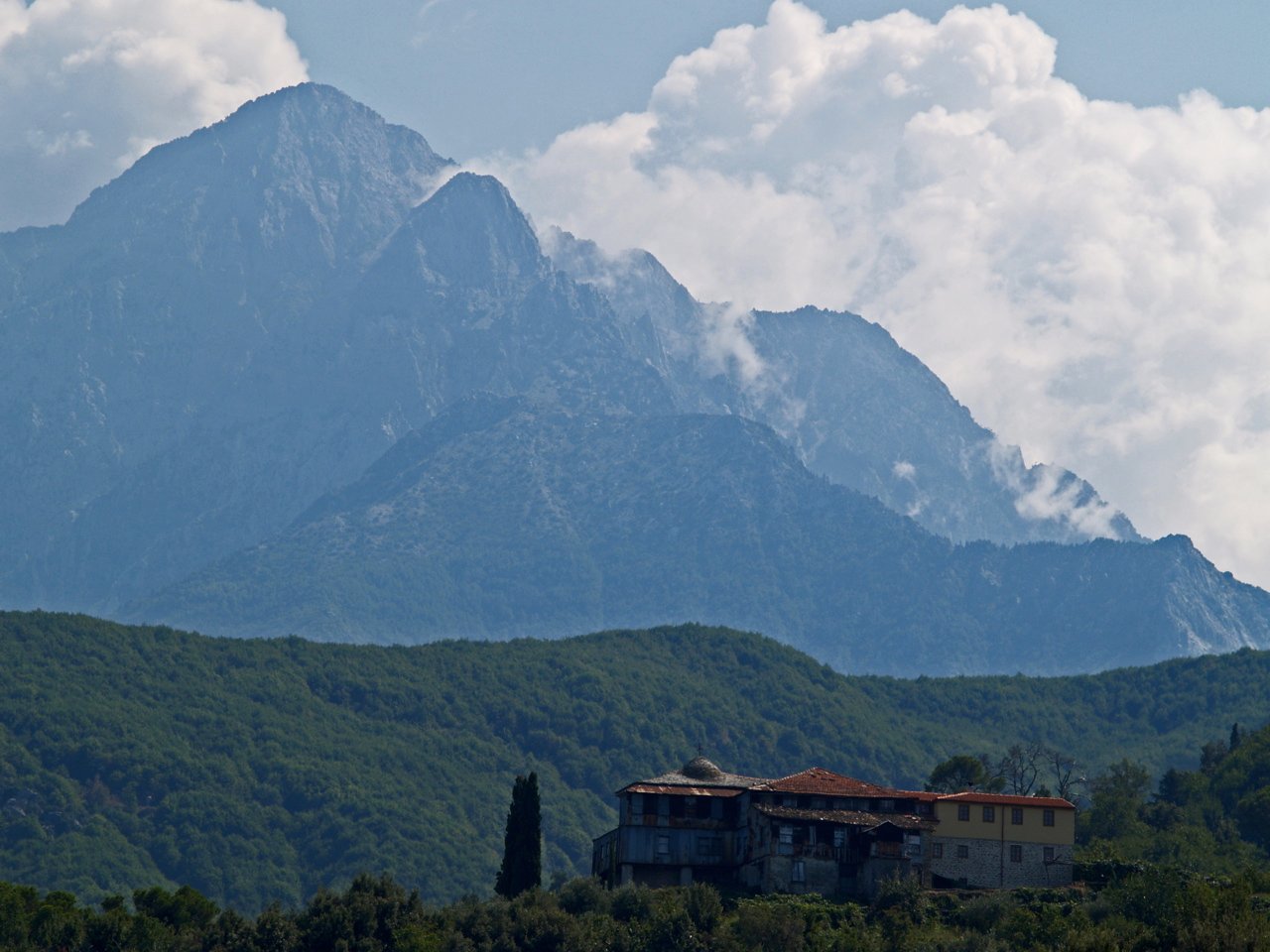
The Holy Mountain: a living Byzantine world
At the tip of the easternmost of the three peninsulas of Chalkidiki in northern Greece, the Athos peninsula rises to a pyramidal peak of 2,033 metres — Mount Athos, the Holy Mountain. For 1,700 years, monks have lived on its slopes and in its cliff-perched monasteries, maintaining a form of Orthodox Christian monasticism that has preserved practices, liturgies, and art forms from Byzantium that have disappeared from the rest of the world. The peninsula is a self-governing monastic state within the Greek Republic, and it has been closed to women since the 10th century.
UNESCO inscription: 1,700 years of unbroken religious tradition
Inscribed in 1988, Mount Athos was recognised by UNESCO both as a cultural landscape of exceptional significance — containing 20 monasteries, 12 sketes, and hundreds of individual cells and hermitages built over 1,700 years — and as a living embodiment of Orthodox Christian spiritual tradition. The UNESCO citation emphasises that Athos is not a museum of monasticism but a living community where the full range of Byzantine cultural practices — liturgy, iconography, manuscript illumination, music, and ascetic prayer — continues uninterrupted.
Twenty monasteries: the great houses of Athos
The 20 ruling monasteries of Athos are organised in a hierarchical order established in the 10th century: the Great Lavra (founded 963 CE by Saint Athanasios) is the oldest and most senior, followed by Vatopedi, Iveron, Hilandar (Serbian), and 16 others — including a Russian monastery (Saint Panteleimon), a Bulgarian monastery (Zographou), and a Romanian skete (Prodromos). Together they house approximately 2,000 monks, scholars, and laymen in residence. The monasteries’ libraries contain over 15,000 illuminated manuscripts — the largest collection in the world outside the Vatican.
A world without clocks: Byzantine time
On Mount Athos, time runs differently. The monastic day begins at sunset (Julian calendar time), dividing day and night into equal hours that vary with the seasons. Byzantine chant — unchanged since the 14th century — marks the canonical hours of prayer: Vespers, Compline, Midnight Office, Matins, and the Divine Liturgy before dawn. The liturgical cycle follows the Julian calendar, 13 days behind the Gregorian, so Christmas falls on January 7th. Visitors who spend a night in a monastery report the experience of temporal displacement as profound and disorienting.
The icons and frescoes: Byzantine art in situ
The monasteries of Athos contain the largest surviving collection of Byzantine art in its original context. The churches are painted floor to ceiling with frescoes; the iconostases (altar screens) are covered with gold icons; the sacristies hold reliquaries, embroidered vestments, and liturgical vessels accumulated over a millennium. The Protaton church in Karyes (the capital of the monastic republic) contains frescoes by the 14th-century master Manuel Panselinos — considered the finest Byzantine paintings after Hagia Sophia.
The ban on women: the Avaton
The restriction on women entering Mount Athos — the avaton — is the most controversial aspect of the peninsula’s status. Tradition dates it to a charter of Emperor Constantine IX Monomachos (1060 CE), though the practice is likely older. The European Parliament has repeatedly called for the ban to be lifted as incompatible with EU gender equality law; Greece has maintained it as a legitimate religious exemption. Female tourists can view the monasteries from boats offshore; the peninsula remains accessible only to male pilgrims who obtain a special permit (the diamonitirion).
Getting the diamonitirion: visiting Athos today
Male visitors (maximum 100 non-Orthodox and 10 Orthodox pilgrims per day) must obtain the diamonitirion through the Holy Epistasia in Karyes or via the Pilgrims Bureau in Thessaloniki. Advance booking is essential and may require several months lead time. The permit allows a 4-day stay (extendable). Ferries depart from Ouranoupolis (the last secular village before the restricted zone) twice daily. Accommodation in monastery guesthouses is free but includes participation in liturgical life; donations are expected. Mobile phones and cameras require sensitivity around the monks.
Find it on the map
See this place and what’s around it →📷 Become a Cultural Heritage Online photographer
Share your photos of places: they stay published under your name as the author. The more they're seen, the more you get noticed — and soon a contest will reward the most appreciated photos.
Log in or sign up free to add a photo