

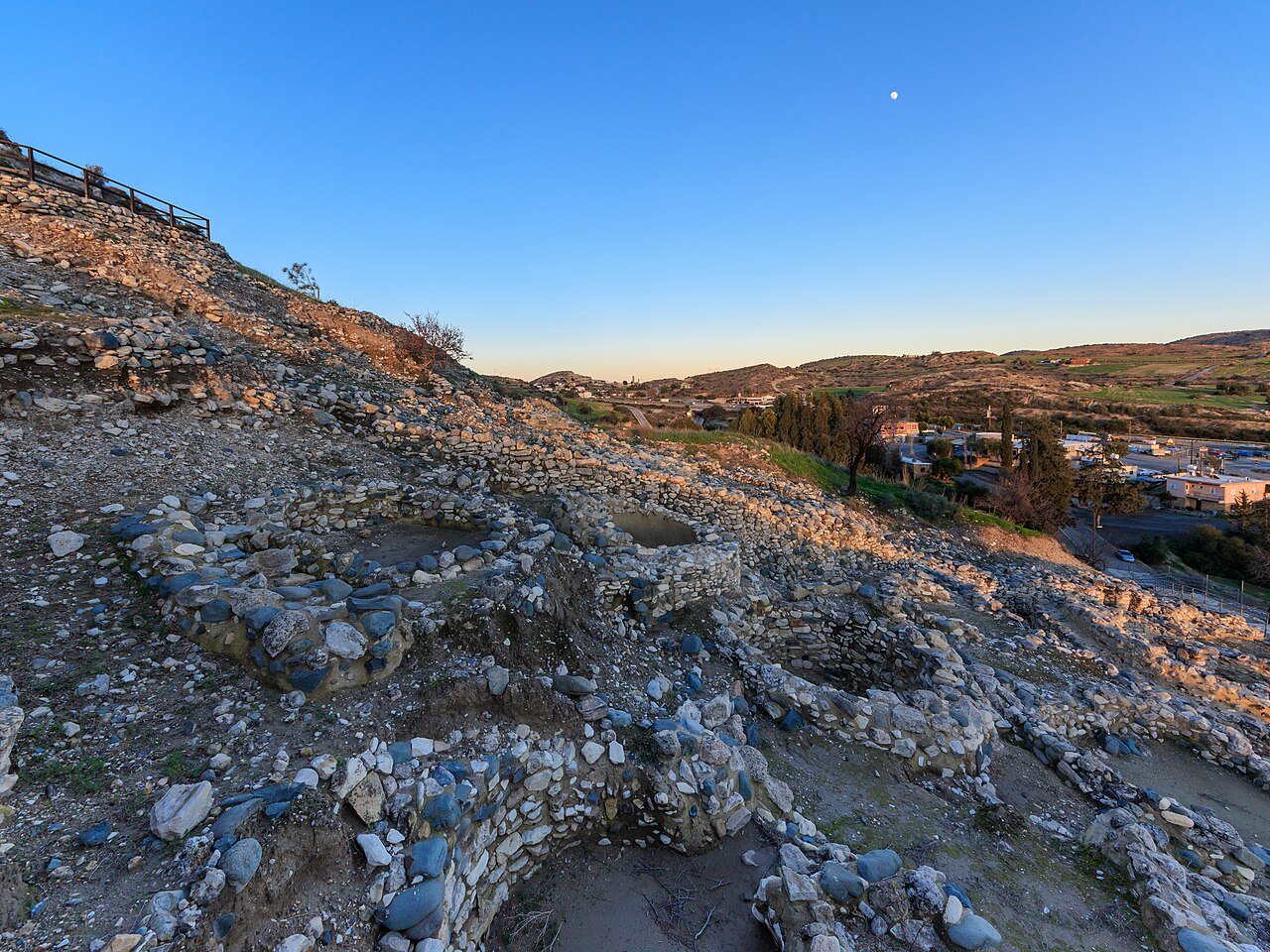
A Neolithic village 9,000 years old
On a natural hill above the Maroni River valley in southern Cyprus, the site of Choirokoitia (known internationally as Khirokitia) preserves one of the most significant Neolithic settlements in the Eastern Mediterranean. Inhabited from approximately 7000 to 4000 BCE, the village consisted of circular stone-built houses (tholoi) clustered densely around a central street, each house serving as both dwelling and burial place — the dead were buried beneath the floors, accompanying the living through the full cycle of life in the same structure.
UNESCO inscription: the earliest complex society in Cyprus
Inscribed in 1998, Choirokoitia was recognised by UNESCO as an outstanding example of prehistoric settlement that provides exceptional evidence of the development of human society in Cyprus during the Neolithic period. The site is particularly significant because it shows a complete, undisturbed stratigraphic sequence spanning 3,000 years — a rare opportunity to study the gradual evolution of a community’s architecture, burial practices, and material culture across multiple generations.
The tholos houses: architecture of the round
The characteristic building form of Choirokoitia is the tholos: a circular or oval plan structure, its walls built in dry-stone masonry of local limestone, its roof presumably of perishable materials (timber, reed, or mudbrick). The houses are clustered so densely — some share walls, others are stacked on terraces cut into the hillside — that the settlement resembles a densely packed urban environment despite its Stone Age date. Population estimates suggest between 300 and 600 inhabitants at its peak, an extraordinarily high density for a pre-ceramic Neolithic community.
The dead beneath the floor: burial practices at Khirokitia
The most distinctive aspect of the Choirokoitia community is its burial practice. The dead were interred beneath the floors of the houses they had inhabited, in a flexed position with their knees drawn to the chest, often accompanied by grave goods: stone vessels, shell ornaments, and occasionally figurines. This practice — living above the dead — reflects a cosmology in which the continuity between the living and the ancestors was maintained by physical proximity. As many as 26 burials have been found beneath a single house floor.
The aceramic Neolithic: life before pottery
Choirokoitia is one of the best-documented sites of the “Aceramic Neolithic” — the period before the invention of pottery (which in Cyprus appeared around 4000 BCE). The absence of pottery did not mean a primitive life: the inhabitants of Choirokoitia made sophisticated stone vessels (from andesite imported from the Troodos mountains), carved bone tools, produced sophisticated figurines, and maintained a complex agricultural system including domesticated goats, pigs, and cattle. Their diet, recovered from food residues in the soil, was varied and nutritionally rich.
An island population in isolation
Cyprus was first permanently settled around 10,000–9000 BCE, making it one of the last major Mediterranean islands to be colonised by humans. The Choirokoitia community descended from mainland Near Eastern farmers who crossed the sea — a journey of at least 65 km — bringing with them domesticated animals and cultivated plants. Once established on the island, the community developed in relative isolation, producing cultural forms found nowhere else. The site belongs to a “Khirokitian” culture whose boundaries are still being defined by ongoing excavation.
The reconstructed village: touching the Neolithic
The archaeological park at Choirokoitia includes a cluster of full-scale reconstructions of tholos houses, built by archaeologists using the same materials and techniques as the original inhabitants. Visitors can enter the reconstructed houses and experience the spatial quality of the interior — low ceilings, circular plan, the floor level slightly raised from the burial layer beneath. The reconstructions are based on detailed analysis of the excavated remains and are updated as new evidence emerges.
Visiting Khirokitia
The site is located 6 km from the A1 motorway at the Khirokitia exit, 35 km west of Larnaca airport. It is open daily from 8:30 am to sunset; admission is modest. The combination of excavated remains, reconstructed houses, and a well-designed site museum (at the entrance) makes it one of the most accessible Neolithic sites in the Mediterranean. A visit takes 1–2 hours; the panoramic view over the Maroni valley is an additional reward.
Find it on the map
See this place and what’s around it →📷 Become a Cultural Heritage Online photographer
Share your photos of places: they stay published under your name as the author. The more they're seen, the more you get noticed — and soon a contest will reward the most appreciated photos.
Log in or sign up free to add a photo