
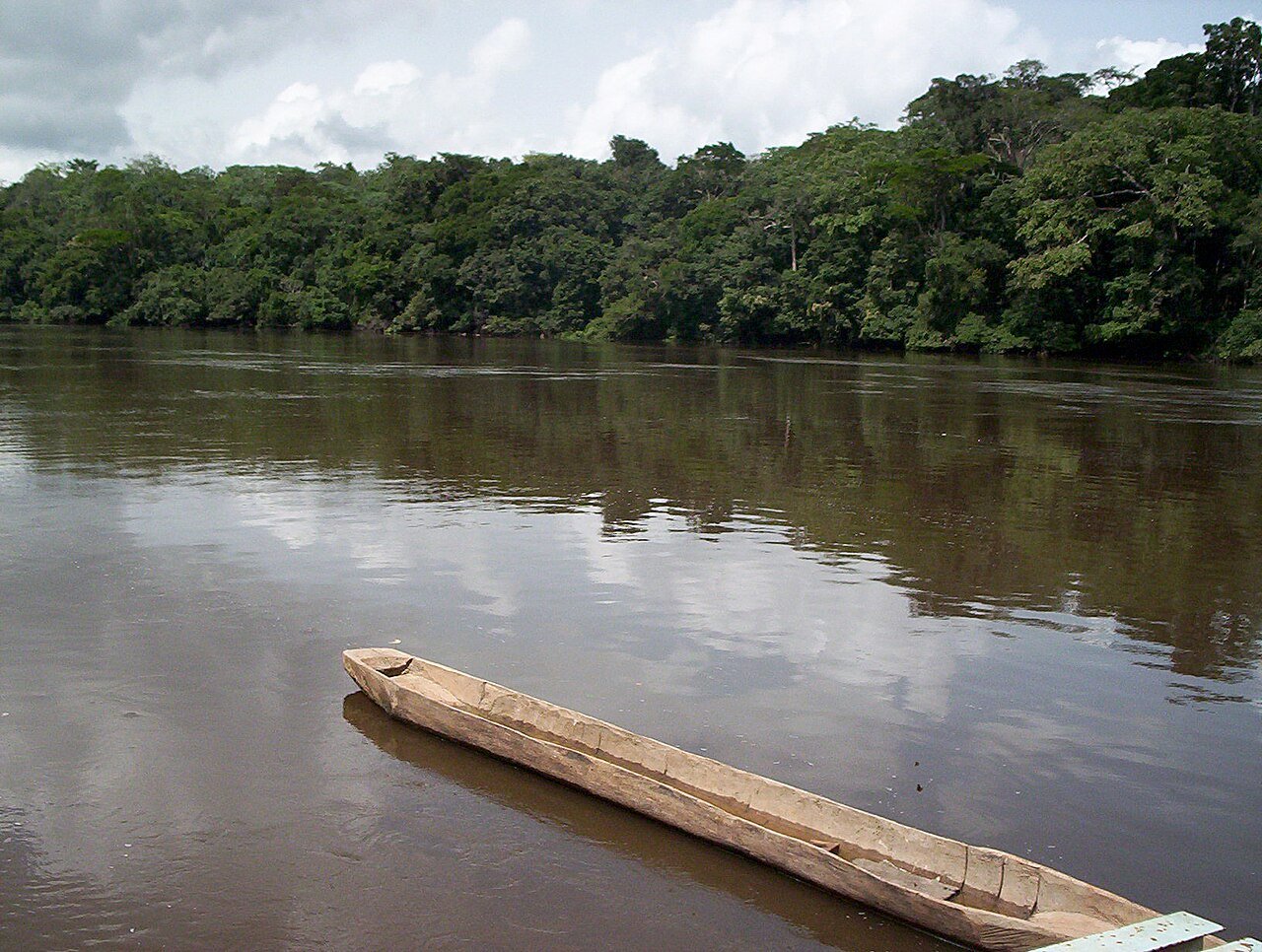
A river-enclosed rainforest: the natural moat of the Dja
In the humid south of Cameroon, the Dja River describes a vast meander that almost completely encircles a 5,260 km² block of undisturbed equatorial rainforest. This natural boundary — the river is the boundary on three sides of the reserve — has helped protect the Dja Faunal Reserve from illegal hunting and logging, making it one of the largest and least disturbed areas of Congo Basin rainforest still surviving. It is home to 107 mammal species, 320 bird species, and 1,500 plant species including many endemics.
UNESCO inscription: the best-protected forest in Africa
Inscribed in 1987, the Dja Reserve was recognised by UNESCO as one of Africa’s largest tropical forest reserves, with an exceptional diversity of primates and large mammals. The UNESCO citation notes that 90% of the reserve is undisturbed primary forest — a figure virtually unmatched in equatorial Africa. The integrity of this ecosystem has been maintained largely by the Baka and Badjoue peoples who have lived at its margins for centuries without large-scale agriculture or permanent settlements inside the forest.
The great apes of Dja: gorillas, chimpanzees, and mandrills
The Dja Reserve supports the full guild of Congo Basin primates: western lowland gorillas (Gorilla gorilla gorilla), central chimpanzees (Pan troglodytes troglodytes), western lowland gorillas, agile mangabeys, drills, and mandrills — the largest of all monkeys, with their spectacular blue and red face markings. Population surveys suggest the reserve holds one of the largest mandrill populations on Earth, along with significant numbers of forest elephants, bongo antelopes, and forest buffalo.
Forest elephants: keystone engineers of the Dja
The African forest elephant (Loxodonta cyclotis) — a separate species from the savanna elephant, smaller and with straighter tusks — is a critical ecosystem engineer in the Dja. Elephants create clearings, disperse seeds, and maintain the complex mosaic of forest types that supports the reserve’s exceptional biodiversity. Dja is one of the few remaining strongholds for this species, which has been decimated by ivory poaching across much of its range. An estimated 1,000–2,000 forest elephants inhabit the reserve.
The Baka: indigenous forest people and their knowledge
The Baka (sometimes called Pygmies) have lived in and around the Dja forest for millennia, their culture and knowledge systems inseparable from the forest ecology. Baka hunters understand the behaviour, habitat, and seasonal movements of forest animals with extraordinary precision; their medicinal plant knowledge encompasses hundreds of species. The reserve’s management has struggled to balance conservation objectives with the rights and needs of the Baka communities whose territory it encompasses.
Conservation threats: logging, poaching, and bushmeat
Despite its relative isolation, the Dja Reserve faces significant threats. Logging concessions border the reserve on all sides; illegal logging and charcoal production have penetrated the buffer zone. The bushmeat trade — the hunting of wild animals for food — is widespread in southern Cameroon, and the reserve’s wealth of wildlife makes it a target. Dja was listed on UNESCO’s World Heritage in Danger list from 1987 to 2019 due to these pressures; corrective measures have improved its management status but threats remain active.
A reserve of superlatives
The Dja occupies a unique position among African protected areas: it is the largest unfragmented rainforest block in Cameroon, one of the most diverse mammal assemblages in Africa, and the home of indigenous communities whose ecological knowledge represents a form of natural heritage as valuable as the forest itself. It forms part of the larger Congo Basin forest complex that includes Dzanga-Sangha (CAR), Nouabalé-Ndoki (Republic of Congo), and Odzala — together constituting the second-largest tropical forest on Earth after the Amazon.
Visiting Dja
The reserve is difficult to access by design. The nearest town, Somalomo, is reached by road from Yaoundé (5–6 hours). A network of research stations and community ecotourism camps at the forest edge offer guided walks, boat trips on the Dja River, and gorilla tracking (permit required). The Baka community of Doumo-Pierre operates guided forest walks that provide the most authentic entry into the Dja ecosystem. The rainy season (August–November) makes access very difficult; the dry season (December–February) is the best time to visit.
Find it on the map
See this place and what’s around it →📷 Become a Cultural Heritage Online photographer
Share your photos of places: they stay published under your name as the author. The more they're seen, the more you get noticed — and soon a contest will reward the most appreciated photos.
Log in or sign up free to add a photo