
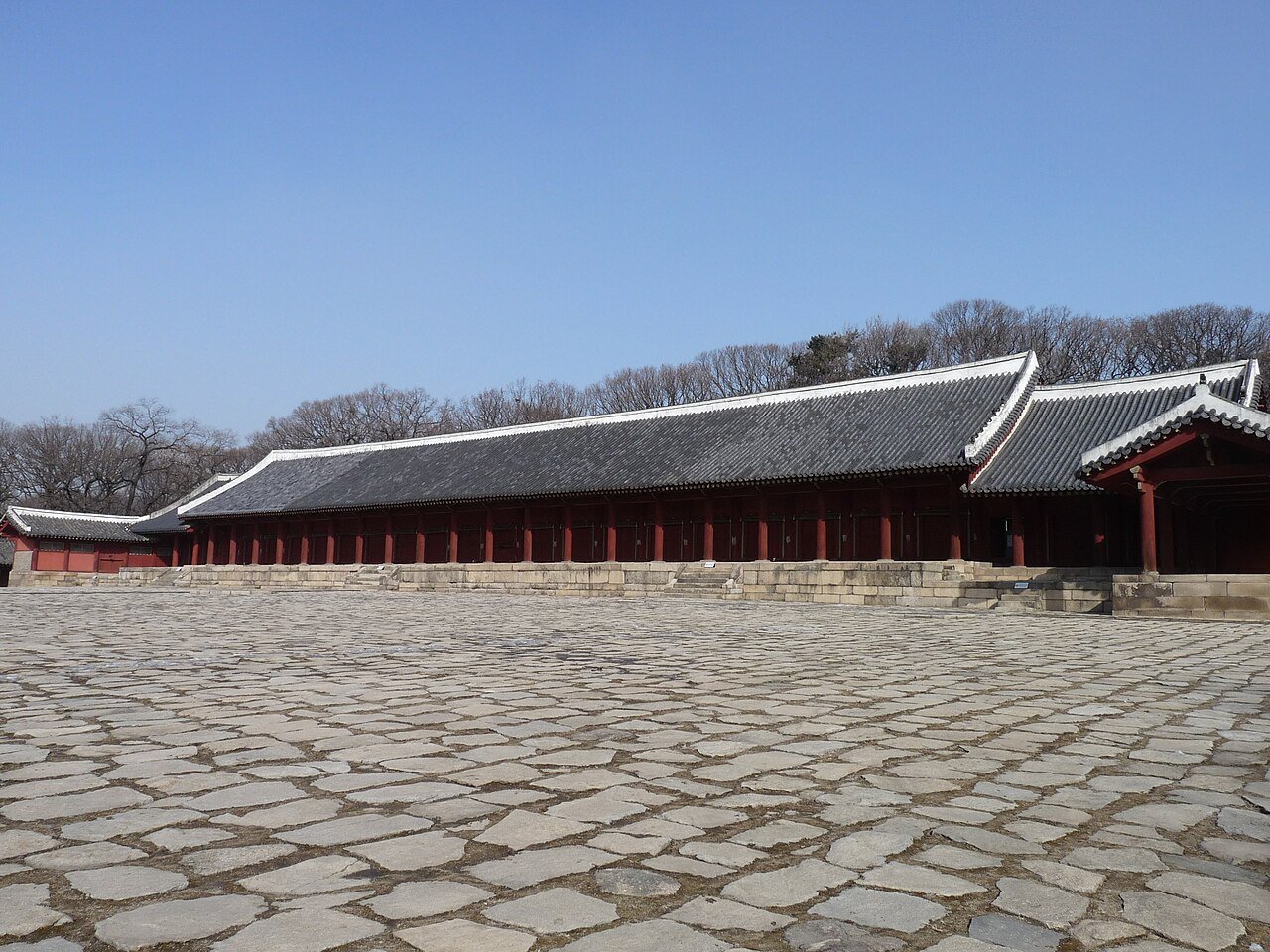
The longest wooden building in Korea: a hall built for the ancestors
In the heart of Seoul, enclosed by ancient walls and shaded by 600-year-old trees, stands Jongmyo — the Royal Ancestral Shrine of the Joseon dynasty. Its principal hall, the Jeongjeon, is a single horizontal structure 101 metres long: the longest wooden building in Korean history, its length determined not by architectural ambition but by the number of royal spirit tablets that had to be housed within it. Each Joseon king who died was given a chamber here; the hall was extended nineteen times to accommodate them all.
UNESCO inscription: shrine, ritual, and music together
Inscribed in 1995, Jongmyo is uniquely recognised by UNESCO both for its architecture — an outstanding example of Confucian shrine design — and for its associated ritual, the Jongmyo Jerye, which has been performed continuously since 1394. The Jongmyo Jerye (inscribed separately on the Intangible Cultural Heritage list in 2001) is the only royal ancestral rite of East Asia to have survived intact into the present, performed each May by descendants of the Joseon royal family.
The Joseon dynasty and the Confucian state
Founded in 1392 by General Yi Seonggye (Taejo), the Joseon dynasty governed Korea for 519 years, until 1910 — the longest-reigning dynasty in East Asian history. Its founding ideology was Neo-Confucianism, and the state was organised around Confucian principles of filial piety, ritual propriety, and ancestral veneration. The construction of Jongmyo in 1394, within a year of the dynasty’s founding, was the political and spiritual act that legitimised the new regime by connecting it to the chain of royal ancestors stretching back to antiquity.
The spirit tablets: presences, not symbols
The Jeongjeon houses 49 spirit tablets of 19 kings and 30 queens. In Korean Confucian belief, these tablets are not mere symbols but actual dwelling places of the royal spirits — presences that can be offended by negligence and must be maintained through regular ritual offerings of food, music, and dance. The building’s design, its orientation, the height of its eaves, and the arrangement of its rooms all serve this purpose: creating a space where the living and the royal dead can communicate.
The Jongmyo Jerye: five hours of ritual precision
The annual rite lasts five hours. Participants — all descendants of the Joseon royal family — process in period costume from Gyeongbokgung Palace to Jongmyo, carrying the spirit tablets. At the shrine, three sets of offerings are presented to each tablet chamber while the Jongmyo Jeryeak (ritual music, composed in the 15th century) is performed by court orchestra and dancers in a sequence that has not changed in 500 years. The music, played on ancient instruments including the bronze bell chime (pyeonjong) and the stone chime (pyeongyeong), was designated a UNESCO Masterpiece of Oral and Intangible Heritage in 2001.
Architecture of restraint: the Confucian aesthetic
Jongmyo’s architecture is deliberately austere. There are no decorative paintings, no bright colours, no elaborate roof ornaments — the features that mark Buddhist temples and palaces. The Jeongjeon’s exterior is finished in plain grey tile and unpainted timber, its grandeur deriving entirely from scale and proportion. The surrounding garden, planted with trees of varieties that had spiritual associations in the Confucian tradition, enforces the mood of solemnity appropriate to a house of the dead.
Six centuries in the city: survival through turbulence
Jongmyo has survived Japanese invasion (the tablets were evacuated during the Imjin War, 1592–1598), colonial suppression (the Japanese colonial government reorganised the rites), and the Korean War (1950–1953). Each time, the rites resumed and the shrine was restored. Today, set in a walled park in central Seoul — surrounded by modern buildings, 10 minutes walk from Gyeongbokgung Palace — it stands as the most direct material link to the Joseon world.
Visiting Jongmyo
Jongmyo is open Tuesday through Sunday, closed on Mondays. Admission is by guided tour only (tours in Korean and English run hourly). The shrine is a 5-minute walk from Jongno 3-ga subway station. The annual Jongmyo Jerye rite is performed in early May and is open to public observation; it is one of the most extraordinary ceremonial spectacles in East Asia. Advance booking is not required but arrival by 8:30 am is recommended for the best viewing positions.
Find it on the map
See this place and what’s around it →📷 Diventa un fotografo di Cultural Heritage Online
Condividi le tue foto dei luoghi: restano pubblicate con la tua firma come autore. Più vengono viste, più ti fai conoscere — e presto un concorso premierà le foto più apprezzate.
Accedi o registrati gratis per aggiungere una foto