
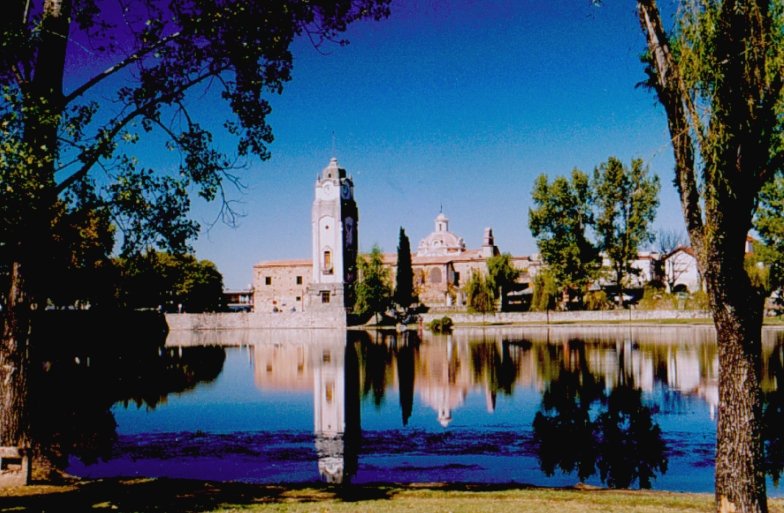
A Jesuit Civilisation in the Southern Cone
The Jesuit Block in central Córdoba and five rural estancias in the surrounding pampas and sierras together form one of the most complete surviving testimonies to the Jesuit project of evangelisation and civilisation-building in South America. Inscribed by UNESCO in 2000, the property illustrates how the Society of Jesus created, between 1599 and their expulsion in 1767, a network of urban institutions and agricultural estates that shaped Argentine intellectual and economic life for generations after their departure.
The Manzana Jesuita in Córdoba
The Jesuit Block (Manzana Jesuita) occupies an entire city block in the historic centre of Córdoba, Argentina’s second city. It contains the Universidad Nacional de Córdoba — founded in 1622 and the oldest university in Argentina — the Colegio Nacional de Monserrat, the Residencia, and the Church of the Society of Jesus (La Compañia). The block was designed as a self-sufficient educational and spiritual complex: students slept in the residencia, attended lectures in the colegio, and participated in liturgy in the church, while priests administered the surrounding Jesuit mission territory from the residencia offices.
The Church of the Society of Jesus
The Church of La Compañia, completed around 1670, is the finest example of Baroque architecture in Argentina. Its facade of carved stone rises above the street in a rhythm of pilasters and niches characteristic of Roman Baroque church design transplanted to South America. The interior ceiling — a magnificent barrel vault constructed from cedar wood using shipbuilding techniques because the Jesuits had no stone-vaulting specialists available — has survived earthquakes and centuries of use. The side altars contain paintings by Indigenous and mestizo artists trained in Jesuit workshops, blending European iconographic conventions with Andean colour sensibilities.
The Five Rural Estancias
Radiating from Córdoba, five Jesuit estancias — Santa Catalina, Jesus Maria, Caroya, La Candelaria, and Alta Gracia — served as agricultural and cattle-ranching enterprises that funded the urban educational complex. Each estancia had a church, a residence for the Jesuit brothers, workshops for carpentry, weaving, and ironworking, and extensive fields worked by Indigenous labourers and African enslaved people. The architectural character of each — thick adobe walls, arcaded cloisters, campaniles of cut stone — reflects both practical adaptation to the Argentine climate and the transmission of European Baroque design through Jesuit pattern books.
Education and the Diffusion of Knowledge
The Universidad de Córdoba was for over a century the only institution in the Viceroyalty of the Rio de la Plata granting university degrees. It trained the lawyers, theologians, physicians, and administrators who governed colonial Argentina, and its alumni were central figures in the independence movement of 1816. The Jesuit approach to education — combining Latin, philosophy, theology, and practical sciences — created a literate elite whose intellectual formation shaped Argentine political culture long after the Jesuit expulsion of 1767.
Evangelisation and Indigenous Communities
The Jesuits in Córdoba worked primarily with the Comechingon people of the nearby sierras and with the Guarani communities of the farther missions. Their method combined religious instruction with practical training in European agricultural techniques, ironworking, music, and painting — producing hybrid cultural forms that survive in the folk art and religious festivals of the Córdoba sierras. The estancias employed and in many cases incorporated Indigenous workers as skilled craftspeople, and the decorative programmes of the estancia churches reflect this cultural synthesis in their iconography.
Expulsion and Aftermath
The Jesuit expulsion ordered by the Spanish Crown in 1767 terminated the Society’s 168-year presence in Córdoba overnight. The university was transferred to the Franciscans and later to the state; the estancias were auctioned to secular landowners who converted them to purely agricultural enterprises. Despite this rupture, the architectural fabric of the estancias survived because their solid stone and adobe construction outlasted more flimsy secular buildings of the same period, and their remote locations protected them from urban development that transformed Córdoba’s historic centre in the 19th and 20th centuries.
UNESCO Recognition and Visitor Access
The Jesuit Block and Estancias of Córdoba were inscribed on the UNESCO World Heritage List in 2000 under criteria (ii), (iv), and (vi), recognised for their illustration of the Jesuit process of evangelisation, their outstanding architectural quality, and their direct association with the intellectual and religious heritage of South America. The Manzana Jesuita is accessible on foot from Córdoba’s Plaza San Martin; the estancias are distributed within a two-hour driving radius, forming an ideal circuit through the Cordobese sierras.
Find it on the map
See this place and what’s around it →📷 Become a Cultural Heritage Online photographer
Share your photos of places: they stay published under your name as the author. The more they're seen, the more you get noticed — and soon a contest will reward the most appreciated photos.
Log in or sign up free to add a photoIs this page about you?
This page is read by travellers and heritage enthusiasts who find it on Google. Tell us how you are connected to this place and we will take it from there.