
A Medieval Town Frozen in Time
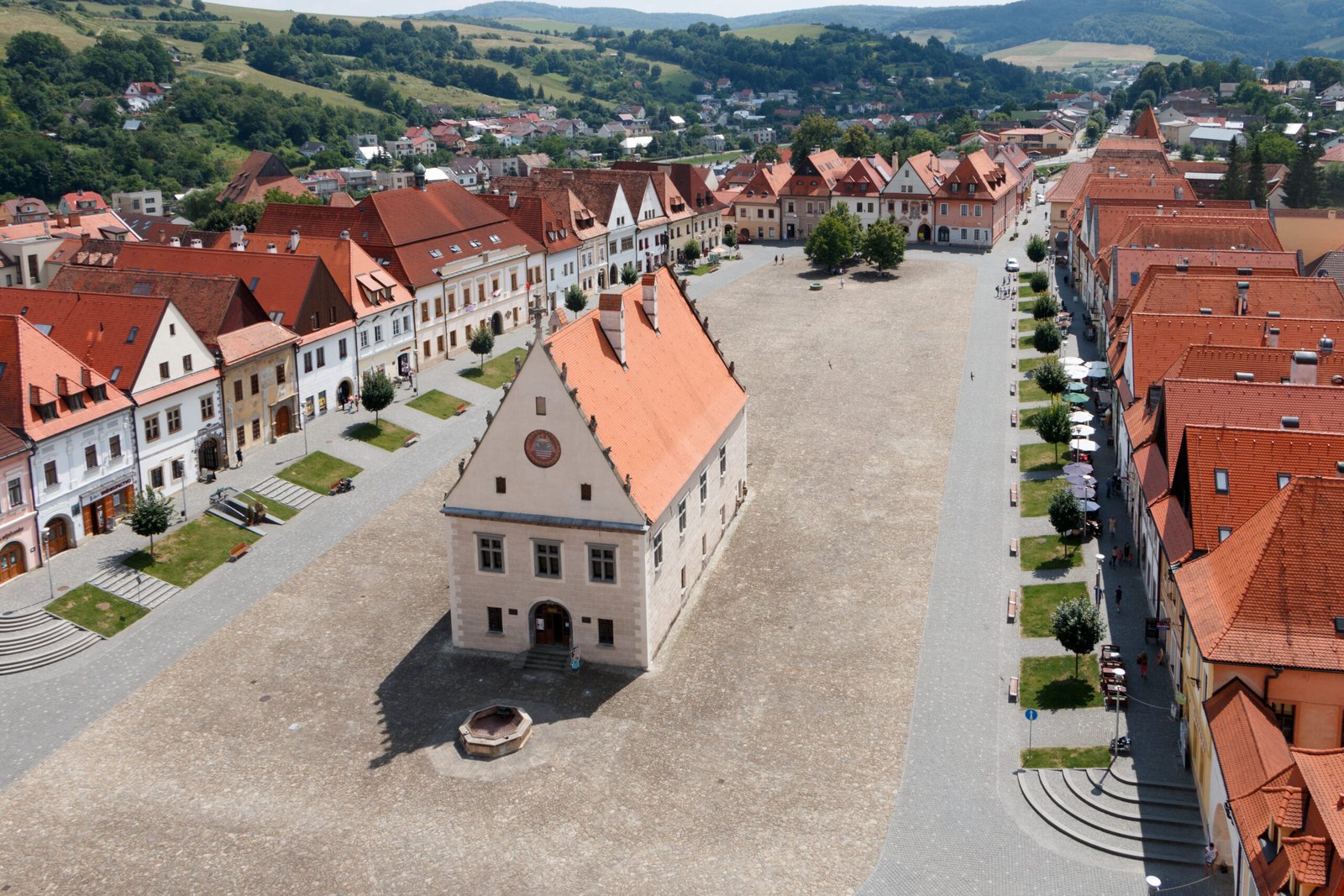
Bardejov, in the Presov region of northeastern Slovakia, is one of the best-preserved medieval towns in Central Europe. Its rectangular market square, intact Gothic church, Renaissance town hall, and harmonious rows of burgher houses have survived largely unaltered since the 15th century — a rarity in a region repeatedly crossed by armies, fires, and waves of modernisation. UNESCO inscribed Bardejov on the World Heritage List in 2000 as an outstanding example of a fortified medieval trading town.
The Market Square and Its Burgher Houses
The Namestie Osloboditelov (Liberation Square) is a long rectangular plaza enclosed by a double row of Gothic and Renaissance merchant houses. Each facade tells a story of civic prosperity and stylistic ambition: pointed gables in the German Gothic tradition give way to arcaded Renaissance loggias added by merchants enriched by the town’s position on trade routes connecting Poland, Hungary, and the Baltic. Ground floors were traditionally used as shops and storage, while upper floors housed the families that ran the Silesian cloth, Hungarian wine, and Ruthenian salt trades.
The Basilica of St Egidius
The Church of St Egidius (Bazilika Sv. Egidia) anchors the northwest corner of the square. Construction began in the 14th century and continued through the 15th, producing a late Gothic hall church with an impressive three-nave interior. The church contains eleven Gothic winged altarpieces, among the finest examples of late medieval woodcarving and painting in Slovakia, created by workshops active from Cracow to Vienna. The choir stalls, stone baptismal font, and carved choir screen add to an interior that reads as a complete survey of late Gothic ecclesiastical art.
The Renaissance Town Hall
The town hall standing in the centre of the square was rebuilt in Renaissance style between 1505 and 1511, making it one of the earliest Renaissance civic buildings in the region now forming Slovakia. Its arcaded ground floor, clock tower, and decorated gable reflect the influence of Italian and German Renaissance urbanism reaching Slovakia through the patronage of the Hungarian Jagellonian court. The building now houses the Saris Museum, whose collections include medieval manuscripts, guild records, and the archive of the town council documenting Bardejov’s history from 1352.
Fortifications and Urban Structure
Bardejov was granted royal town status by the Hungarian crown in 1376 and immediately began constructing defensive walls that still encircle the historic core. The walls, punctuated by towers and bastions added in the 15th and 16th centuries in response to Ottoman and Hussite threats, remain intact for most of their circuit. The moat has been converted to a park, but the wall walk and several towers are accessible to visitors, offering elevated views of the medieval street grid that radiates from the market square with almost no 20th-century intrusion.
Bardejov and the Hussite Influence
In the early 15th century, Hussite armies from Bohemia swept through northeastern Slovakia, leaving behind not only destruction but also a wave of reformist religious ideas that challenged Catholic orthodoxy decades before Luther. Bardejov became a significant centre for the dissemination of Hussite and later Lutheran ideas in the region, with its merchant elite corresponding with Reformation theologians in Wittenberg and Cracow. The town’s religious history — Catholic, Hussite, Lutheran, returning Catholic — is encoded in the layered furnishings of St Egidius, where altarpieces commissioned under different confessional regimes stand side by side.
The Jewish Quarter and Bardejov Spa
A modest but historically significant Jewish quarter once occupied the area adjacent to the main square, with a synagogue dating from the 18th century. Bardejov Spa (Bardejovske Kupele), located two kilometres north of the town, was a fashionable mineral-water resort from the 18th century onward, frequented by Hungarian nobility, Polish aristocracy, and, famously, the Empress Maria Theresa. The spa village retains its Classicist colonnades and wooden pavilions, providing an architectural complement to the medieval town core.
UNESCO Recognition and Conservation Status
The Historic Town of Bardejov was inscribed on the UNESCO World Heritage List in 2000 under criteria (iii) and (iv), recognised as an exceptional example of a fortified medieval trading town that illustrates important stages in the development of urban communities in Central Europe and the diffusion of Gothic and Renaissance culture. Active conservation programmes maintain the authenticity of the historic core, and strict planning rules prevent alterations to facades within the buffer zone.
Find it on the map
See this place and what’s around it →📷 Diventa un fotografo di Cultural Heritage Online
Condividi le tue foto dei luoghi: restano pubblicate con la tua firma come autore. Più vengono viste, più ti fai conoscere — e presto un concorso premierà le foto più apprezzate.
Accedi o registrati gratis per aggiungere una foto