
Three Monuments of a Civilisation
Qufu, in Shandong Province, holds three inseparable landmarks dedicated to Confucius (551–479 BCE): the Temple of Confucius (Kong Miao), the Kong Family Mansion (Kong Fu), and the Kong Lin cemetery where the philosopher and more than 100,000 of his descendants rest. Together they form one of China’s oldest and largest monumental complexes, inscribed by UNESCO in 1994 as an outstanding testimony to Confucian civilisation.
The Temple of Confucius
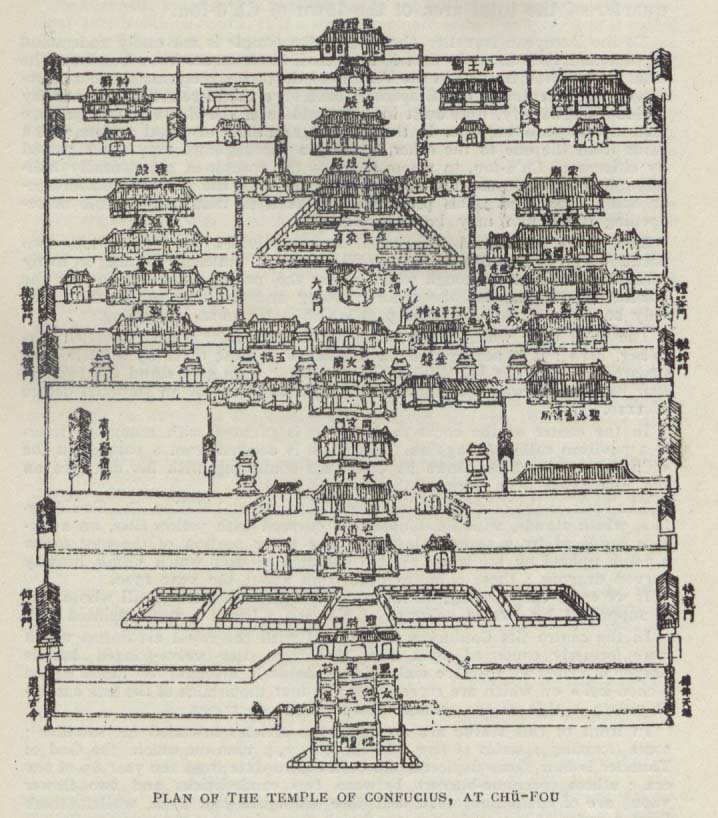
Kong Miao was first built a year after the philosopher’s death in 478 BCE and has been continuously expanded over 2,500 years. Today it comprises 466 rooms spread across nine courtyards aligned on a north-south axis nearly one kilometre long. The crowning structure, the Dacheng Dian (Hall of Great Achievement), rises on a terrace of carved stone and shelters a large gilded statue of Confucius. Columns of carved dragons — a motif normally reserved for imperial structures — signal the extraordinary status granted to the sage by successive dynasties.
The Kong Family Mansion
Kong Fu served as the private residence of the Duke of Yansheng, the hereditary title held by Confucius’s eldest male descendants, a lineage recognised and funded by Chinese governments from the Han dynasty onward. The mansion covers nearly 16 hectares and contains more than 450 rooms arranged in official, residential, and garden zones. Archives preserved here — household accounts, genealogical records, ritual protocols — constitute an irreplaceable documentary source for Chinese social history spanning the 16th to 20th centuries.
The Cemetery of Confucius
Kong Lin is the oldest artificially maintained park in the world and the largest family cemetery in China, occupying roughly 200 hectares enclosed by a wall more than 7 kilometres long. The tomb of Confucius himself, a simple earthen mound marked by a stele, stands at the centre. Thousands of carved stone animals, warriors, and officials line the approach roads to the most significant tombs. Ancient cypresses and sophora trees — some over 1,000 years old — give the forest a cathedral-like quality of accumulated time.
Confucian Philosophy and Its Global Legacy
Confucius taught that social harmony depended on the cultivation of personal virtue, reciprocal obligations between rulers and subjects, and the proper performance of ritual. His ideas — systematised in the Analects compiled by his disciples — shaped governance, education, and family structure across East Asia for over two millennia. Imperial examination systems in China, Korea, Vietnam, and Japan drew directly on the Confucian canon, making Qufu a spiritual centre radiating influence far beyond its own walls.
Architectural Conservation Over Two Millennia
Nearly 300 buildings at the site span from the Han dynasty to the Qing, representing a near-continuous architectural record. Significant restorations were carried out under the Song, Ming, and Qing courts following fires, floods, and wartime damage. The present temple complex was largely rebuilt after a devastating fire in 1499 during the Ming dynasty, yet earlier foundations, stelae, and ritual objects were preserved within each reconstruction, creating a layered palimpsest rather than a single frozen moment.
Steles and Inscriptions
The temple houses more than 2,000 stone steles bearing inscriptions from emperors, scholars, and calligraphers across dynasties — one of the largest concentrations of carved stone text in China. These steles record imperial edicts conferring honours on Confucius, donations for building projects, and poetic tributes by visiting literati. They function simultaneously as historical documents, calligraphic masterworks, and devotional objects, demonstrating how script itself became a medium of Confucian reverence.
UNESCO Recognition
The Temple, Cemetery, and Mansion of Confucius were inscribed on the UNESCO World Heritage List in 1994 under criteria (i), (iv), (vi), recognised for the outstanding universal value of their architecture, their 2,500-year span of continuous use, and their role as the wellspring of a philosophical tradition that shaped civilisation across East Asia and, through its later reception, influenced Enlightenment thought in Europe. The annual Confucius Cultural Festival in late September draws scholars and pilgrims for ceremonies held without interruption since the Han dynasty.
Find it on the map
See this place and what’s around it →📷 Become a Cultural Heritage Online photographer
Share your photos of places: they stay published under your name as the author. The more they're seen, the more you get noticed — and soon a contest will reward the most appreciated photos.
Log in or sign up free to add a photo