
Overview & Significance
Hidden among the rivers and canals of southwestern Bangladesh, in the delta where the Ganges meets the Bay of Bengal, lies Bagerhat — known in the 15th century as Khalifatabad. Founded by the Turkish general Ulugh Khan Jahan Ali around 1450 CE, it was conceived as an Islamic city from the ground up: a metropolis of mosques, mausoleums, reservoirs, and roads carved from the dense Sundarbans mangrove forest. Its surviving monuments represent the most concentrated ensemble of early Islamic architecture in the Indian subcontinent.
Historical Background
Khan Jahan Ali arrived in Bengal in the early 15th century, possibly from the Delhi Sultanate, and established his seat of power at the confluence of the Bhairab and Daratana rivers. Within decades he had transformed the area into a prosperous city, constructing hundreds of buildings, digging artificial water tanks (dighi) for irrigation and drinking water, and laying roads through the Sundarbans. After his death around 1459, the city gradually declined as the rivers shifted course, eventually being absorbed by the forest. British surveyors rediscovered it in the 19th century, revealing a remarkably intact medieval Islamic landscape.
Key Features & Architecture
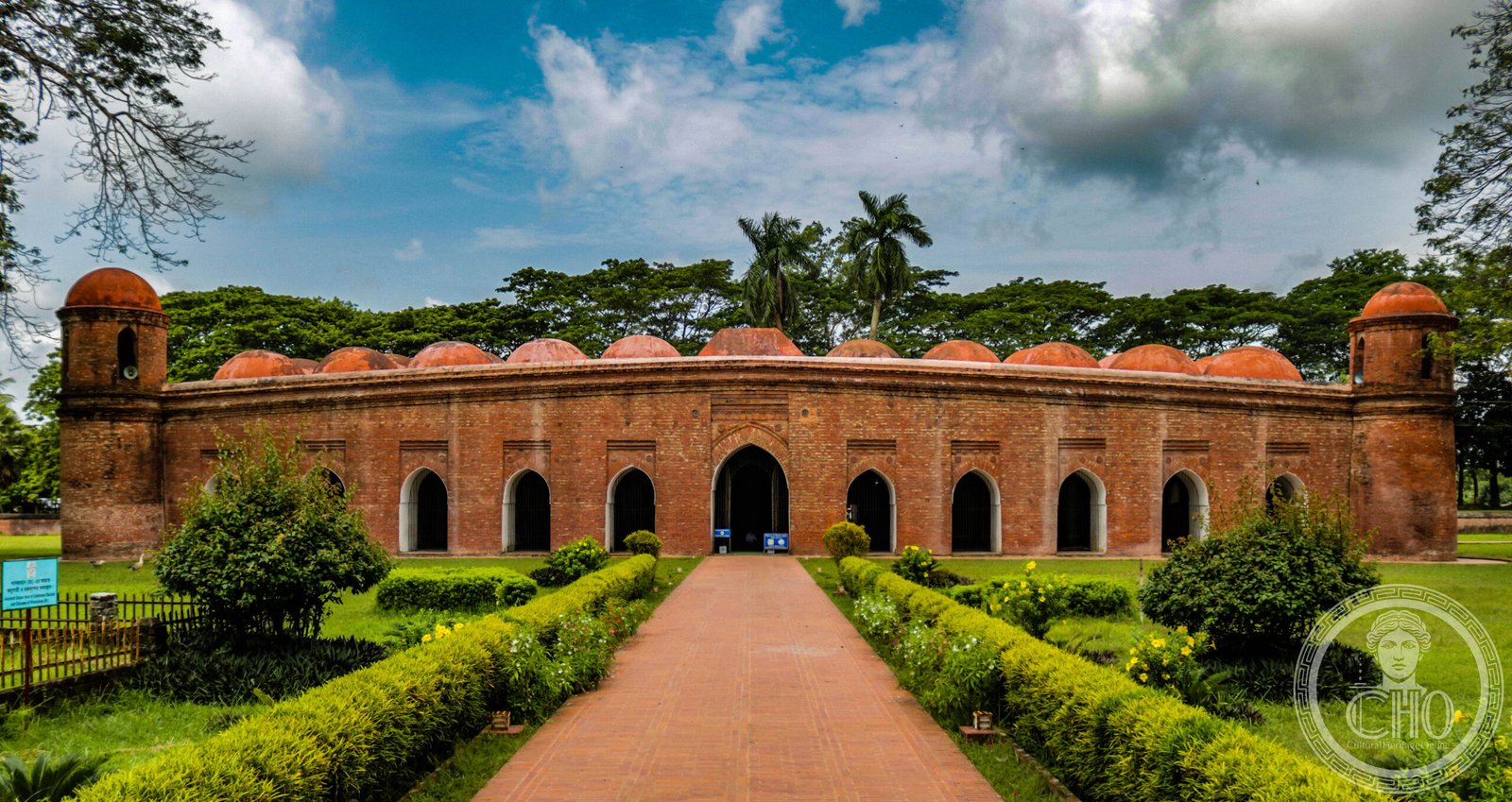
At the heart of the site stands the Shat Gumbad Masjid (Sixty Dome Mosque), a monumental rectangular prayer hall supported by 60 stone pillars and roofed with 77 terracotta domes — one of the largest medieval mosques in the Indian subcontinent. Its red brick walls and black basalt pillars (transported from India or Southeast Asia at great cost) reflect the characteristic Bengali Sultanate style that blended regional brick masonry with imported Islamic forms. The Chunakhola Mosque and the Nine-Dome Mosque are smaller but architecturally refined variants of the same tradition.
Cultural or Ecological Importance
Bagerhat represents a pivotal moment in the Islamisation of Bengal, when a powerful general used architecture to project authority, piety, and permanence in a newly conquered frontier landscape. The artificial water tanks he constructed — some still in use today — demonstrate a sophisticated understanding of delta hydrology. The site also sits at the edge of the Sundarbans, the world’s largest mangrove forest and a UNESCO site in its own right, making Bagerhat a cultural complement to one of the planet’s most ecologically significant natural landscapes.
UNESCO Inscription Criteria
Bagerhat was inscribed in 1985 under cultural criteria (iii) and (vi). UNESCO recognised the site as exceptional testimony to a vanished civilisation — the independent sultanate culture of medieval Bengal — and as directly associated with events and ideas of outstanding universal significance, specifically the early diffusion of Islam into the Bengal Delta and the architectural synthesis it produced. The ensemble’s integrity, preservation, and continued religious use strengthened the case for inscription.
Visitor Experience
Bagerhat is one of Bangladesh’s most rewarding cultural destinations, combining monumental scale with intimacy. The Sixty Dome Mosque, seen at dawn before tourist groups arrive, is genuinely awe-inspiring — its forest of pillars and the rhythm of its domes create an almost hypnotic interior space. The mausoleum of Khan Jahan Ali beside its sacred crocodile pond adds a dimension of living pilgrimage: devotees still come to feed the resident gharials, venerated as the saint’s companions. The entire monumental zone is compact enough to explore on foot in a half-day.
Getting There & Practical Info
Bagerhat is 14 km northeast of Khulna city, accessible by bus or auto-rickshaw from Khulna’s main bus terminal in about 30 minutes. Khulna is connected to Dhaka by overnight train (Sundarban Express) and by air (Jessore Airport, 60 km). The Sixty Dome Mosque, Khan Jahan’s tomb, and the Chunakhola Mosque cluster within an easy walking circuit. The Archaeological Museum of Bagerhat, located inside the site, provides excellent contextual information. Entrance fees are low; guides are available at the mosque entrance.
Nearby Attractions & Context
Khulna serves as the gateway city for both Bagerhat and the Sundarbans, making a combined itinerary of cultural and natural heritage highly practical. Day and overnight boat trips into the Sundarbans depart from Mongla (30 km south of Bagerhat), offering the chance to see Royal Bengal tiger, spotted deer, and Irrawaddy dolphin in a mangrove landscape of global ecological importance. The river town of Barisal, accessible by river ferry from Khulna, adds a traditional Bengali waterway experience to a regional itinerary.
Find it on the map
See this place and what’s around it →📷 Diventa un fotografo di Cultural Heritage Online
Condividi le tue foto dei luoghi: restano pubblicate con la tua firma come autore. Più vengono viste, più ti fai conoscere — e presto un concorso premierà le foto più apprezzate.
Accedi o registrati gratis per aggiungere una foto