Panama has five UNESCO World Heritage Sites — a compact but remarkably varied list that stretches from sixteenth-century Spanish fortifications on the Caribbean coast to one of the most biodiverse national parks on earth. Few countries of comparable size carry so much weight in a single heritage column: colonial road systems that once carried New World silver across a continent, island archipelagos where evolution has quietly continued in isolation, and rainforests that represent the geological seam where two great landmasses finally collided. From Cultural Heritage Online.
Why Panama’s list looks the way it does
Panama’s five inscriptions (as of 2025) divide into two cultural and three natural sites — a ratio that reflects the country’s dual identity as both a corridor of colonial empire and one of the planet’s most significant biological crossroads. The isthmus is narrow enough that the Spanish could build roads from ocean to ocean within decades of conquest, yet ecologically complex enough to host species assemblages found nowhere else on earth.
That corridor logic shapes every inscription on the list. Whether the site in question is a stone fortification, a rainforest national park, or a colonial trade route, each property owes its existence and its exceptional value to Panama’s position as the hinge between two continents and two oceans. The 2025 inscription of the Colonial Transisthmian Route makes this argument most explicitly, grouping six components — including already-listed properties — into a single serial nomination.
The first inscriptions
Panama entered the World Heritage List in 1980 and 1981 with two properties that together defined the country’s early heritage identity: one colonial, one natural.
- Fortifications on the Caribbean Side of Panama: Portobelo-San Lorenzo (1980) — two Spanish military complexes built at the end of the sixteenth century to protect the Caribbean terminus of the silver route.
- Darién National Park (1981) — a vast rainforest on Panama’s southeastern border, recognised for representing the meeting point where the previously separated North and South American landmasses finally joined, and for the exceptional biodiversity that followed.
The fortifications inscription was swift — Spain had poured considerable engineering into these Caribbean defences, and Portobelo in particular served as the main port through which Andean silver passed on its way to Europe. Darién followed a year later, earning recognition as a Natural World Heritage Site and later an Emergency List designation that underscored the pressure the park was already under.
The most visited — and the alternatives
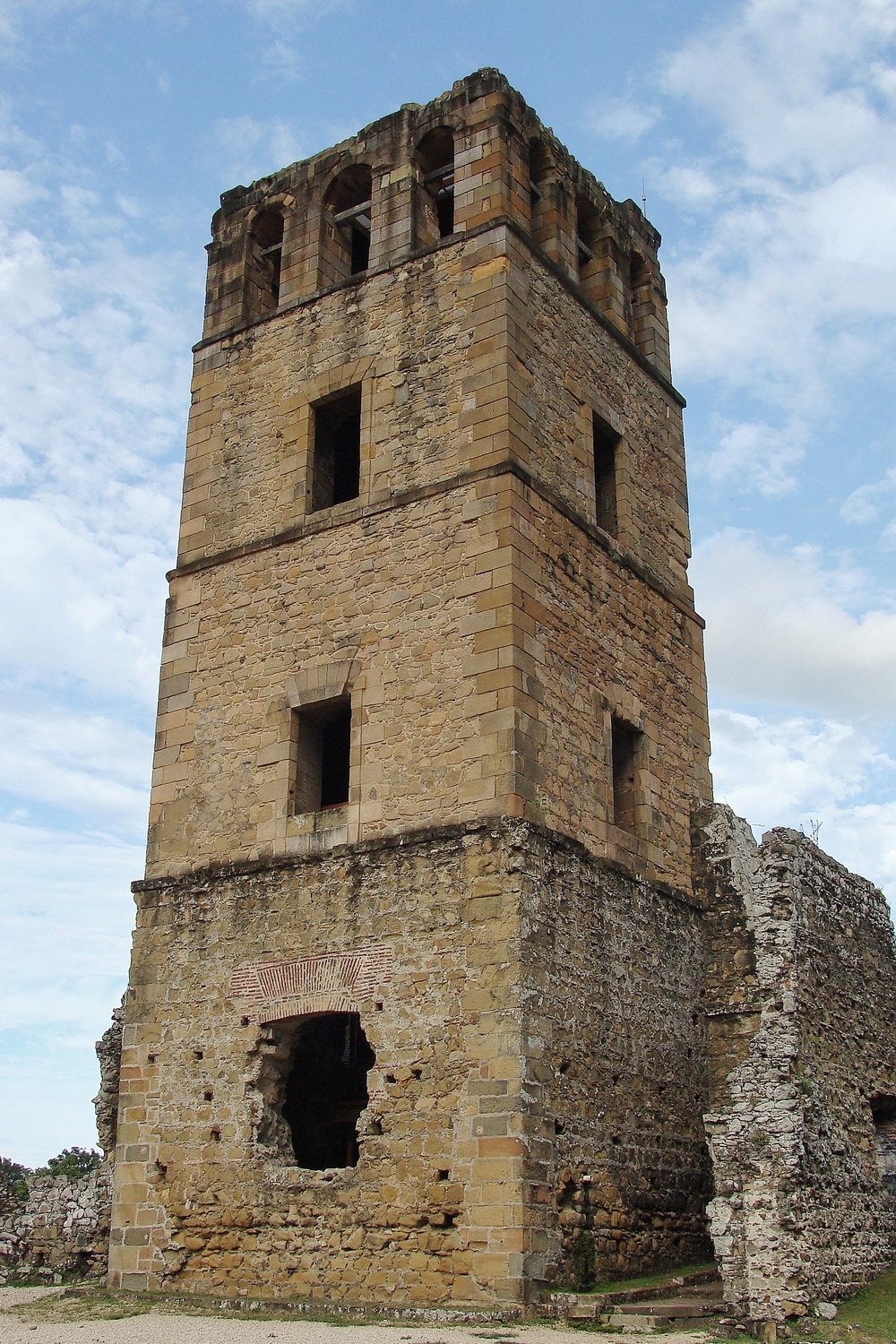
The Archaeological Site of Panamá Viejo and the Historic District of Panamá, inscribed in 1997, draws the most international visitors. The ruined tower of the original city, founded in 1519 and destroyed in 1671, stands against the modern Panama City skyline — one of the more visually striking contrasts in Latin American heritage tourism. The adjacent colonial quarter, Casco Viejo, preserves the street grid of the city rebuilt two years after the original was sacked.
Less frequented but equally significant are three properties that reward the detour:
- Coiba National Park and its Special Zone of Marine Protection (2005) — a Pacific island park where geographic isolation has allowed species to diverge visibly from their mainland counterparts, functioning as a natural laboratory comparable in some respects to the Galápagos.
- Fortifications on the Caribbean Side of Panama: Portobelo-San Lorenzo (1980) — placed on the List of World Heritage in Danger in 2012 because of environmental degradation and uncontrolled urban encroachment, making it one of the more urgent conservation cases in Central America.
- Colonial Transisthmian Route of Panamá (2025) — the newest inscription, encompassing the stone-paved Camino de Cruces and the Royal Road built by the Spanish between the sixteenth and nineteenth centuries to carry goods overland between the Atlantic and Pacific.
Natural and shared sites
All three of Panama’s natural inscriptions sit in the western or southern reaches of the country. Darién National Park, covering roughly 575,000 hectares, contains harpy eagles, giant anteaters, and several species of endangered big cat, and is one of the largest remaining blocks of Pacific rainforest in Central America. Coiba, offshore in the Gulf of Chiriquí, protects one of the largest marine protected areas in the eastern Pacific.
The Talamanca Range-La Amistad Reserves, inscribed in 1990, is a transnational site shared with Costa Rica — the Costa Rican portion had been listed independently in 1983, and the Panamanian section was added seven years later. La Amistad spans one of the most complex mountain ecosystems in Mesoamerica, with altitudinal gradients that compress multiple biomes within a single contiguous protected area. It is the only mixed transnational inscription on Panama’s list.
How to find them
Panama’s five World Heritage Sites are distributed across strikingly different landscapes — Caribbean coast, Pacific island, highland forest, and capital city — which means planning a heritage itinerary requires mapping them carefully before committing to routes. The fortifications and the colonial city are accessible from Panama City; Darién and Coiba each require more logistical preparation and, in Darién’s case, attention to current safety advisories.
Panama’s World Heritage sites sit alongside thousands of other places on CHO’s interactive map, with GPS and sourced editorial history for each. See also our guides to Italy’s and France’s UNESCO sites, and our piece on cultural travel beyond mass tourism.
Frequently Asked Questions
How many UNESCO World Heritage Sites does Panama have?
Panama has five UNESCO World Heritage Sites as of 2025: two cultural and three natural. The most recent addition, the Colonial Transisthmian Route of Panamá, was inscribed in 2025 and encompasses the Spanish colonial road network that once connected the Atlantic and Pacific coasts.
What was Panama’s first UNESCO World Heritage Site?
Panama’s first World Heritage inscription was the Fortifications on the Caribbean Side of Panama: Portobelo-San Lorenzo, added to the list in 1980. These Spanish military complexes, built from the late sixteenth century onward, guarded the Caribbean end of the route along which New World silver travelled toward Europe. Darién National Park followed the year after, in 1981.
Which of Panama’s World Heritage Sites is listed as endangered?
The Fortifications on the Caribbean Side of Panama: Portobelo-San Lorenzo has been on the List of World Heritage in Danger since 2012. The site faces threats from environmental degradation and unplanned urban development in the immediate surroundings of the historic structures.
Is any of Panama’s World Heritage Sites shared with another country?
Yes. The Talamanca Range-La Amistad Reserves is a transnational site shared with Costa Rica. The Costa Rican portion was first inscribed in 1983, with the Panamanian section added in 1990, making it the only shared inscription on Panama’s current World Heritage list.
Sources used in this article
- UNESCO — State Party Panama — World Heritage list.
- UNESCO — Panama: World Heritage Sites.
- CHO magazine — What is a World Heritage Site?
- CHO — Interactive map of heritage sites.
Sources
- S1 — Castillero Calvo, Alfredo. Sociedad, economía y cultura en el Panamá colonial. CELA, 1999. / Heckadon-Moreno, Stanley. Naturalistas del Istmo de Panamá. Instituto Smithsonian, 1998. ISBN 978-9962-614-00-5.
- S2 — Ward, Christopher. Imperial Panama: Commerce and Conflict in Isthmian America, 1550–1800. University of New Mexico Press, 1993. ISBN 978-0-8263-1434-5.
Spotted an error? Write to editorial@culturalheritageonline.com and we correct it the same day.