Malaysia has six UNESCO World Heritage Sites, a compact but remarkably varied list that spans primordial rainforest older than the Amazon, cave systems sheltering evidence of human life stretching back tens of thousands of years, colonial port cities whose shophouse façades layer Chinese, Malay, Indian, and European ornament into a single streetscape, and a forest park stitched together from the wreckage of tin-mining land. From Cultural Heritage Online.
Why Malaysia’s list looks the way it does
With six sites across cultural and natural categories, Malaysia’s World Heritage count sits well below neighbours such as China or India, but each inscription has a distinct character. The country’s geography does much of the explanatory work: Borneo’s interior holds some of the world’s oldest tropical rainforests and some of its most complex karst formations, while the peninsula’s western coast preserves the port cities through which the spice trade once moved. That geographic spread — Peninsular Malaysia, Sabah, and Sarawak — means the list crosses very different ecological and historical zones.
Four of the six sites are classified as cultural and two as natural; there are no mixed inscriptions. The pace of inscription has been uneven: two sites arrived in 2000, one in 2003, one in 2008, one in 2024, and the most recent in 2025, suggesting a pattern of occasional, carefully considered nominations rather than systematic campaigns.
The first inscriptions
Malaysia’s opening entries on the World Heritage List, both awarded in 2000, were natural sites on the island of Borneo:
- Kinabalu Park (Sabah, 2000) — home to Mount Kinabalu, at 4,095 metres the highest peak between the Himalayas and New Guinea, and to an extraordinary density of plant species found nowhere else on Earth.
- Gunung Mulu National Park (Sarawak, 2000) — a limestone karst landscape containing the world’s largest cave chamber by volume, Sarawak Chamber, and passages explored to a cumulative length of more than 300 kilometres.
Both inscriptions recognised outstanding universal value on natural criteria, centred on biodiversity and geomorphology rather than cultural history. They remain Malaysia’s only two natural World Heritage Sites.
The most visited — and the alternatives
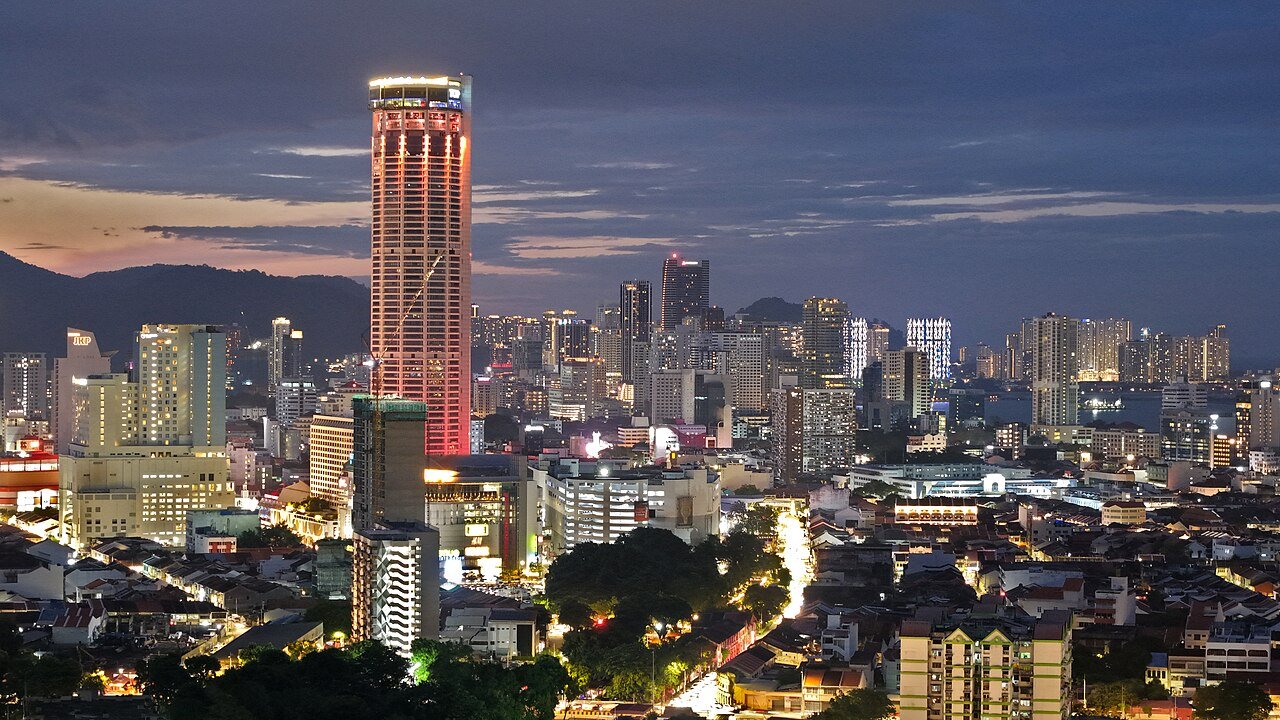
The site that draws the most international attention is the serial inscription Historic Cities of the Straits of Malacca (2008), which covers George Town in Penang and Malacca City on the peninsula’s west coast. George Town in particular is celebrated for its density of pre-war shophouses, clan jetties built on stilts over the water, and an urban fabric that reflects centuries of trade diaspora. Malacca carries the traces of successive Portuguese, Dutch, and British colonial administrations in its fortifications, churches, and administrative buildings clustered around the Stadthuys.
Less visited but no less significant are three other sites worth seeking out. The Lenggong Valley (Peninsular Malaysia, 2012) contains archaeological finds including stone tools provisionally dated to around 1.83 million years ago, placing them among the oldest yet discovered outside Africa. The Archaeological Heritage of Niah National Park’s Caves Complex (Sarawak, 2024) holds evidence of continuous human occupation from the late Pleistocene into the early Holocene, making it one of Southeast Asia’s most important prehistoric sites. And the Forest Research Institute Malaysia Forest Park Selangor (2025), the most recently inscribed site, tells a different kind of story: a forest deliberately restored since the 1920s on land devastated by tin mining, now a functioning research landscape at the edge of greater Kuala Lumpur.
Natural and shared sites
Kinabalu Park and Gunung Mulu National Park represent two distinct expressions of Borneo’s ecological significance. Kinabalu is inscribed partly for its role as a meeting point of Asian and Australian flora, generating exceptional levels of endemism among ferns, orchids, and pitcher plants. Mulu’s outstanding natural value rests on its karst topography — sheer pinnacles of eroded limestone rising from the jungle canopy, and cave networks that host millions of wrinkle-lipped free-tailed bats in nightly exodus columns visible from the park’s viewing platforms.
Neither site is transnational, but the Historic Cities of the Straits of Malacca functions as a serial inscription spanning two Malaysian states, Penang and Malacca. The rationale for treating them as a single entry is their shared history as commercial hubs of the Straits of Malacca trading corridor, each shaped by the same succession of maritime powers even as they developed distinct architectural identities.
How to find them
The six sites are distributed across three distinct parts of the country. Kinabalu Park and Gunung Mulu National Park are in Malaysian Borneo and require separate flights from the peninsula; they are not easily combined in a short itinerary. Lenggong Valley sits in the interior of Perak state and is straightforwardly accessible from Ipoh. The Niah Caves Complex is reached from Miri in Sarawak. George Town and Malacca are both on the west coast of Peninsular Malaysia, connected by intercity bus and within a few hours of Kuala Lumpur. FRIM Selangor Forest Park, inscribed in 2025, sits immediately north-west of the capital and is the site most easily reached on a day visit.
Malaysia’s World Heritage sites sit alongside thousands of other places on CHO’s interactive map, with GPS and sourced editorial history for each. See also our guides to Italy’s and France’s UNESCO sites, and our piece on cultural travel beyond mass tourism.
Frequently Asked Questions
How many UNESCO World Heritage Sites does Malaysia have?
Malaysia has six UNESCO World Heritage Sites as of 2025. The list comprises four cultural sites and two natural sites, spread across Peninsular Malaysia and the Borneo states of Sabah and Sarawak.
What was Malaysia’s first UNESCO World Heritage Site?
Malaysia’s first World Heritage inscriptions came in 2000, when Kinabalu Park in Sabah and Gunung Mulu National Park in Sarawak were both added to the list simultaneously. Both were recognised for their outstanding natural value, particularly their biodiversity and geological formations.
What is Malaysia’s most recently inscribed World Heritage Site?
The most recently inscribed site is the Forest Research Institute Malaysia Forest Park Selangor, added to the list in 2025. It is a restored forest landscape near Kuala Lumpur, originally rehabilitated from heavily degraded tin-mining land beginning in the 1920s.
Are any of Malaysia’s World Heritage Sites shared with other countries?
None of Malaysia’s six World Heritage Sites are transnational inscriptions shared with other countries. However, the Historic Cities of the Straits of Malacca (2008) is a serial inscription that links two Malaysian cities — George Town in Penang and Malacca City — under a single nomination based on their shared commercial and colonial history.
Sources used in this article
- UNESCO — State Party Malaysia — World Heritage list.
- UNESCO — Malaysia: World Heritage Sites.
- CHO magazine — What is a World Heritage Site?
- CHO — Interactive map of heritage sites.