Montenegro has four UNESCO World Heritage Sites, a compact but remarkably varied roster that spans a glacier-carved limestone massif, a fortified medieval port city, a transnational field of carved medieval tombstones, and a chain of Adriatic defensive architecture shared with Croatia and Italy. For a country of just under 14,000 square kilometres, that breadth of inscription speaks to an exceptional density of layered human and natural history packed into a narrow Balkan coastal corridor and its mountainous interior. From Cultural Heritage Online.
Why Montenegro’s list looks the way it does
Montenegro’s four inscriptions divide into three cultural sites and one natural site — a ratio that reflects both the country’s strategic position on the eastern Adriatic and the UNESCO review cycles through which it has progressed since independence in 2006. Much of the inscribed cultural fabric derives from the long contest between Venice, the Byzantine world, and the Ottoman Empire for control of the Dalmatian coast and its hinterland, leaving a built landscape that is Mediterranean, Slavic, and Illyrian all at once.
The natural inscription, Durmitor National Park, tells a different story: a glacial limestone plateau shaped by tectonic and hydraulic forces over millions of years, far removed from the coastal trade routes that defined so much of the cultural heritage below. Together, the four sites trace a north-to-south and coast-to-interior axis that gives Montenegro’s UNESCO presence an unusual geographic coherence for such a small country.
The first inscriptions
Montenegro’s engagement with UNESCO heritage listing began early and dramatically. In 1979 — at only the third session of the World Heritage Committee — two sites entered the list simultaneously:
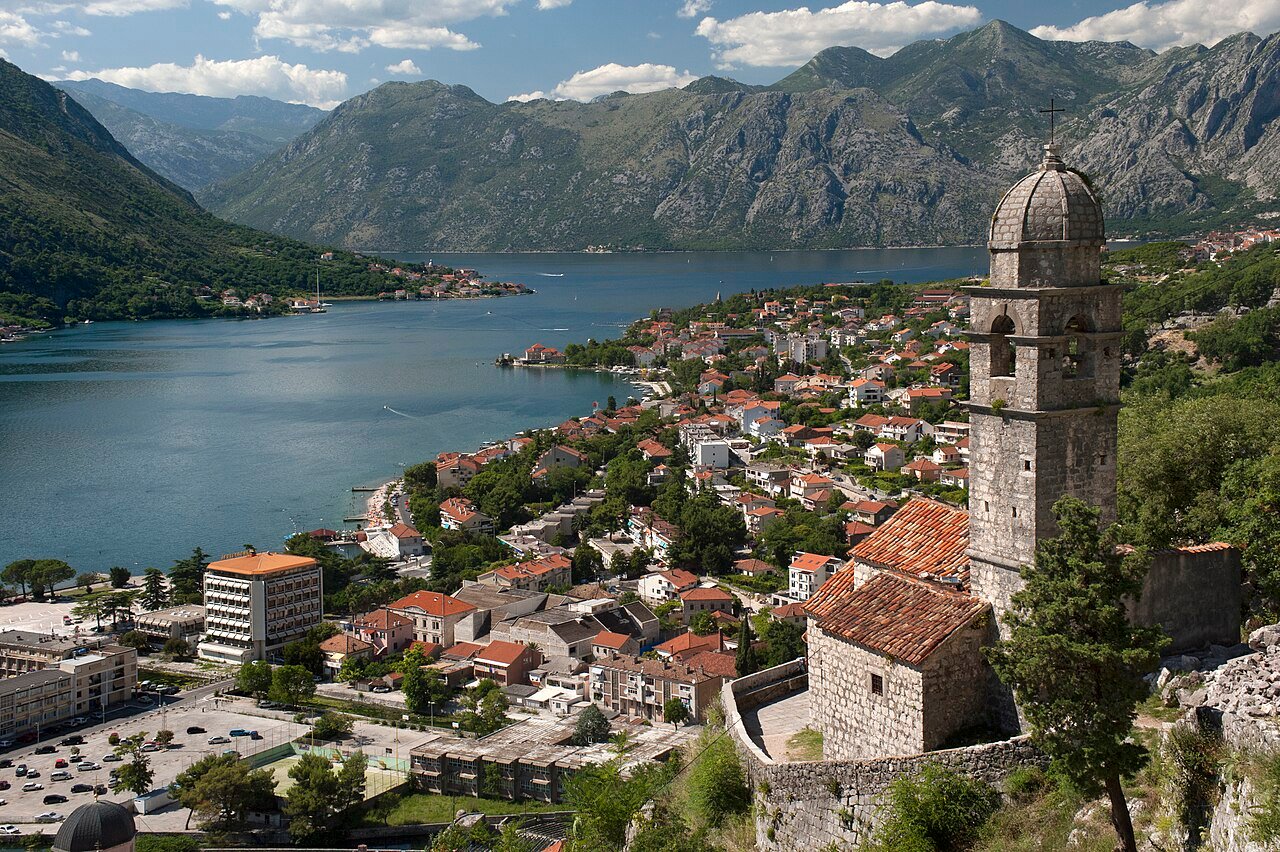
- Natural and Culturo-Historical Region of Kotor (1979) — a walled medieval city at the inner reaches of the Bay of Kotor, inscribed the same year a magnitude-6.9 earthquake struck the region and placed it immediately on the List of World Heritage in Danger.
- Durmitor National Park (1980, expanded 2005) — though inscribed the following year rather than in the opening 1979 session, Durmitor’s listing belongs to the same foundational wave that established Yugoslavia’s early heritage profile on the world stage.
Kotor’s dual status — inscribed and endangered simultaneously — made it one of the first sites where UNESCO’s protective mechanism was tested in real time. Restoration work eventually led to its removal from the danger list, and the city today stands as Montenegro’s most internationally recognised heritage address.
The most visited — and the alternatives
Kotor commands the greatest visitor attention of any site on Montenegro’s list. Its concentric Venetian walls climb the steep limestone flank of Mount Lovćen above the old town, enclosing a Romanesque cathedral, a maze of narrow lanes, and a vernacular urban fabric that has survived earthquake, Napoleonic occupation, and Austro-Hungarian administration without losing its medieval legibility. Summer crowds on the waterfront promenade can be dense, but the upper fortifications above Saint Ivan’s Fortress offer a less-trafficked vantage that most day-trippers bypass.
The two more recent cultural inscriptions reward travellers willing to look beyond the coast. The Stećci Medieval Tombstone Graveyards (2016) are a serial transnational inscription shared with Bosnia and Herzegovina, Croatia, and Serbia: tens of thousands of monolithic medieval tombstones, some elaborately carved with figural and geometric motifs, scattered across highland pastures in what was once the medieval kingdom of Bosnia. Montenegro’s component sites sit in the country’s eastern interior. The Venetian Works of Defence between the 16th and 17th Centuries (2017), co-inscribed with Croatia and Italy, include the fortifications at Kotor itself — meaning Kotor actually appears on two separate UNESCO inscriptions — alongside lesser-visited fortified positions that document a half-century of Venetian military engineering along the Adriatic littoral.
Natural and shared sites
Durmitor National Park, inscribed in 1980 and enlarged in 2005, is Montenegro’s only natural World Heritage Site and one of the more dramatic landscapes in the western Balkans. The park’s centrepiece is the Tara River Canyon, whose walls reach approximately 1,300 metres — among the deepest river gorges in Europe. The plateau above holds eighteen glacial lakes, of which the Black Lake below Žabljak is the most accessible, ringed by black pine forest and framed by peaks that exceed 2,500 metres. The Tara itself is a designated UNESCO biosphere reserve, adding a second layer of international recognition to the same river system.
Two of Montenegro’s four inscriptions are explicitly transnational. The Stećci graveyards span four countries, reflecting the pan-regional distribution of a funerary culture that predates modern national borders. The Venetian defensive network connects Montenegro to the eastern Adriatic arc that runs from the Venetian lagoon through Dalmatia to the Albanian frontier — a reminder that the Adriatic coast was, for three centuries, a single strategic problem for the Republic of Venice. Both serial inscriptions are managed through intergovernmental coordination bodies that sit outside any single national heritage administration.
How to find them
All four sites are reachable by road, though Durmitor and the inland Stećci locations require more travel time from the coast than Kotor. The Bay of Kotor is served by ferry from Bari (Italy) and by the Tivat and Podgorica airports. Žabljak, the gateway town for Durmitor, sits about two and a half hours by road from the coast. The Stećci sites in Montenegro are dispersed across highland terrain and best visited with a detailed regional map and advance research into access conditions, which vary seasonally.
Montenegro’s World Heritage sites sit alongside thousands of other places on CHO’s interactive map, with GPS and sourced editorial history for each. See also our guides to Italy’s and France’s UNESCO sites, and our piece on cultural travel beyond mass tourism.
Frequently Asked Questions
How many UNESCO World Heritage Sites does Montenegro have?
Montenegro has four UNESCO World Heritage Sites as of 2026: the Natural and Culturo-Historical Region of Kotor (1979), Durmitor National Park (1980, expanded 2005), the Stećci Medieval Tombstone Graveyards (2016), and the Venetian Works of Defence between the 16th and 17th Centuries (2017). Three are classified as cultural sites and one as natural.
What was Montenegro’s first UNESCO World Heritage Site?
The Natural and Culturo-Historical Region of Kotor was Montenegro’s first UNESCO inscription, entered on the World Heritage List in 1979 at the third session of the World Heritage Committee. Notably, a major earthquake struck the region that same year, and the site was placed simultaneously on the List of World Heritage in Danger — one of the earliest applications of that protective mechanism.
Is Durmitor National Park a UNESCO World Heritage Site?
Yes. Durmitor National Park was inscribed as a UNESCO World Heritage Site in 1980, with an extension added in 2005. It is Montenegro’s only natural inscription on the list and is known for the Tara River Canyon, one of the deepest river gorges in Europe at around 1,300 metres, as well as eighteen glacial lakes.
Which UNESCO sites in Montenegro are shared with other countries?
Two of Montenegro’s four UNESCO inscriptions are transnational serial sites. The Stećci Medieval Tombstone Graveyards are co-inscribed with Bosnia and Herzegovina, Croatia, and Serbia. The Venetian Works of Defence between the 16th and 17th Centuries are shared with Croatia and Italy, reflecting the unified Adriatic defensive strategy of the former Republic of Venice.
Sources used in this article
- UNESCO — State Party Montenegro — World Heritage list.
- UNESCO — Montenegro: World Heritage Sites.
- CHO magazine — What is a World Heritage Site?
- CHO — Interactive map of heritage sites.
Sources
- S1 — Roberts, Elizabeth. Realm of the Black Mountain: A History of Montenegro. Cornell University Press, 2007. ISBN 978-0-8014-4601-6.
- S2 — Morrison, Kenneth. Montenegro: A Modern History. I.B. Tauris, 2009. ISBN 978-1-84511-710-8.
Spotted an error? Write to editorial@culturalheritageonline.com and we correct it the same day.