

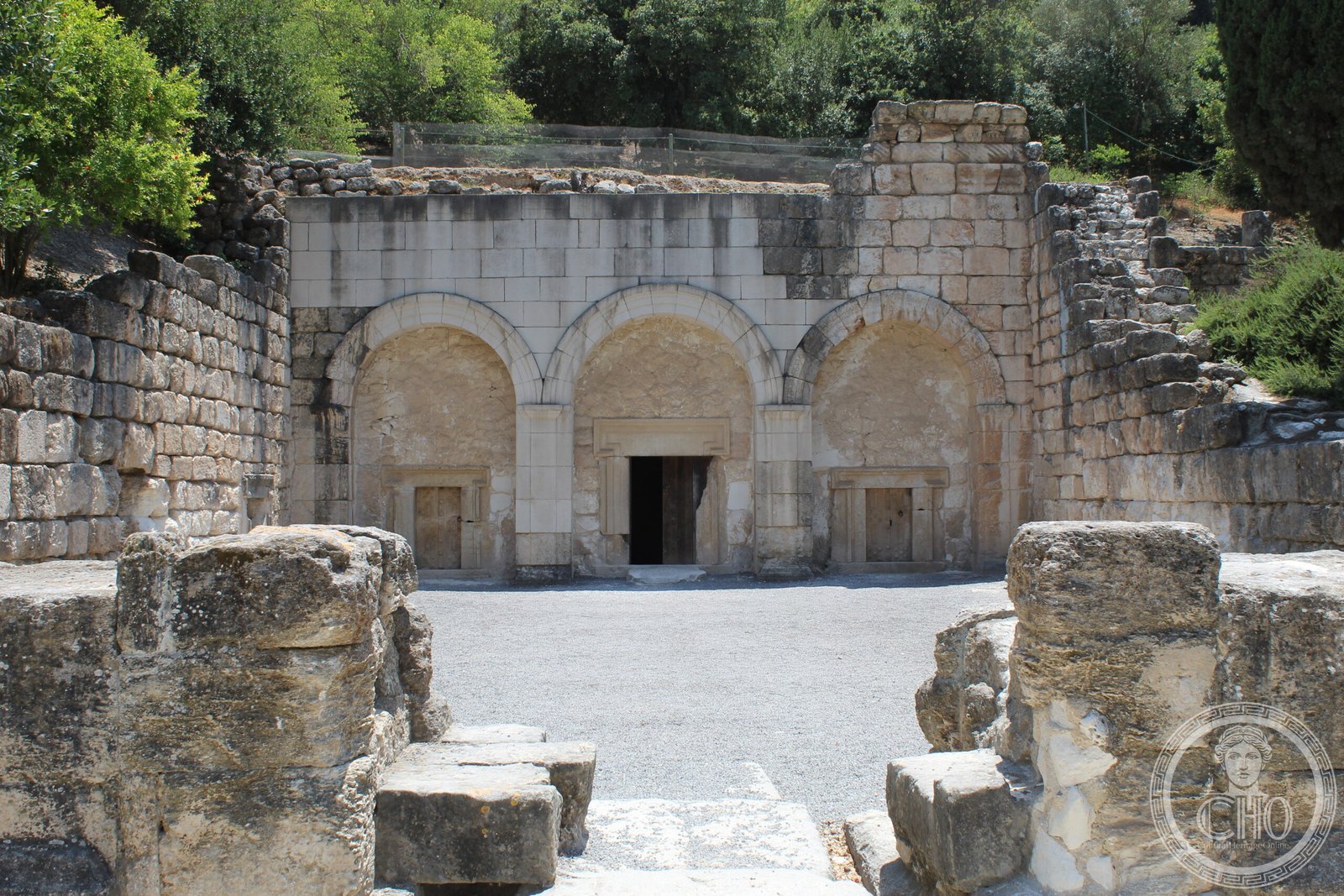
In the hills at the foot of the Lower Galilee stretches one of the most important Jewish necropolises of the ancient world: Beit She’arim, seat of the Sanhedrin under Rabbi Judah the Prince in the second century, is the burial site that transformed late antique Judaism. Cut into the limestone, its catacombs hold thousands of graves with decorated sarcophagi and inscriptions in Hebrew, Greek, Aramaic and Palmyrene — an extraordinary document of the vitality of Judaism after the destruction of the Temple.
At a glance
Beit She’arim National Park (UNESCO 2015) contains one of the most extensive Jewish necropolises of late antiquity: a complex of rock-cut catacombs used from the 2nd to the 5th centuries CE, during which Beit She’arim served as the seat of the Sanhedrin (the supreme Jewish religious council) under Rabbi Judah HaNasi. The site contains dozens of catacombs with thousands of burial niches, stone sarcophagi decorated with Jewish and Hellenistic motifs, and inscriptions in Hebrew, Greek, Aramaic and Palmyrene. After the burial there of Rabbi Judah HaNasi, Beit She’arim became the preferred burial ground for Jews from across the Mediterranean world.
Key facts
- UNESCO: World Heritage since 2015 (Necropolis of Beit She’arim, ref. 1471)
- Period: 2nd to 5th centuries CE
- Sanhedrin: Beit She’arim was the seat of the supreme Jewish council under Rabbi Judah HaNasi (c. 170–217 CE)
- Languages: inscriptions in Hebrew, Greek, Aramaic and Palmyrene
- Sarcophagi: stone coffins with Jewish and Hellenistic decorative motifs
- Significance: marks the renewal of Jewish identity after the destruction of the Temple (70 CE)
History
After the destruction of the Second Temple by Rome in 70 CE and the failure of the Bar Kokhba revolt in 135 CE, the centre of Jewish religious life moved north to Galilee. Around 170 CE, Rabbi Judah HaNasi — the compiler of the Mishnah and the leading authority of the Jewish world — established the seat of the Sanhedrin at Beit She’arim. His burial here after his death around 217 CE transformed the site into the principal Jewish burial ground of the ancient world: Jews from across the Mediterranean — from Rome, Phoenicia, Palmyra and further afield — had their remains brought to Beit She’arim to rest near the great rabbi.
The catacombs were carved during the 2nd–4th centuries and fell into disuse after the Byzantine period. Rediscovered and excavated from 1936 by Alexander Zaid, Nahman Avigad and Benjamin Mazar, Beit She’arim revealed an extraordinary record of late antique Jewish life, language and artistic tradition. UNESCO inscribed it in 2015 as a landmark in the history of Jewish heritage.
What you see
The national park contains the remains of the ancient town, a basilica, oil presses and several catacombs that are accessible to visitors. The most impressive is Catacomb 20 — the Cave of the Coffins — with restored sarcophagi decorated with menorahs, eagles, human figures and geometric patterns. The catacombs are cool and dimly lit, with inscriptions carved into stone doorways and sarcophagus lids.
The setting is an olive-tree-covered hillside overlooking the Jezreel Valley. A museum near the entrance explains the archaeology and the importance of the Sanhedrin period to Jewish history.
Practical information
- Open: Saturday–Thursday 8:00–17:00; Friday 8:00–16:00 (approximate; check locally)
- Entry: national park admission fee applies
- Time needed: 1.5–2 hours
- Setting: 20 km east of Haifa in the foothills of the Lower Galilee
Getting there
Beit She’arim is in the Kiriyat Tivon area, 20 km east of Haifa. By car from Haifa: take Route 75 east. Bus connections from Haifa and Nazareth. GPS: 32.70° N, 35.13° E.
Nearby
- Megiddo — the UNESCO tell of the biblical Armageddon, 25 km south
- Nazareth — the city associated with Jesus, 20 km east
- Haifa — the port city with the Bahá’í gardens (another UNESCO site) on Mount Carmel
Sources
- UNESCO World Heritage Centre — “Necropolis of Beit She’arim” (ref. 1471)
- Encyclopaedia Britannica — Beit She’arim
- Israel Antiquities Authority — official site documentation
Find it on the map
See this place and what’s around it →📷 Become a Cultural Heritage Online photographer
Share your photos of places: they stay published under your name as the author. The more they're seen, the more you get noticed — and soon a contest will reward the most appreciated photos.
Log in or sign up free to add a photo