Ukraine has 8 UNESCO World Heritage Sites, a compact but remarkably varied list that spans Byzantine cathedral complexes, primeval forest, Baroque metropolitanate palaces, and one of the oldest geodetic survey networks on Earth. Seven are classified as cultural, one as natural, and several cross national borders as transnational inscriptions. Taken together, they trace the arc of a civilisation that shaped Eastern European Christianity, Slavic urbanism, and Central European science. From Cultural Heritage Online.
Why Ukraine’s list looks the way it does
Ukraine joined the World Heritage Convention in 1988, at the tail end of the Soviet period, and its first inscription followed within two years. The country’s eight sites reflect the concentrations of monument density along the Dnieper corridor — where Kyivan Rus power was centred in the medieval period — and in the Carpathian west, where vernacular religious architecture and primeval forest have survived at scale. The list is relatively short compared to Western European countries of similar size, partly because the decades since independence have brought significant political and economic disruption to the nomination process.
The ongoing Russian invasion, which began in February 2022, has added a new urgency to the conversation about heritage protection in Ukraine. The Historic Centre of Odesa was placed on the List of World Heritage in Danger at the same session it was inscribed, in 2023 — an unusual step that underlines the scale of the threat facing the country’s built environment.
The first inscriptions
Ukraine’s first World Heritage listing, entered in 1990, comprised two of Kyiv’s defining medieval monuments:
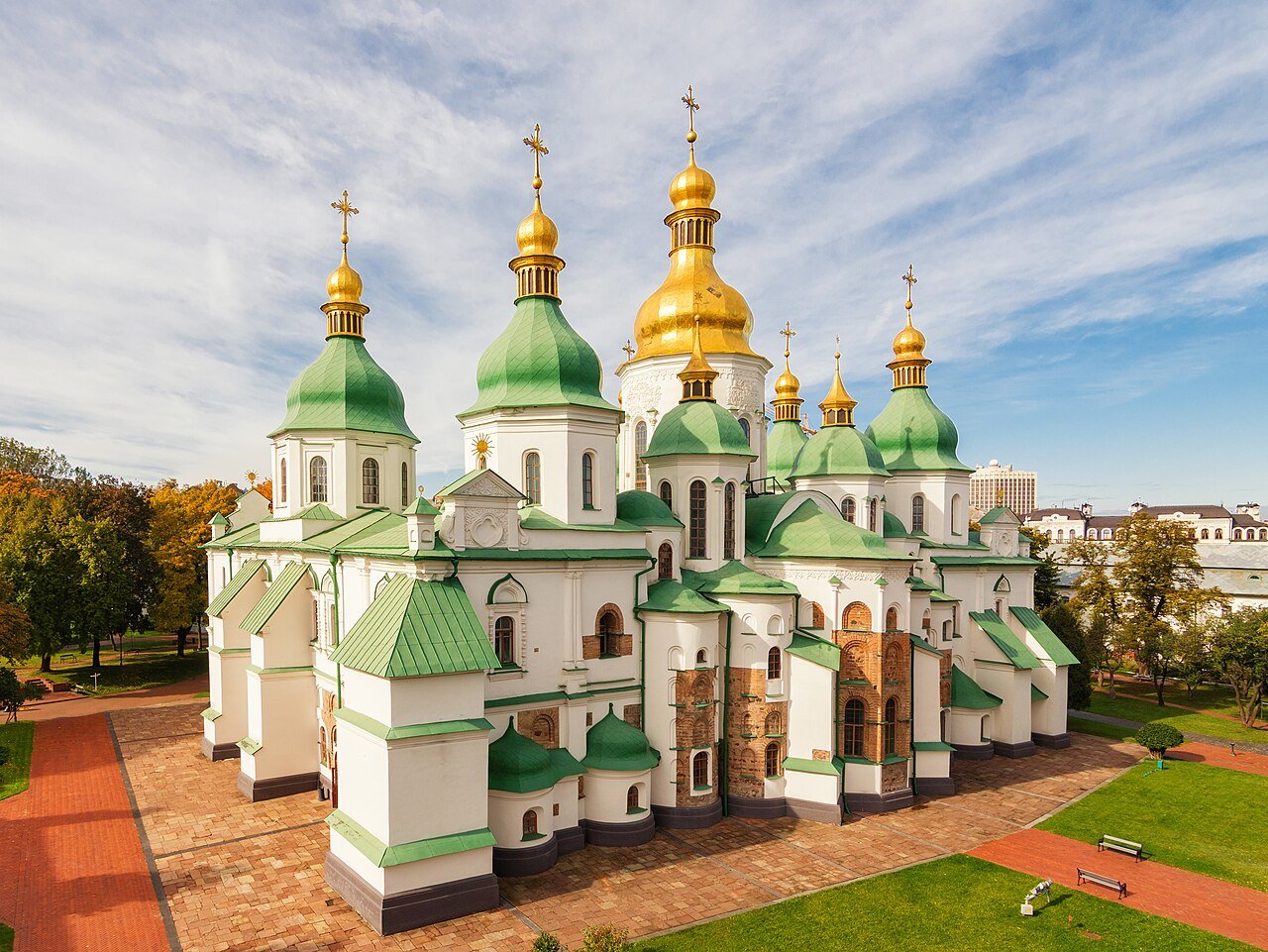
- Saint-Sophia Cathedral and Related Monastic Buildings — founded in the eleventh century under Yaroslav the Wise, the cathedral contains the most complete surviving cycle of original Byzantine mosaics and frescoes in the world.
- Kyiv-Pechersk Lavra (Monastery of the Caves) — an Orthodox lavra established in 1051, known for its network of catacombs, its Baroque bell towers, and its centuries-long role as the spiritual centre of Eastern Slavic Christianity.
Both sites remain in Kyiv and continue to draw pilgrims and visitors, though both are also listed as endangered heritage, given their proximity to an active conflict zone.
The most visited — and the alternatives
Saint-Sophia Cathedral and Kyiv-Pechersk Lavra receive by far the largest share of international visitors on the Ukrainian World Heritage list. The cathedral’s golden domes and the lavra’s labyrinthine cave system are among the most recognisable landmarks in Eastern Europe. The Historic Centre of Odesa, added in 2023, encompasses the city’s celebrated Potemkin Stairs and its grid of neoclassical and eclectic architecture — though the security situation has understandably constrained tourism there.
Three inscriptions offer a different kind of encounter. The Residence of Bukovinian and Dalmatian Metropolitans in Chernivtsi (2011) is a nineteenth-century historicist palace ensemble commissioned by the Austro-Hungarian empire, blending Byzantine, Gothic, and Baroque motifs — it now serves as Chernivtsi National University and is in use daily. The Wooden Tserkvas of the Carpathian Region (2013, shared with Poland) are sixteen timber-frame churches from the sixteenth through nineteenth centuries scattered across the Carpathian foothills, each still serving a local community. The Struve Geodetic Arc (2005), a transnational inscription shared with nine other countries, includes four triangulation-point markers in Ukrainian territory; it records the first precise measurement of a long arc of Earth’s meridian, completed in the mid-nineteenth century.
Natural and shared sites
Ukraine has one natural World Heritage Site: the Ancient and Primeval Beech Forests of the Carpathians and Other Regions of Europe, a sprawling transnational designation now shared with seventeen countries. The Ukrainian component — in the Zakarpattia region — protects old-growth beech forest that has developed without significant human intervention since the last ice age. The site was first inscribed in 2007 under a smaller transnational cluster and has expanded several times as additional countries joined.
Transnational inscriptions are a recurring pattern in Ukraine’s World Heritage portfolio. Beyond the beech forests, the Wooden Tserkvas are shared with Poland, and the Struve Arc spans from Norway to Moldova. This reflects the reality that many of the landscape and cultural systems that shaped Ukraine cross modern political borders — and that international cooperation has sometimes advanced nominations that a single country could not have achieved alone.
How to find them
Ukraine’s eight World Heritage sites are spread across several distinct regions: Kyiv in the north-central zone, Odesa on the Black Sea coast, Chernivtsi in the southwest, and the Carpathian mountain corridor in the far west. Pre-war, Kyiv was the logical base for a heritage itinerary, with the two eleventh-century inscriptions accessible on foot or by metro. The western Carpathian cluster — beech forests and wooden churches — rewards slower, self-driven travel through a landscape that remains relatively little visited by international audiences.
Ukraine’s World Heritage sites sit alongside thousands of other places on CHO’s interactive map, with GPS and sourced editorial history for each. See also our guides to Italy’s and France’s UNESCO sites, and our piece on cultural travel beyond mass tourism.
Frequently Asked Questions
How many UNESCO World Heritage Sites does Ukraine have?
As of 2026, Ukraine has 8 UNESCO World Heritage Sites: 7 cultural and 1 natural. Three of these are transnational inscriptions shared with neighbouring countries or broader European consortia.
What was Ukraine’s first UNESCO World Heritage Site?
Ukraine’s first World Heritage inscription, made in 1990, covered two Kyiv monuments: Saint-Sophia Cathedral and Related Monastic Buildings, and Kyiv-Pechersk Lavra (the Monastery of the Caves). Both were inscribed in the same year and remain among the most significant medieval heritage sites in Eastern Europe.
Which of Ukraine’s World Heritage Sites is listed as endangered?
Two sites currently appear on the UNESCO List of World Heritage in Danger: the Kyiv monuments, added to the danger list due to the ongoing armed conflict, and the Historic Centre of Odesa, which was placed on the danger list at the moment of its inscription in 2023. UNESCO placed Odesa on the list immediately given the active threat posed by the Russian invasion.
Does Ukraine have any natural UNESCO World Heritage Sites?
Ukraine has one natural World Heritage Site: the Ancient and Primeval Beech Forests of the Carpathians and Other Regions of Europe, a transnational property now shared with seventeen countries. The Ukrainian component protects old-growth beech forest in the Zakarpattia region that has remained largely undisturbed since the last ice age.
Sources used in this article
- UNESCO — State Party Ukraine — World Heritage list.
- UNESCO — Ukraine: World Heritage Sites.
- CHO magazine — What is a World Heritage Site?
- CHO — Interactive map of heritage sites.