Ecuador has 5 UNESCO World Heritage Sites, a compact list that ranges from the volcanic archipelago that reshaped the theory of evolution to ancient roads carved across the roof of the Andes. Few countries of its size concentrate so many distinct forms of global significance into one designation record. From Cultural Heritage Online.
Why Ecuador’s list looks the way it does
Ecuador’s five inscriptions reflect the country’s extraordinary environmental and cultural layering. The Pacific coast gives way to the Andes — one of the world’s most active volcanic chains — and then to the Amazon basin, while 1,000 kilometres offshore the Galápagos archipelago sits in a marine crossroads where three ocean currents converge. That compressed geography made it inevitable that UNESCO’s early work in Ecuador would draw on both natural and cultural criteria.
The cultural three properties tell a complementary story: a colonial capital preserved at 2,850 metres above sea level; a second highland city whose street plan survives almost intact from the sixteenth century; and a segment of the longest pre-Columbian road network ever built. Together the five sites span roughly four decades of inscription activity, from 1978 to 2014, and represent 3 cultural and 2 natural properties.
The first inscriptions
Ecuador joined the World Heritage Convention’s inaugural inscription cycle in 1978, when the programme was still in its first year. Two properties entered the list simultaneously, setting the tone for everything that followed:
- Galápagos Islands (1978) — the volcanic archipelago in the Pacific Ocean, whose isolation produced the species diversity that informed Charles Darwin’s work on natural selection.
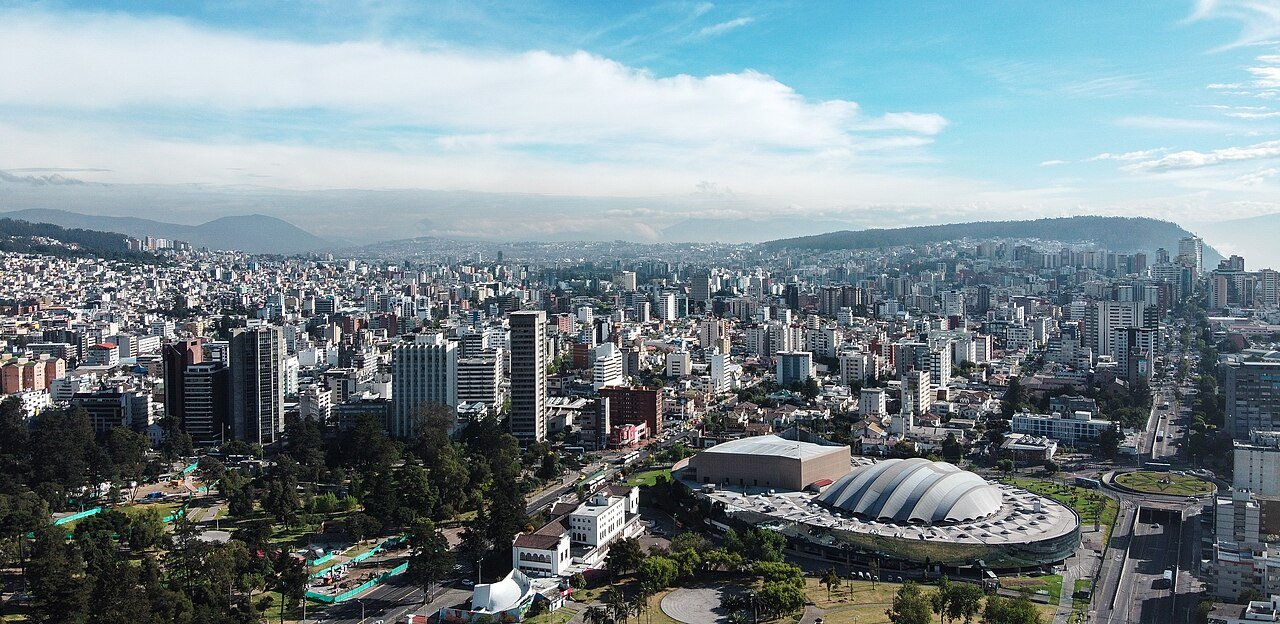
- City of Quito (1978) — the historic centre of Ecuador’s capital, one of the best-preserved colonial cities in Latin America, with a skyline of Baroque churches and convents set against the backdrop of Pichincha volcano.
Their simultaneous inscription was not coincidental. UNESCO’s early deliberations sought to demonstrate the programme’s global reach and its capacity to recognise both natural and cultural heritage in a single session. Ecuador provided both, and both sites remain among the most recognised properties on the South American list.
The most visited — and the alternatives
The Galápagos Islands draw the most international visitors, protected by strict access controls that limit group sizes and channel tourism through a network of designated paths. Quito’s historic centre is the other headline property: a 320-hectare zone that survived the twentieth century largely intact, preserving street blocks, monasteries and plazas that date to the Spanish foundation of 1534 on the ruins of an Inca settlement.
Two properties receive considerably less international attention yet reward closer inspection. The Historic Centre of Santa Ana de los Ríos de Cuenca, inscribed in 1999, is Ecuador’s third city and its most architecturally coherent colonial settlement: the Renaissance grid plan imposed at its 1557 foundation remains readable in the present street layout, and the fusion of Spanish urban design with local building traditions is visible in almost every block. Then there is Sangay National Park (1983), where active stratovolcano Sangay — regarded as one of the most persistently active volcanoes on earth — rises above a sweep of terrain that descends from glaciated páramo through cloud forest to tropical lowlands. The park’s very inaccessibility has kept its ecosystems intact.
Natural and shared sites
Ecuador’s two natural properties could hardly be more different in character. The Galápagos Islands are a marine and terrestrial system shaped by volcanic activity and oceanic isolation; their endemic species lists — giant tortoises, marine iguanas, flightless cormorants — made them a reference point for conservation biology long before the World Heritage designation. Sangay National Park, on the mainland, was inscribed five years later on the strength of its biodiversity and its active geological processes, though it has appeared on the List of World Heritage in Danger and faced pressure from agricultural encroachment.
The fifth site is transnational in a different sense. Qhapaq Ñan, Andean Road System, inscribed in 2014, is shared with Argentina, Bolivia, Chile, Colombia and Peru, and covers more than 30,000 kilometres of road infrastructure built and maintained by the Inca Empire. Ecuador contributes 23 of the inscription’s 273 component sites — mountain passes, administrative centres and waystation settlements that formed the logistical backbone of the largest pre-Columbian state in the Americas. It is the most recent of Ecuador’s inscriptions and one of the most ambitious serial nominations ever submitted to the World Heritage Committee.
How to find them
All five properties are accessible to independent travellers, though conditions vary considerably. Galápagos visits require advance booking through licensed tour operators, and a park entrance fee applies. Quito and Cuenca are directly accessible by air; both historic centres are walkable from city-centre accommodation. Sangay National Park has limited infrastructure, and access to the volcano zone requires proper altitude preparation. Qhapaq Ñan components in Ecuador are distributed across several highland provinces, and some segments are best reached with a local guide.
Ecuador’s World Heritage sites sit alongside thousands of other places on CHO’s interactive map, with GPS and sourced editorial history for each. See also our guides to Italy’s and France’s UNESCO sites, and our piece on cultural travel beyond mass tourism.
Frequently Asked Questions
How many UNESCO World Heritage Sites does Ecuador have?
Ecuador has 5 UNESCO World Heritage Sites, comprising 3 cultural and 2 natural properties. The list spans from 1978, when the first two sites were inscribed simultaneously, to 2014, the year of the most recent addition.
What was Ecuador’s first UNESCO World Heritage Site?
Ecuador had two first sites, both inscribed in 1978 during the inaugural cycle of the World Heritage programme: the Galápagos Islands and the City of Quito. They were listed concurrently and remain among the country’s most internationally recognised properties.
What is the most recently inscribed World Heritage Site in Ecuador?
Qhapaq Ñan, Andean Road System, was inscribed in 2014. It is a transnational serial property shared with Argentina, Bolivia, Chile, Colombia and Peru, covering more than 30,000 kilometres of Inca road infrastructure across the continent.
Does Ecuador have any natural UNESCO World Heritage Sites?
Yes, Ecuador has two natural World Heritage Sites: the Galápagos Islands (1978), renowned for the endemic species that contributed to Darwin’s theory of natural selection, and Sangay National Park (1983), which contains one of the world’s most persistently active volcanoes and a broad span of Andean ecosystems.
Sources used in this article
- UNESCO — State Party Ecuador — World Heritage list.
- UNESCO — Ecuador: World Heritage Sites.
- CHO magazine — What is a World Heritage Site?
- CHO — Interactive map of heritage sites.