Chile has seven UNESCO World Heritage Sites, all of them cultural designations, stretching from the hyperarid Atacama Desert in the north to the rainy archipelago of Chiloé in the south. Together they span more than three thousand years of human presence on the continent’s Pacific edge: ancient mummification practices, Andean road engineering, industrial boom-and-bust cycles, and the singular stone monuments of a remote Pacific island. From Cultural Heritage Online.
Why Chile’s list looks the way it does
Seven inscriptions across thirty years is a modest count for a country of Chile’s geographic and cultural depth. The pattern reflects a deliberate approach: Chile has nominated sites that represent exceptional universal value rather than pursuing volume. Every inscription on the list carries a distinct rationale — no two sites overlap in type, period, or geography.
It is also striking that all seven designations are cultural rather than natural. Chile’s national parks and wilderness areas, including Patagonia and the Atacama, have not yet translated into World Heritage nominations, leaving the list shaped almost entirely by the marks human societies have left on the landscape over millennia.
The first inscriptions
Chile’s entry into the World Heritage system began in 1995 with a single nomination that would become the country’s most recognized site internationally:
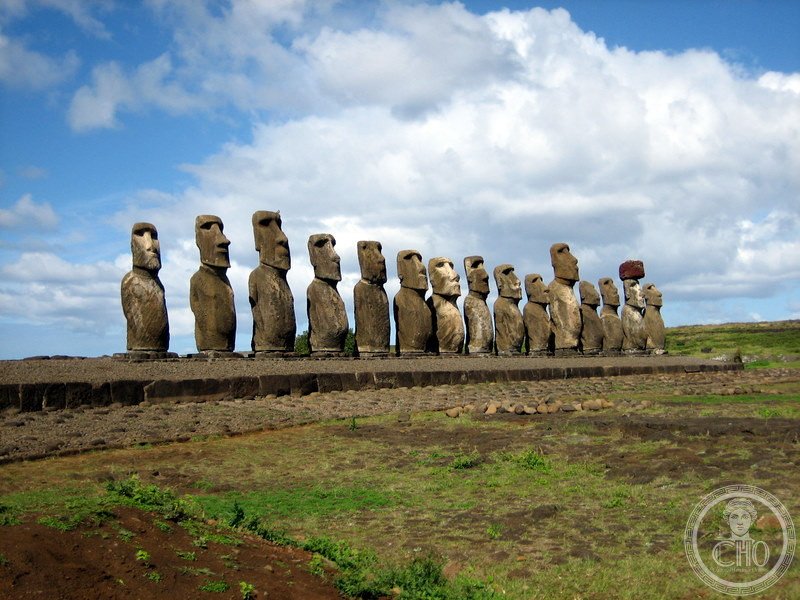
- Rapa Nui National Park (1995) — the monumental moai statues of Easter Island, located some 3,700 kilometres off the Chilean coast in the Pacific Ocean.
Five years later, in 2000, a second site joined the list before a cluster of inscriptions in the mid-2000s extended the range:
- Churches of Chiloé (2000) — sixteen timber churches across the Chiloé Archipelago, recognised for a building tradition that fused Jesuit missionary architecture with local materials and craft knowledge.
- Historic Quarter of the Seaport City of Valparaíso (2003)
- Humberstone and Santa Laura Saltpeter Works (2005)
- Sewell Mining Town (2006)
The most visited — and the alternatives
Rapa Nui and Valparaíso draw the bulk of international attention. The moai platforms of Easter Island are among the most studied archaeological features in the world; the port hills of Valparaíso, lined with painted façades and connected by historic funicular elevators, have become a standard stop on South American itineraries.
The other five sites receive far fewer visitors despite carrying substantial historical weight. The Humberstone and Santa Laura saltpeter works, in the Atacama, document the nitrate-mining industry that once funded the Chilean state — the site was placed on the List of World Heritage in Danger until 2019 because of structural vulnerability, and conservation work continues. The Churches of Chiloé represent one of the most coherent surviving examples of a regional building tradition in Latin America: sixteen working churches, most still in use, built entirely in wood without a single metal fastener in the original structure. Sewell, a copper-mining company town perched at 2,200 metres in the Andes, once housed 15,000 people and is now accessible only by a single road from Rancagua, giving it an eerie preserved quality.
Natural and shared sites
Chile currently holds no natural or mixed UNESCO designations, an unusual situation for a country whose territory includes some of the planet’s most extreme environments. The transnational Qhapaq Ñan inscription, added in 2014, is the closest the list comes to landscape-scale heritage: Chile contributes 33 components of the Andean Road System, a pre-Incan and Incan network of paths, bridges, and way stations extending more than 30,000 kilometres across six countries — Argentina, Bolivia, Colombia, Ecuador, Peru, and Chile.
The most recently inscribed site, added in 2021, shifts attention back to the far north. The Settlement and Artificial Mummification of the Chinchorro Culture, in the Arica and Parinacota region, preserves what are currently considered the oldest known examples of intentional human mummification in the world, predating Egyptian mummification practices by several thousand years.
How to find them
Chile’s seven sites spread across an extreme range of latitudes and environments, from coastal Pacific to high Andean plateau to sub-Antarctic archipelago. Most require dedicated travel rather than passing visits: Rapa Nui is a five-hour flight from Santiago; Chiloé involves either a ferry crossing or a road journey south through the Lake District; Humberstone sits in a desert interior rarely served by tourist infrastructure.
Chile’s World Heritage sites sit alongside thousands of other places on CHO’s interactive map, with GPS and sourced editorial history for each. See also our guides to Italy’s and France’s UNESCO sites, and our piece on cultural travel beyond mass tourism.
Frequently Asked Questions
How many UNESCO World Heritage Sites does Chile have?
Chile has seven UNESCO World Heritage Sites, as of 2025. All seven are cultural designations; Chile currently holds no natural or mixed World Heritage nominations.
What was Chile’s first UNESCO World Heritage Site?
Rapa Nui National Park, on Easter Island, was Chile’s first World Heritage inscription, recognised in 1995. The site is known internationally for its stone moai statues, which were erected by the Rapa Nui people between roughly the thirteenth and sixteenth centuries.
What is the most recently inscribed World Heritage Site in Chile?
The most recent inscription is the Settlement and Artificial Mummification of the Chinchorro Culture, located in the Arica and Parinacota region in northern Chile, added to the World Heritage List in 2021. The site documents mummification practices that predate those of ancient Egypt by several thousand years.
Is Chile part of any transnational UNESCO inscriptions?
Yes. Chile is one of six countries sharing the Qhapaq Ñan, Andean Road System inscription, recognised in 2014 alongside Argentina, Bolivia, Colombia, Ecuador, and Peru. Chile contributes 33 components of the road network, which spans more than 30,000 kilometres across western South America.
Sources used in this article
- UNESCO — State Party Chile — World Heritage list.
- UNESCO — Chile: World Heritage Sites.
- CHO magazine — What is a World Heritage Site?
- CHO — Interactive map of heritage sites.