Syria has 6 UNESCO World Heritage Sites, all of them cultural, spanning a continuous arc of civilisation that stretches from the Nabataean trade routes of the first century through the Crusader fortifications of the medieval period to the rural landscapes of Late Antiquity. These six inscriptions — cities, castles, and ghost villages alike — represent one of the densest concentrations of layered human settlement on the planet. Every site is currently on the List of World Heritage in Danger, a designation that makes understanding and recording them more urgent than ever. From Cultural Heritage Online.
Why Syria’s list looks the way it does
Syria sits at the crossroads where Mesopotamia, the Mediterranean, and the Arabian Peninsula converge. Phoenician, Aramean, Greek, Roman, Byzantine, Islamic, and Crusader cultures each left stratified remains on the same ground, which explains why every Syrian inscription is cultural rather than natural: the outstanding universal value here is almost always about what humans built, traded, and believed, not about geology or biodiversity.
The six inscriptions also span very different scales. Damascus and Aleppo are living cities whose historic cores were inscribed alongside millions of residents. Palmyra and Bosra are largely archaeological. Crac des Chevaliers and Qal’at Salah El-Din are paired military monuments. The Ancient Villages of Northern Syria are an ensemble of roughly 40 abandoned settlements. This breadth reflects both the richness of the country’s record and the selective rigour UNESCO applied when evaluating Syria between 1979 and 2011.
The first inscriptions
Syria entered the World Heritage List at the Third Session of the World Heritage Committee, held in Paris in 1979, with a single founding inscription. The following year brought two more, establishing a core of three sites that remain among the most studied in the entire region.
- Ancient City of Damascus (1979) — one of the oldest continuously inhabited cities in the world, with a street plan that preserves the Roman grid beneath centuries of Islamic urban development.
- Ancient City of Bosra (1980) — a former Nabataean capital absorbed into the Roman province of Arabia, whose remarkably preserved theatre is enclosed within a medieval Arab citadel.
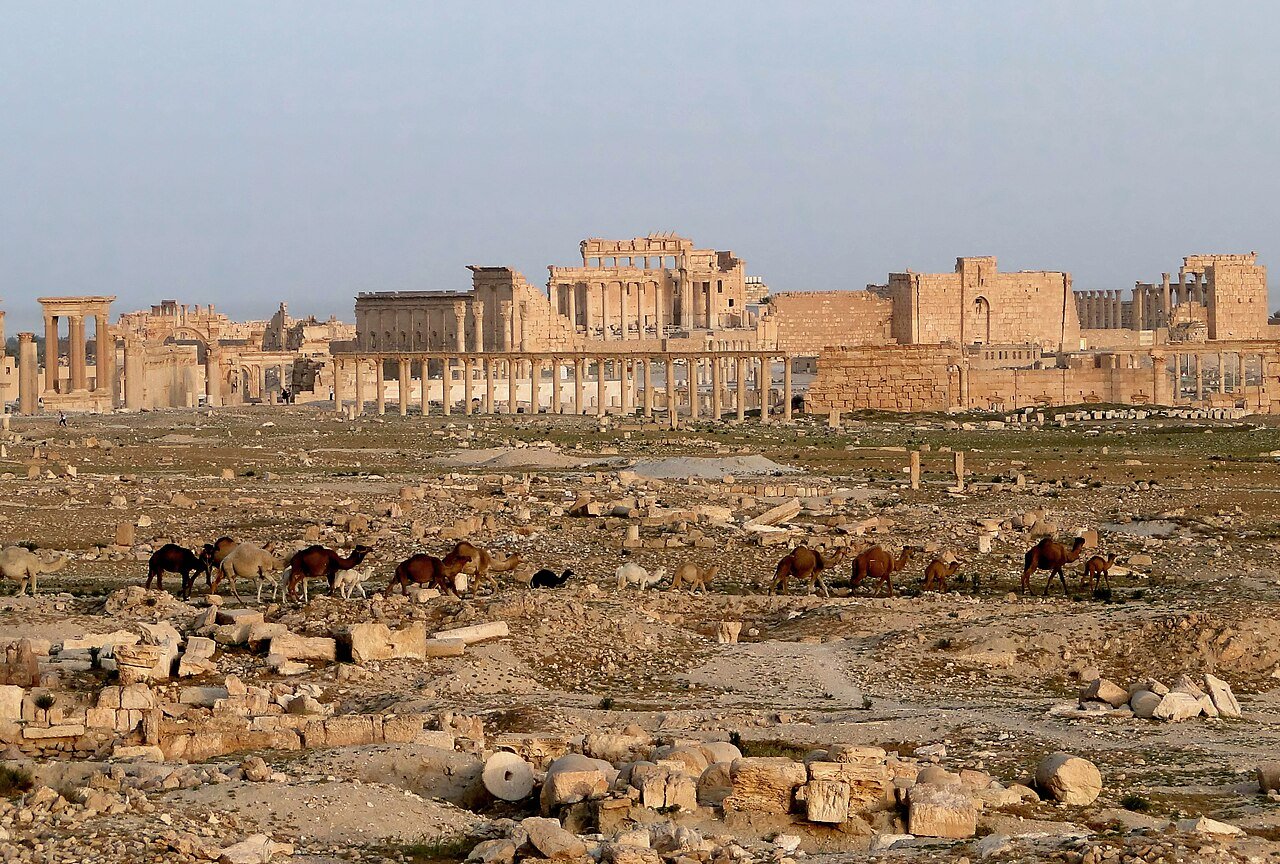
- Site of Palmyra (1980) — a desert caravan city whose colonnaded street, funerary towers, and Temple of Bel made it one of antiquity’s great trading centres.
The most visited — and the alternatives
Before the conflict that began in 2011, Palmyra drew the largest share of international visitors, followed by the medieval souks and citadel of Aleppo. Both sites suffered severe damage during the Syrian Civil War, and their long-term conservation now depends on international cooperation as much as local resources. The Ancient City of Aleppo, inscribed in 1986, had accumulated over 3,000 years of settlement by the time it was listed, making its medina one of the most historically complex urban environments in the Arab world.
Three inscriptions receive comparatively less attention but repay close study. Crac des Chevaliers, paired with Qal’at Salah El-Din under a single 2006 inscription, illustrates how Crusader and Islamic military architecture evolved in direct response to each other over two centuries. Qal’at Salah El-Din in particular retains a near-intact Byzantine moat cut from solid rock. The Ancient Villages of Northern Syria (2011), sometimes called the Dead Cities, comprise approximately 40 settlements abandoned between the 8th and 10th centuries, preserving domestic and religious architecture from the Late Antique and early Byzantine periods in a state rarely found elsewhere — roofless but structurally coherent, with inscriptions and floor plans still legible.
Natural and shared sites
Syria has no inscribed natural or mixed sites. Its entire World Heritage portfolio is cultural. The country is not party to any active transnational serial inscription currently on the World Heritage List, though the Ancient Villages of Northern Syria were evaluated as a serial property in their own right, encompassing eight distinct archaeological parks spread across the limestone massif north-west of Aleppo.
The absence of natural inscriptions does not reflect a lack of ecological significance — Syria’s steppe and Mediterranean coastal habitats are notable — but rather the historical focus of nominations submitted by the country before the conflict suspended institutional activity. Future nominations, when circumstances allow, may address this gap.
How to find them
All six Syrian World Heritage Sites were placed on the List of World Heritage in Danger in 2013, following documented damage from armed conflict. UNESCO and its partners have carried out remote-sensing surveys and condition assessments throughout the conflict period, and recovery planning is underway for several sites. Travellers and researchers monitoring the situation can consult the UNESCO State Party page for Syria for the most current status reports.
Syria’s World Heritage sites sit alongside thousands of other places on CHO’s interactive map, with GPS and sourced editorial history for each. See also our guides to Italy’s and France’s UNESCO sites, and our piece on cultural travel beyond mass tourism.
Frequently Asked Questions
How many UNESCO World Heritage Sites does Syria have?
Syria has 6 UNESCO World Heritage Sites, all of them cultural. They were inscribed between 1979 and 2011, and all six have been on the List of World Heritage in Danger since 2013 due to damage caused by the Syrian Civil War.
What was Syria’s first UNESCO World Heritage Site?
The Ancient City of Damascus was Syria’s first UNESCO World Heritage Site, inscribed at the Third Session of the World Heritage Committee in Paris in 1979. It is considered one of the oldest continuously inhabited cities in the world, with a layered urban fabric that reflects Aramean, Roman, Byzantine, and Islamic occupation.
What is the most recent UNESCO inscription in Syria?
The Ancient Villages of Northern Syria, also known as the Dead Cities, were inscribed in 2011 — the last inscription before the outbreak of conflict. The property encompasses approximately 40 abandoned settlements across eight archaeological parks, preserving Late Antique and Byzantine rural architecture in exceptional condition.
Does Syria have any natural UNESCO World Heritage Sites?
No. All six of Syria’s World Heritage inscriptions are cultural. The country has not yet nominated any site under natural or mixed criteria, though its Mediterranean coastal habitats and steppe landscapes have ecological significance that may form the basis of future nominations when circumstances allow.
Sources used in this article
- UNESCO — State Party Syria — World Heritage list.
- UNESCO — Syria: World Heritage Sites.
- CHO magazine — What is a World Heritage Site?
- CHO — Interactive map of heritage sites.