Jordan has seven UNESCO World Heritage Sites, ranging from Nabataean rock-cut cities and early Islamic desert palaces to a Byzantine mosaic complex, a baptism site, a basalt farming town that survived five civilisations, and a landscape of red sandstone canyons that is at once a natural wonder and a record of human presence stretching back millennia. From Cultural Heritage Online.
Why Jordan’s list looks the way it does
Seven inscriptions spread across four decades reflects a list built on depth rather than volume. Jordan’s territory sits at the crossroads of ancient trade routes connecting the Arabian Peninsula to the Mediterranean, and successive civilisations — Nabataean, Roman, Byzantine, Umayyad, Ottoman — each left layered physical evidence in a landscape that is largely arid, which has helped preserve structures that would have decayed in a more temperate climate.
Six of the seven sites are classified as cultural; one, Wadi Rum, carries a mixed designation, recognised for both its geological formations and its millennia of human habitation. There are no purely natural inscriptions on Jordan’s list, which reflects the committee’s assessment that the country’s most globally significant landscapes are inseparable from the human cultures that shaped them.
The first inscriptions
In 1985, UNESCO added Jordan’s first two sites in the same year, immediately establishing the range that the list would continue to represent: one site of monumental urban ambition, the other of intimate artistic brilliance.
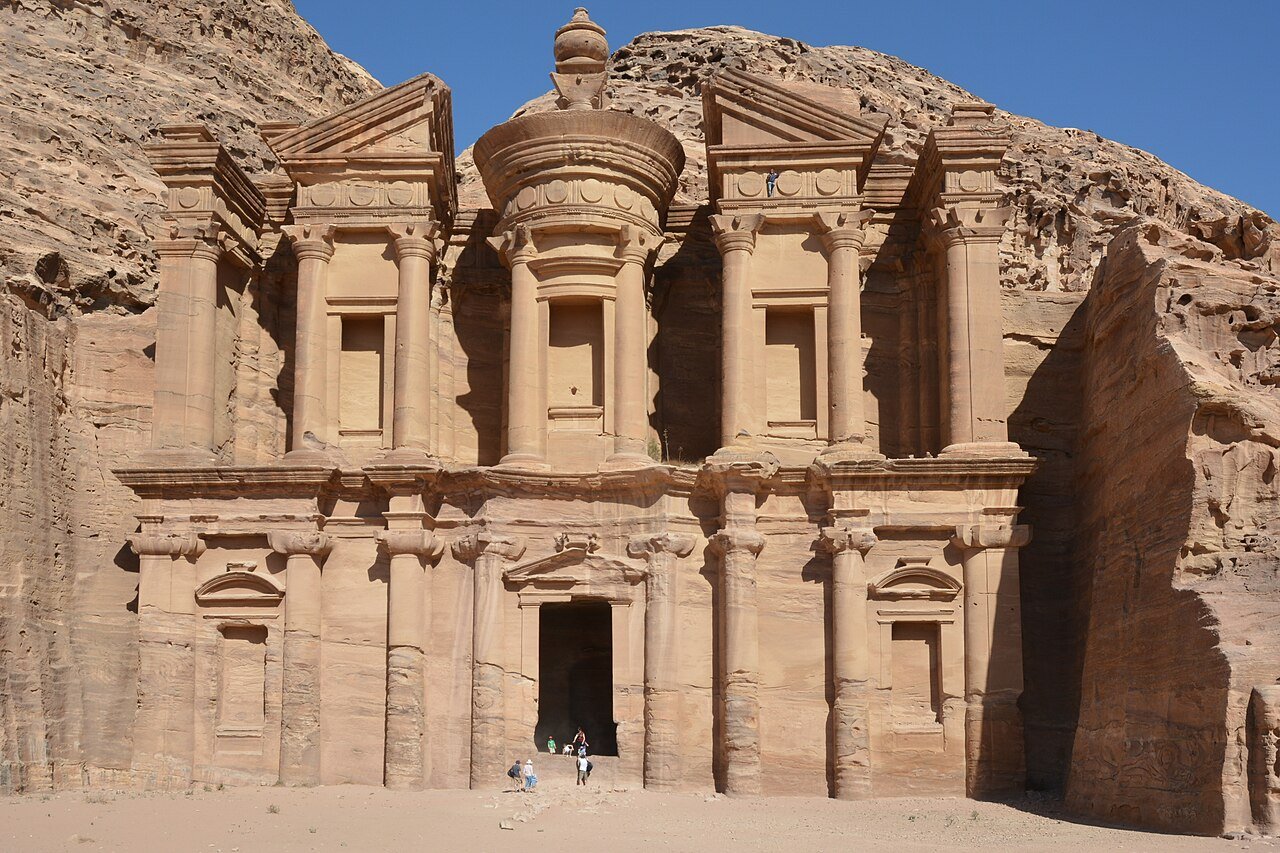
- Petra (1985) — the Nabataean capital carved into rose-red sandstone cliffs in southern Jordan, with a monumental colonnaded street, rock-cut tombs, and a treasury facade that became one of the most recognisable architectural images in the world.
- Quseir Amra (1985) — an early eighth-century Umayyad desert bathhouse in the eastern steppe, celebrated for its secular fresco cycles depicting hunting, bathing, the signs of the zodiac, and royal figures from rival empires, painted at a moment when Islamic figurative art was still openly practised.
The most visited — and the alternatives
Petra draws the vast majority of international visitors to Jordan’s heritage sites, and deservedly so: the scale of the Nabataean city, from the narrow Siq gorge to the Monastery plateau, requires more than a single day to explore adequately. Wadi Rum, inscribed in 2011 for its dramatic sandstone and granite desert valleys and its concentration of petroglyphs and inscriptions spanning the Thamudic, Nabataean, and Arabic scripts, has grown as a travel destination in its own right, partly through its visual familiarity from film productions.
The remaining five sites receive a fraction of that attention, yet each documents a distinct period and function. Um er-Rasas, inscribed in 2005, contains the ruins of a Roman military camp that grew into a Byzantine and early Islamic settlement; its Church of Saint Stephen preserves one of the largest and best-preserved mosaic floors in the region, including a border map of cities. Al-Maghtas, added in 2015, is identified as the site of the Baptism of Jesus on the eastern bank of the Jordan River, with remains of Byzantine churches, a monastery, and baptismal pools. As-Salt, inscribed in 2021, is an Ottoman-era trading town whose limestone architecture and open civic culture earned it designation under the criterion of outstanding universal value for cultural exchange. And Umm Al-Jimāl, Jordan’s most recent addition in 2024, is a basalt stone town in the northern Hauran region that was continuously occupied from the first century through the early Islamic period, preserving urban fabric across five successive civilisations.
Natural and shared sites
Wadi Rum Protected Area is Jordan’s sole mixed site, and it stands as the country’s strongest claim to natural heritage on the World Heritage list. The protected area covers some 74,000 hectares of desert landscape shaped by erosion into arches, narrow canyons, and towering rock faces. Its natural values — geological processes, exceptional scenery, and biodiversity adapted to extreme aridity — are intertwined with evidence of human settlement from the Neolithic period onward, including rock art panels and inscriptions that have become part of the nomination’s cultural argument.
The Wikipedia source consulted for this article does not record any transnational or serial inscriptions involving Jordan on the current World Heritage list. Jordan’s seven inscriptions are all nationally bounded properties, though some, such as Al-Maghtas and Quseir Amra, exist within a broader regional landscape of early Islamic and Byzantine heritage that other countries in the Levant have also nominated separately.
How to find them
Jordan’s seven World Heritage Sites are distributed across the country’s main geographic zones: Petra and Wadi Rum in the south, Um er-Rasas and Quseir Amra in the central and eastern steppe, Al-Maghtas near the Jordan River valley, As-Salt in the northern highlands, and Umm Al-Jimāl in the basalt desert of the far north. Most can be reached by road from Amman, though distances vary considerably; Wadi Rum and Petra are best treated as multi-day stops.
Jordan’s World Heritage sites sit alongside thousands of other places on CHO’s interactive map, with GPS and sourced editorial history for each. See also our guides to Italy’s and France’s UNESCO sites, and our piece on cultural travel beyond mass tourism.
Frequently Asked Questions
How many UNESCO World Heritage Sites does Jordan have?
Jordan has seven UNESCO World Heritage Sites as of 2024. Six are classified as cultural sites and one — Wadi Rum Protected Area — holds a mixed designation, recognised for both its natural landscape and its long record of human habitation and rock art.
What was Jordan’s first UNESCO World Heritage Site?
Jordan received its first two UNESCO inscriptions in the same year, 1985: Petra and Quseir Amra. Petra is the Nabataean rock-cut city in southern Jordan, while Quseir Amra is an early Umayyad desert bathhouse renowned for its figurative fresco cycles painted in the early eighth century.
What is Jordan’s most recently inscribed World Heritage Site?
Umm Al-Jimāl was inscribed in 2024, becoming Jordan’s seventh World Heritage Site. The basalt stone town in the northern Hauran region preserves the urban fabric of a settlement occupied continuously from the first century through the early Islamic period across five successive civilisations.
Which of Jordan’s World Heritage Sites relates to religious history?
Al-Maghtas, inscribed in 2015, is identified as the site of the Baptism of Jesus on the eastern bank of the Jordan River. The archaeological area includes Byzantine-era churches, a monastery complex, and ancient baptismal pools, and it is recognised as a place of pilgrimage for multiple Christian denominations.
Sources used in this article
- UNESCO — State Party Jordan — World Heritage list.
- UNESCO — Jordan: World Heritage Sites.
- CHO magazine — What is a World Heritage Site?
- CHO — Interactive map of heritage sites.
Sources
- S1 — Bienkowski, Piotr, ed. The Art of Jordan. National Museums and Galleries on Merseyside, 1991. ISBN 978-0-906367-40-7.
- S2 — Taylor, Jane. Petra and the Lost Kingdom of the Nabataeans. Harvard University Press, 2002. ISBN 978-0-674-00849-6.
Spotted an error? Write to editorial@culturalheritageonline.com and we correct it the same day.