Switzerland has 13 UNESCO World Heritage Sites, a list that ranges from medieval abbeys and purpose-built watchmaking towns to glacier-carved alpine massifs and ancient lakeside settlements. The country’s compact geography belies an extraordinary span of human activity and natural process, with inscribed properties distributed from the Rhine valley to the Italian border and from the Bernese Oberland to the Jura plateau. From Cultural Heritage Online.
Why Switzerland’s list looks the way it does
Nine of Switzerland’s thirteen inscribed properties are cultural sites, reflecting the country’s long role as a crossroads of Latin, Germanic, and Romansh cultures. The alpine environment channelled settlement, trade, and pilgrimage along a limited number of corridors, concentrating remarkable monuments in valleys and market towns that remained relatively undisturbed for centuries. Religious foundations — abbeys, convents, collegiate churches — dominate the early inscriptions, while later entries capture the industrial modernity that watchmaking and railway engineering brought to the Swiss landscape.
The four natural sites are equally telling. Switzerland sits at the meeting point of the Alps and the Jura, and its geology records events stretching from Triassic reef systems to Pleistocene glaciation. Three of the four natural inscriptions deal directly with alpine geology and landscape; the fourth links Swiss beech forests to a continent-wide serial nomination that now spans eighteen countries.
The first inscriptions
Switzerland entered the World Heritage List in 1983 with three simultaneous inscriptions, each representing a different strand of Swiss cultural identity:
- Old City of Berne — the medieval capital, largely preserved in its original sandstone arcade streetscape
- Abbey of Saint Gall — a Carolingian monastic complex whose library holds one of Europe’s most important collections of early medieval manuscripts
- Benedictine Convent of St John at Müstair — a remote Romansh-speaking valley site carrying the largest surviving cycle of Carolingian frescoes in existence
The three sites together span more than eight centuries of continuous religious and civic life, and each has remained in active use — St Gall as a cathedral, Müstair as a working convent, and Berne as a functioning federal capital — giving Swiss World Heritage a living quality that purely archaeological sites rarely achieve.
The most visited — and the alternatives
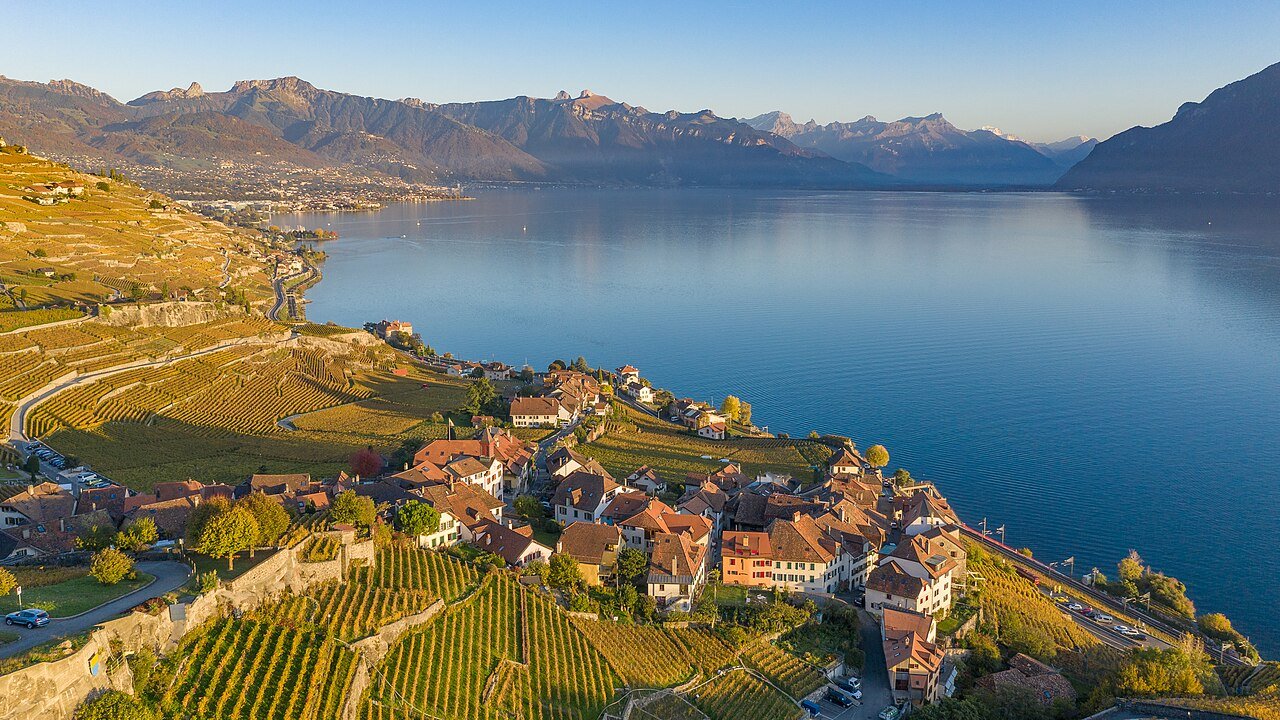
The Swiss Alps Jungfrau-Aletsch draws the largest visitor numbers of any Swiss inscription: the Aletsch Glacier, the longest in the Alps, is accessible by rack railway from Grindelwald and Lauterbrunnen and sits at the centre of a landscape that shaped the Romantic imagination of alpine wilderness across Europe. The Lavaux Vineyard Terraces — roughly 30 kilometres of wine-growing terraces rising above Lake Geneva, first cultivated by Benedictine monks in the eleventh century — also attract substantial crowds, particularly during harvest season.
Less familiar sites repay the detour. La Chaux-de-Fonds and Le Locle, twin towns in the Jura rebuilt after fires in the late eighteenth and nineteenth centuries, were designed explicitly around the watchmaking industry: streets, blocks, and building proportions were calculated to maximise natural light for precision work, producing an urban grid found nowhere else. The Swiss Tectonic Arena Sardona, in the canton of Glarus, preserves an exposed thrust fault where older rock visibly overrides younger strata — a geological formation that helped nineteenth-century scientists establish the modern theory of plate tectonics. The Prehistoric Pile Dwellings, though a transnational inscription, include dozens of Swiss lakeside sites where Neolithic and Bronze Age communities built their homes on platforms above the water.
Natural and shared sites
Beyond Jungfrau-Aletsch, Switzerland’s natural inscriptions include Monte San Giorgio, a pyramid-shaped mountain south of Lugano that contains one of the richest records of Middle Triassic marine life anywhere on earth — a site shared with Italy. The Ancient and Primeval Beech Forests of the Carpathians and Other Regions of Europe, extended in 2021 to include the Forêt de la Vallée de Lodano and the Forêt de la Bettlachstock, links Swiss woodland to a serial nomination spanning eighteen countries across the continent.
Switzerland participates in several important transnational serial inscriptions. The Rhaetian Railway in the Albula and Bernina Landscapes — a feat of early twentieth-century engineering shared with Italy — threads through terrain that defeated conventional construction, using viaducts, spiral tunnels, and helical loops to maintain viable gradients. The Architectural Work of Le Corbusier, a seventeen-country inscription covering the Swiss-born architect’s key buildings, includes his Villa Le Lac on Lake Geneva. The Prehistoric Pile Dwellings nomination is shared with Austria, France, Germany, Italy, and Slovenia, and encompasses more than one hundred sites across the Alpine lakes region.
How to find them
Switzerland’s World Heritage sites sit alongside thousands of other places on CHO’s interactive map, with GPS and sourced editorial history for each. See also our guides to Italy’s and France’s UNESCO sites, and our piece on cultural travel beyond mass tourism.
Frequently Asked Questions
How many UNESCO World Heritage Sites does Switzerland have?
Switzerland has 13 UNESCO World Heritage Sites as of 2021, comprising 9 cultural properties and 4 natural properties. Several of these are serial or transnational inscriptions shared with neighbouring countries.
What was Switzerland’s first UNESCO World Heritage Site?
Switzerland received three simultaneous inaugural inscriptions in 1983: the Old City of Berne, the Abbey of Saint Gall, and the Benedictine Convent of St John at Müstair. All three remain in active use today.
Does Switzerland have any natural UNESCO World Heritage Sites?
Yes — four of Switzerland’s thirteen inscribed properties are natural sites. They are the Swiss Alps Jungfrau-Aletsch, Monte San Giorgio (shared with Italy), the Swiss Tectonic Arena Sardona, and the Ancient and Primeval Beech Forests of the Carpathians and Other Regions of Europe.
What is the most recently inscribed UNESCO site in Switzerland?
The most recent addition came in 2021, when two Swiss forests — the Forêt de la Vallée de Lodano and the Forêt de la Bettlachstock — were added to the expanded Ancient and Primeval Beech Forests serial inscription. This extended an existing transnational site rather than creating a new standalone entry.
Sources used in this article
- UNESCO — State Party Switzerland — World Heritage list.
- UNESCO — Switzerland: World Heritage Sites.
- CHO magazine — What is a World Heritage Site?
- CHO — Interactive map of heritage sites.