Iran has 29 UNESCO World Heritage Sites, a list that stretches from Achaemenid ceremonial capitals and pre-Zoroastrian ziggurats to ancient Bronze Age cities, living cave settlements, and two ecosystems found almost nowhere else on Earth. From Cultural Heritage Online.
Why Iran’s list looks the way it does
Few countries carry as much chronological depth as Iran. Human settlement in the Iranian plateau reaches back more than ten thousand years, and successive empires — Elamite, Achaemenid, Parthian, Sassanid, Safavid — each left monumental architecture across the full breadth of the territory. The UNESCO list reflects that layering: the majority of Iran’s 29 sites (27 of them cultural) record a nearly unbroken chain of civilisations rather than the output of a single era.
This cultural dominance also explains the absence of mixed sites. Iran’s two natural inscriptions — the Lut Desert and the Hyrcanian Forests — represent radically different environments, from one of the hottest and driest places on the planet to a temperate rainforest belt along the Caspian coast. Between these extremes lies a heritage landscape shaped as much by trade routes and water management as by dynastic ambition.
The first inscriptions
Iran joined the World Heritage Convention early. At the third session of the World Heritage Committee, held in Cairo and Luxor in 1979, three sites were inscribed simultaneously, immediately establishing Iran as a major contributor to the global list.
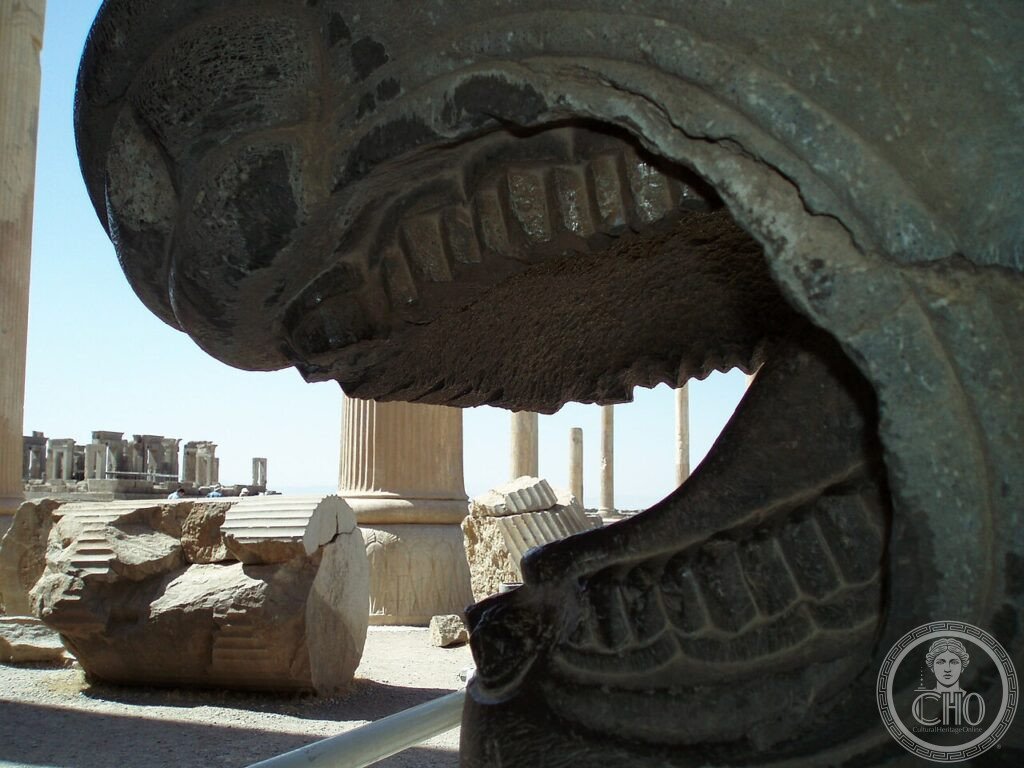
- Persepolis — the ceremonial capital of the Achaemenid Empire, constructed under Darius I and Xerxes in the fifth century BCE, whose stone reliefs remain among the most vivid records of ancient statecraft.
- Meidan Emam (Naqsh-e Jahan Square), Isfahan — one of the largest public squares in the world, flanked by the Royal Mosque, the Mosque of Sheikh Lotfollah, and the Ali Qapu palace, all built under Shah Abbas I in the early seventeenth century.
- Tchogha Zanbil — a vast Elamite ziggurat in Khuzestan dating to around 1250 BCE, the best-preserved example of this temple-tower form outside Mesopotamia.
The most visited — and the alternatives
Persepolis draws the largest share of international visitors, and Isfahan’s Meidan Emam is a near-obligatory stop on the Iran travel circuit. The ancient city of Pasargadae, with the tomb of Cyrus the Great, and the Golestan Palace in Tehran attract substantial crowds too. These sites are undeniably rewarding, but Iran’s list offers quieter inscriptions that repay attention.
- Shahr-e Sukhteh — the “Burnt City” in Sistan, dating to around 3200 BCE, was a major Bronze Age urban centre on trans-Asian trade routes; excavations here uncovered what may be the oldest known artificial eye and a remarkably early animated sequence on a ceramic bowl.
- Cultural Landscape of Maymand — a semi-arid village in Kerman Province where residents have lived in hand-carved soft-rock dwellings for thousands of years, a tradition that continues among a small semi-nomadic community today.
- Gonbad-e Qabus — a slender 53-metre brick tower in Golestan Province, built in 1006 CE, the sole standing remnant of the medieval city of Jorjan and a structural feat that has fascinated architects and engineers for a century.
- The Prehistoric Sites of the Khorramabad Valley — Iran’s most recently inscribed site, added in 2025, comprising six caves and rock shelters in Lorestan Province that document human habitation across multiple prehistoric periods.
Natural and shared sites
The Lut Desert, inscribed in 2016, occupies a tectonic basin in south-eastern Iran where summer ground temperatures have reached the highest ever recorded on Earth. Its wind-sculpted yardang formations — some rising to more than 100 metres — and vast salt flats are visually extraordinary and scientifically significant for arid-land geomorphology. The site is largely inaccessible outside the cooler months, which keeps visitor numbers low relative to its scale.
The Hyrcanian Forests, inscribed in 2019, extend along the southern Caspian coast through the provinces of Golestan, Mazandaran, and Gilan. These broadleaf and mixed forests survived the last Ice Age and now harbour plant and animal species — including the Persian leopard — that vanished from most of Eurasia. The Hyrcanian belt is also shared geographically with Azerbaijan, though Iran’s inscription covers the Iranian portion only. Iran holds no transnational or serial World Heritage nominations shared with other states at present.
How to find them
Iran’s World Heritage sites sit alongside thousands of other places on CHO’s interactive map, with GPS and sourced editorial history for each. See also our guides to Italy’s and France’s UNESCO sites, and our piece on cultural travel beyond mass tourism.
Frequently Asked Questions
How many UNESCO World Heritage Sites does Iran have?
As of 2026, Iran has 29 UNESCO World Heritage Sites. Of these, 27 are cultural and two are natural — the Lut Desert and the Hyrcanian Forests. Iran has no mixed sites.
What was Iran’s first UNESCO World Heritage Site?
Iran had three sites inscribed simultaneously in 1979, at the third session of the World Heritage Committee: Persepolis, Meidan Emam (Naqsh-e Jahan Square) in Isfahan, and Tchogha Zanbil. All three remain among the country’s most celebrated heritage sites.
What is Iran’s most recently inscribed UNESCO World Heritage Site?
The Prehistoric Sites of the Khorramabad Valley in Lorestan Province was inscribed in 2025, making it Iran’s newest World Heritage Site. It comprises six caves and rock shelters that document prehistoric human occupation across several periods.
Does Iran have any natural UNESCO World Heritage Sites?
Iran has two natural World Heritage Sites. The Lut Desert, inscribed in 2016, is recognised for its extreme temperatures and dramatic yardang landforms. The Hyrcanian Forests, inscribed in 2019, are ancient Caspian-coastal woodlands that survived the last Ice Age and shelter rare species including the Persian leopard.
Sources used in this article
- UNESCO — State Party Iran — World Heritage list.
- UNESCO — Iran: World Heritage Sites.
- CHO magazine — What is a World Heritage Site?
- CHO — Interactive map of heritage sites.