
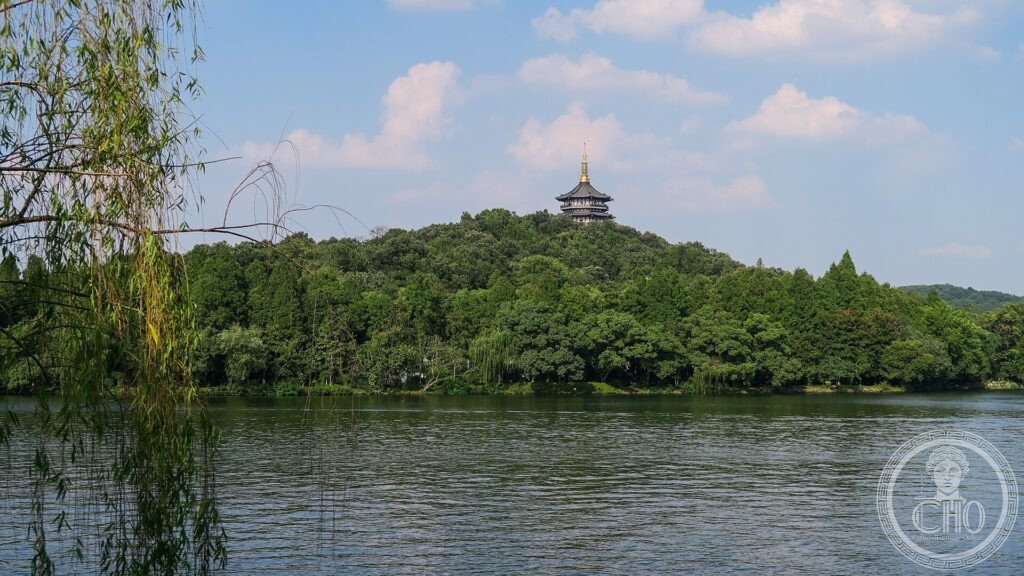
For more than a thousand years, Hangzhou’s West Lake has embodied the Chinese ideal of harmony between man and nature: flowering causeways, islands, pagodas and bridges arranged as if in a painting. Sung by poets and painted by artists, it shaped the gardens of all East Asia as a model of landscape beauty.
At a glance
The West Lake (Xi Hu) of Hangzhou, in eastern China, is a cultural landscape that has shaped the Chinese ideal of scenic beauty for more than a thousand years. Its waters, ringed by hills and dotted with islands, causeways, temples, pagodas and gardens, were deliberately composed over centuries into a series of celebrated views — the “Ten Scenes” — that inspired poets, painters and garden-makers across East Asia. This influential cultural landscape was inscribed by UNESCO in 2011.
Key facts
- UNESCO: World Heritage since 2011 (West Lake Cultural Landscape of Hangzhou)
- A composed landscape: shaped by causeways, islands, temples and pagodas
- The Ten Scenes: classic views named since the Song dynasty
- Leifeng Pagoda: a famous pagoda on the southern shore
- Inspiration: a model for gardens across China, Japan and Korea
- Hangzhou: a great historic city, once a Song capital
History
Once a shallow lagoon, the West Lake was shaped over centuries by deliberate works: governors and poets — among them Bai Juyi and Su Shi (Su Dongpo), who built the famous causeways — dredged it, raised dykes, planted willows and lotus, and set temples and pagodas among the hills. Hangzhou became one of the greatest cities of medieval China, capital of the Southern Song, and the lake its scenic soul.
By the Song dynasty the “Ten Scenes of West Lake” had been named and celebrated in poetry and painting, fixing an ideal of harmonious landscape that influenced garden design throughout East Asia. Carefully maintained ever since, the lake remains a living composition of water, hills and human art.
What you see
The lake spreads calm and silver between wooded hills, crossed by the long Bai and Su causeways and dotted with islands such as the “Three Pools Mirroring the Moon”. On the shores and heights stand pagodas — the Leifeng and the Baochu — temples, pavilions and gardens, each framing one of the celebrated views.
Willows, lotus and arched bridges complete the scene that generations of painters have sought to capture.
Practical information
- Lake: freely accessible; boats cross to the islands
- Time needed: a day to walk the causeways and shores
- Note: very popular; quieter early or late in the day
- Setting: in the city of Hangzhou, south-west of Shanghai
Getting there
West Lake lies on the western edge of Hangzhou, the capital of Zhejiang province in eastern China, reached by high-speed train from Shanghai in under an hour. The lake adjoins the city centre. GPS: 30.245° N, 120.135° E.
Nearby
- Lingyin Temple — a great Buddhist temple in the hills nearby
- Longjing — the tea-growing hills west of the lake
- Grand Canal — the UNESCO canal that reaches Hangzhou
Sources
- UNESCO World Heritage Centre — “West Lake Cultural Landscape of Hangzhou” (ref. 1334)
- Hangzhou West Lake authority — official body
- Encyclopaedia Britannica — Hangzhou; West Lake
Find it on the map
See this place and what’s around it →📷 Become a Cultural Heritage Online photographer
Share your photos of places: they stay published under your name as the author. The more they're seen, the more you get noticed — and soon a contest will reward the most appreciated photos.
Log in or sign up free to add a photo