
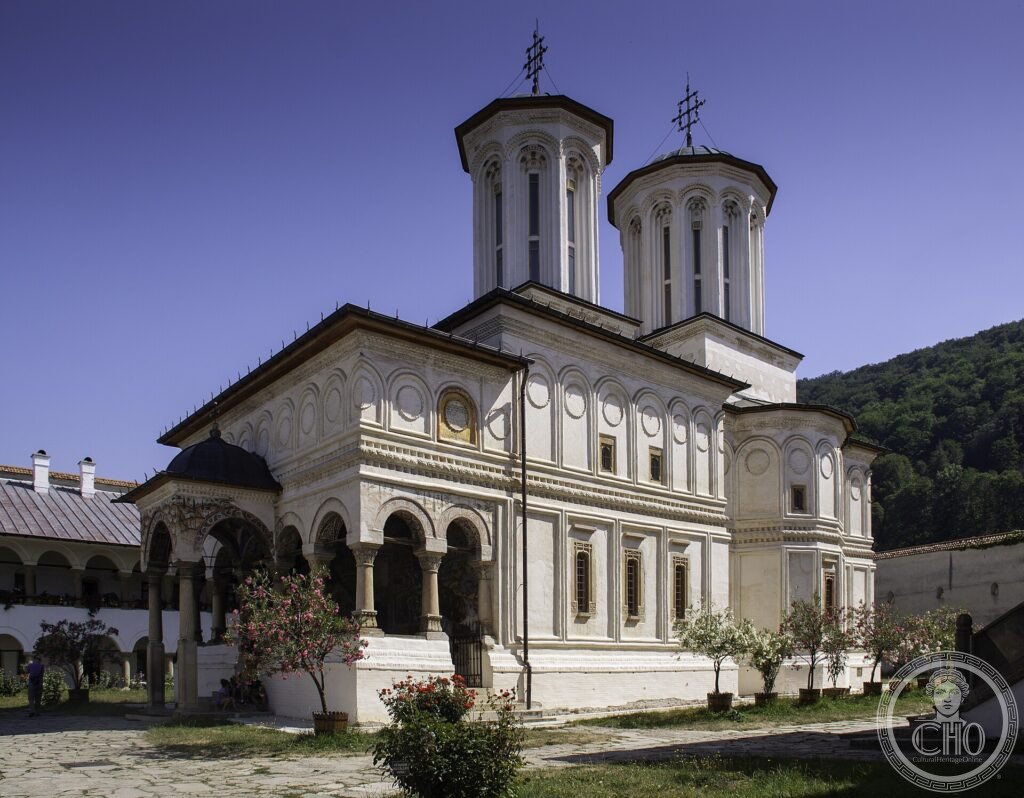
Fondato nel 1690 dal principe Constantin Brâncoveanu, Horezu è il capolavoro dello stile che porta il suo nome: il “brâncovenesc”, una raffinata sintesi di forme bizantine, ottomane e barocche. Equilibrio delle proporzioni, portici scolpiti, affreschi: qui nacque una scuola di pittura che segnò l’arte romena.
At a glance
The Monastery of Horezu, in Wallachia, was founded in 1690 by Prince Constantin Brâncoveanu and is the masterpiece of the “Brâncovenesc” style named after him — a refined synthesis of Byzantine, Ottoman and Western Baroque forms that flourished in late-17th-century Romania. Renowned for its purity of proportion, its richly carved stone and wood, and its frescoes, Horezu was also the seat of a celebrated school of mural and icon painting. It was inscribed by UNESCO in 1993.
Key facts
- UNESCO: World Heritage since 1993 (Monastery of Horezu)
- Founded: 1690 by Prince Constantin Brâncoveanu
- Brâncovenesc style: a blend of Byzantine, Ottoman and Baroque forms
- Carved porches: finely worked stone and wood
- School of painting: a renowned centre of mural and icon art
- Setting: in the foothills of the Carpathians in Wallachia
History
Constantin Brâncoveanu, prince of Wallachia at the turn of the 18th century, was a great patron of the arts, fostering a distinctive style that fused the Orthodox Byzantine tradition with elements drawn from the Ottoman world and the European Baroque. In 1690 he founded the monastery of Horezu as its supreme expression and his intended burial place.
The church, with its serene proportions, carved stone porch and frescoes, set the model for the Brâncovenesc style across Romania, and a school of painters trained here spread it further. Brâncoveanu himself was executed by the Ottomans in 1714; the monastery endured as the finest monument of his age.
What you see
The white church stands in a walled court, its façade balanced and calm, fronted by an open porch of carved stone columns and arches; twin towers rise above. Inside and on the porch, frescoes cover the walls, including a famous Last Judgement, in the refined manner of the Horezu school.
Around the church spread the monastery’s ranges, cells and smaller chapels, set against the green Carpathian foothills.
Practical information
- Monastery: active and open to visitors; modest dress required
- Time needed: 1 hour
- Note: the town of Horezu is also known for its painted ceramics
- Setting: in Vâlcea county, northern Oltenia
Getting there
Horezu Monastery is near the town of Horezu in Vâlcea county, Wallachia, southern Romania, in the Carpathian foothills. It is reached by road from Râmnicu Vâlcea. GPS: 45.1797° N, 24.0036° E.
Nearby
- Horezu town — famous for its traditional painted pottery
- Cozia Monastery — a medieval monastery on the Olt river
- Carpathian foothills — the hills and spas of Oltenia
Sources
- UNESCO World Heritage Centre — “Monastery of Horezu” (ref. 597)
- Ministry of Culture of Romania — official body
- Encyclopaedia Britannica — Constantin Brâncoveanu; Romanian art
Find it on the map
See this place and what’s around it →📷 Become a Cultural Heritage Online photographer
Share your photos of places: they stay published under your name as the author. The more they're seen, the more you get noticed — and soon a contest will reward the most appreciated photos.
Log in or sign up free to add a photoIs this page about you?
This page is read by travellers and heritage enthusiasts who find it on Google. Tell us how you are connected to this place and we will take it from there.