
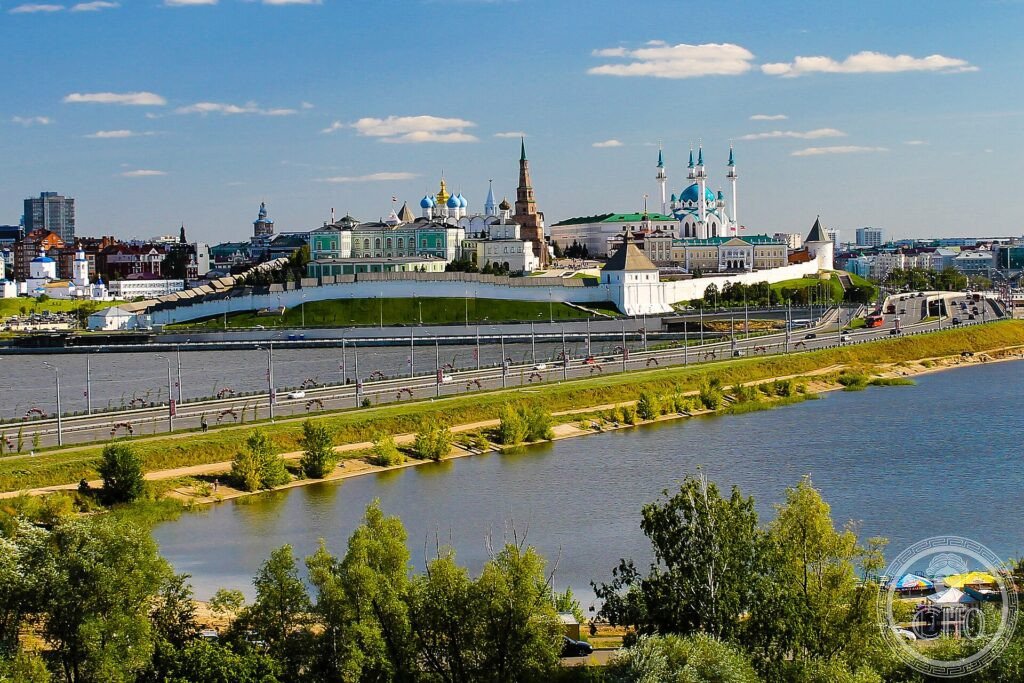
Capitale del Tatarstan, Kazan è la città dove si toccano due mondi: il khanato tataro musulmano e la Russia ortodossa che lo conquistò nel 1552. Il suo Cremlino bianco riassume questo incontro: la grande moschea Qol Sharif accanto alle cattedrali, e la misteriosa torre pendente di Söyembikä.
At a glance
The Kazan Kremlin, capital of the Republic of Tatarstan on the Volga, is a unique meeting point of Tatar Muslim and Russian Orthodox cultures. Built on the site of the citadel of the Khanate of Kazan, conquered by Ivan the Terrible in 1552, its white walls enclose Orthodox cathedrals, the leaning Söyembikä Tower and the great Qol Sharif Mosque, rebuilt in 2005 in memory of the one destroyed in the conquest. This layered fortress was inscribed by UNESCO in 2000.
Key facts
- UNESCO: World Heritage since 2000 (Historic and Architectural Complex of the Kazan Kremlin)
- Two faiths: Orthodox cathedrals and a great mosque within one fortress
- Qol Sharif Mosque: rebuilt in 2005, recalling the mosque destroyed in 1552
- Söyembikä Tower: a leaning brick tower, a symbol of the city
- Conquered 1552: the Khanate of Kazan fell to Ivan the Terrible
- Annunciation Cathedral: the 16th-century Orthodox cathedral within the walls
History
Kazan was the capital of a Tatar khanate, a Muslim successor state of the Golden Horde, with a citadel and the renowned Qol Sharif Mosque. In 1552 Ivan the Terrible besieged and took the city, destroying the mosque and absorbing the khanate into Russia; he raised Orthodox cathedrals and rebuilt the kremlin in white stone, employing the masters who also built St Basil’s in Moscow.
For centuries the kremlin embodied Russian rule over a Muslim land, with the enigmatic Söyembikä Tower at its heart. In the post-Soviet revival of Tatar identity, the Qol Sharif Mosque was rebuilt within the walls, opening in 2005, so that mosque and cathedral now stand side by side as a symbol of coexistence.
What you see
Within the white walls, the four blue minarets and dome of the rebuilt Qol Sharif Mosque rise opposite the Orthodox Annunciation Cathedral. Between them leans the brick Söyembikä Tower, tilting visibly, wrapped in legend. The governor’s palace and museums complete the ensemble, with views over the Volga and the Kazanka.
The contrast of mosque and cathedral within one fortress is the essence of the site.
Practical information
- Kremlin: the grounds are open; the mosque, cathedral and museums welcome visitors
- Time needed: half a day
- Note: modest dress to enter the mosque and cathedral
- Views: the walls overlook the river and the modern city
Getting there
Kazan is the capital of Tatarstan, on the Volga about 800 km east of Moscow. It has an international airport and high-speed trains from Moscow. The kremlin is in the city centre. GPS: 55.7989° N, 49.1056° E.
Nearby
- Bolgar — the medieval Tatar capital down the Volga, also UNESCO-listed
- Sviyazhsk — the island town and monastery, another UNESCO site
- The Volga — Russia’s great river, with cruises from Kazan
Sources
- UNESCO World Heritage Centre — “Historic and Architectural Complex of the Kazan Kremlin” (ref. 980)
- Kazan Kremlin Museum-Reserve — official body
- Encyclopaedia Britannica — Kazan
Find it on the map
See this place and what’s around it →📷 Become a Cultural Heritage Online photographer
Share your photos of places: they stay published under your name as the author. The more they're seen, the more you get noticed — and soon a contest will reward the most appreciated photos.
Log in or sign up free to add a photoIs this page about you?
This page is read by travellers and heritage enthusiasts who find it on Google. Tell us how you are connected to this place and we will take it from there.