
Prima di Mosca ci fu Novgorod: una delle più antiche città russe, capitale di una repubblica mercantile che si reggeva sull’assemblea cittadina. Dentro le mura del Cremlino sorge la cattedrale di Santa Sofia, la più antica chiesa di Russia, e intorno una corona di chiese medievali sopravvissute ai secoli.
At a glance
Veliky Novgorod, on the river Volkhov, is one of the oldest cities in Russia and a cradle of its statehood and culture. From the 12th century it was the centre of a powerful merchant republic, governed by a popular assembly, the veche, rather than by a prince alone. Within its kremlin, the Detinets, stands the Cathedral of St Sophia, the oldest church in Russia, and the city and its surroundings preserve an exceptional group of medieval churches and frescoes. They were inscribed by UNESCO in 1992.
Key facts
- UNESCO: World Heritage since 1992 (Historic Monuments of Novgorod and Surroundings)
- One of the oldest: a chief city of early Rus, traditionally founded in 859
- The Republic: a medieval merchant republic ruled by the veche assembly
- St Sophia Cathedral (1045–1050): the oldest surviving church in Russia
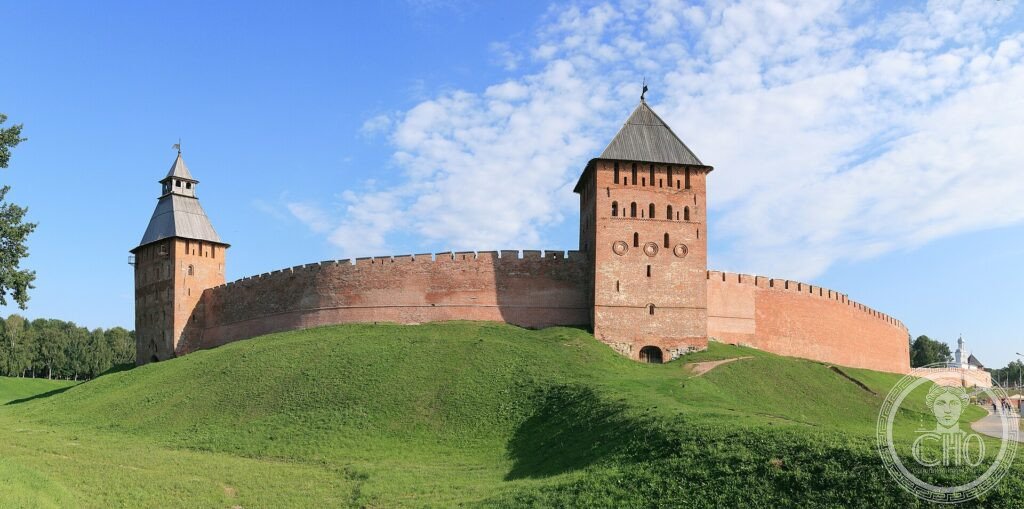
- The Detinets: the kremlin on the river, with red-brick walls and towers
- Frescoes: medieval wall paintings survive in churches around the city
History
Novgorod stands at the start of Russian history: tradition makes it the seat of Rurik, the Varangian prince invited to rule in 862, and it grew rich on trade along the routes linking the Baltic to Byzantium. From the 12th century it threw off princely control and became a republic, its decisions taken by the veche, the assembly of citizens, a rare experiment in medieval self-government.
As a member of the Hanseatic trade network it prospered, building stone churches whose walls were covered in frescoes. Spared the Mongol sack that devastated other Russian cities, it preserved an unbroken medieval heritage until it was absorbed by Moscow in 1478. War damage in the 20th century was followed by careful restoration.
What you see
The Detinets rises on its mound above the Volkhov, its red walls enclosing the Cathedral of St Sophia, whose grey domes and bronze doors date back almost a thousand years. The Millennium of Russia monument stands nearby, a bronze celebration of the nation’s history.
Across the river, the old marketplace and a cluster of medieval churches recall the merchant republic; in churches around the city, rare frescoes survive.
Practical information
- Kremlin: the Detinets grounds are open; the cathedral and museum charge entry
- Time needed: a full day for the kremlin, churches and museum
- Note: several outlying churches lie a short drive from the centre
- Museum: the Novgorod Museum holds icons and birch-bark documents
Getting there
Veliky Novgorod is in north-western Russia, between Moscow and St Petersburg. It is reached by train from St Petersburg (about 3 hours) or by road. GPS: 58.5217° N, 31.2756° E.
Nearby
- Yuriev Monastery — a medieval monastery on the river south of the city
- Vitoslavlitsy — an open-air museum of wooden architecture nearby
- St Petersburg — the imperial capital, about 3 hours north
Sources
- UNESCO World Heritage Centre — “Historic Monuments of Novgorod and Surroundings” (ref. 604)
- Novgorod State Museum-Reserve — official body
- Encyclopaedia Britannica — Veliky Novgorod
Find it on the map
See this place and what’s around it →📷 Become a Cultural Heritage Online photographer
Share your photos of places: they stay published under your name as the author. The more they're seen, the more you get noticed — and soon a contest will reward the most appreciated photos.
Log in or sign up free to add a photo