
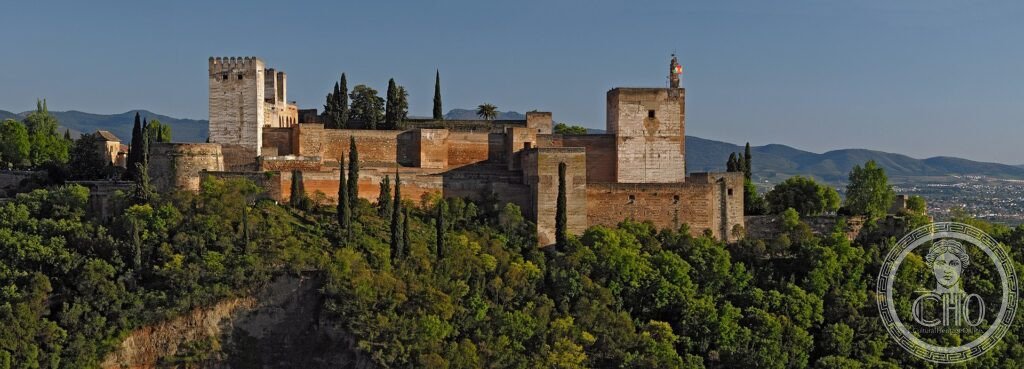
Granada (VIII–XV sec.): la città dell’Alhambra, l’Islam ultimo in Spagna
Granada ospita l’Alhambra, il capolavoro dell’arte islamica in Europa, ma è anche la città dove il cristianesimo riprese il potere dal regno Nasride. Dentro le mura, la moschea divenne cattedrale, il palazzo divenne museo. Granada è il luogo dove due civiltà si incontrano e si trasformano reciprocamente.
At a glance
Granada sits in the foothills of the Sierra Nevada in southern Spain, historically the seat of the last Islamic kingdom in Iberia—the Nasrid Emirate. The city’s name is synonymous with the Alhambra, the fortress-palace complex that stands above the city and represents the apex of Islamic art and architecture in medieval Europe. When the Nasrids fell to the Catholic Monarchs in 1492, the mosque became a cathedral, and Granada entered a new era. The old Moorish city survives in the Albaicín quarter, a labyrinth of narrow lanes and white-washed houses. The Alhambra and Albaicín were jointly inscribed by UNESCO in 1984 (Alhambra) and 1994 (Albaicín).
Key facts
- UNESCO: World Heritage 1984 (Alhambra); 1994 (Albaicín)
- Alhambra (14th–15th centuries): fortress-palace of the Nasrid emirs; pinnacle of Islamic medieval architecture in Spain
- Last Islamic kingdom: Granada was the capital of the Nasrid Emirate (1238–1492), the last Muslim state in medieval Iberia
- Fall to Catholic Monarchs: conquered by Isabella I and Ferdinand II in 1492, ending the Reconquista
- Cathedral (1518–1703): built atop the Great Mosque; one of Spain’s grandest Renaissance structures
- Albaicín: the medieval Moorish quarter with steep lanes, carmenes (white-washed houses with gardens), and historic mosques turned churches
History
Granada was founded as a major city during the Islamic period and became the seat of the Nasrid Emirate in 1238, the last surviving independent Muslim state in medieval Spain. For 254 years, under the Nasrid dynasty, Granada flourished as a centre of Islamic art, poetry, scholarship and craft. The Alhambra rose as both fortress and royal palace, its chambers decorated with intricate muqarnas (stalactite vaults), arabesques, and quotations from the Qur’an in calligraphy. In 1492, Granada fell to Isabella I and Ferdinand II, marking the end of the Reconquista. The mosque was converted into a cathedral, the emirate dissolved, and many Muslims were either expelled or forced to convert to Christianity.
Though Islam’s political power was broken, the city retained much of its Islamic character, especially in the Albaicín quarter, where the street plan, architecture and atmosphere still reflect its Moorish past.
What you see
The Alhambra rises above the city, its outer walls crenellated and set with towers. Inside, the Palacios Nazaríes (Nasrid Palaces) are a sequence of courts and chambers of breathtaking refinement: the Patio de los Leones (Court of Lions), the Hall of the Two Sisters, the Hall of the Abencerrages, each decorated with intricate stucco, tilework, carved wooden ceilings and fountains. The Generalife, a summer palace with gardens and pavilions, adjoins the Alhambra. Below, the Albaicín quarter is a maze of steep streets lined with whitewashed and ochre-coloured houses, some with small gardens (carmenes) hidden behind high walls. The Cathedral, with its grand Renaissance façade and cavernous interior, dominates the modern city centre.
Practical information
- Visiting the Alhambra: timed tickets required (book ahead); allow 3–4 hours minimum
- Albaicín: best explored on foot early in the morning; wear comfortable shoes (steep streets)
- Viewpoint: the Mirador de San Nicolás in the Albaicín offers the classic sunset view of the Alhambra
- Time needed: 1–2 days to see the Alhambra, Cathedral, Albaicín, and museums
Getting there
Granada is located in Andalusia in southern Spain, about 430 km south of Madrid (5–6 hours by car) and well-served by trains and buses. The city sits at 738 m altitude in the foothills of the Sierra Nevada. The Alhambra is on the hill to the north-west; the Cathedral and Albaicín are in the old city below. GPS: 37.1769° N, 3.5881° W.
Nearby
- Sierra Nevada — Spain’s highest mountains, with alpine scenery and hiking
- Córdoba — another Andalusian city with a great mosque-cathedral, about 250 km north
- Ronda — hilltop town in the mountains, about 100 km west
Sources
- UNESCO World Heritage Centre — “Alhambra, Generalife and Albaicín” (refs. 314, 1984 & 1994)
- Alhambra Official Guide — historical and architectural documentation
- Granada Turismo — city guide and cultural information
- Encyclopaedia Britannica — Granada, Spain & Islamic Iberia
Find it on the map
See this place and what’s around it →📷 Diventa un fotografo di Cultural Heritage Online
Condividi le tue foto dei luoghi: restano pubblicate con la tua firma come autore. Più vengono viste, più ti fai conoscere — e presto un concorso premierà le foto più apprezzate.
Accedi o registrati gratis per aggiungere una foto