
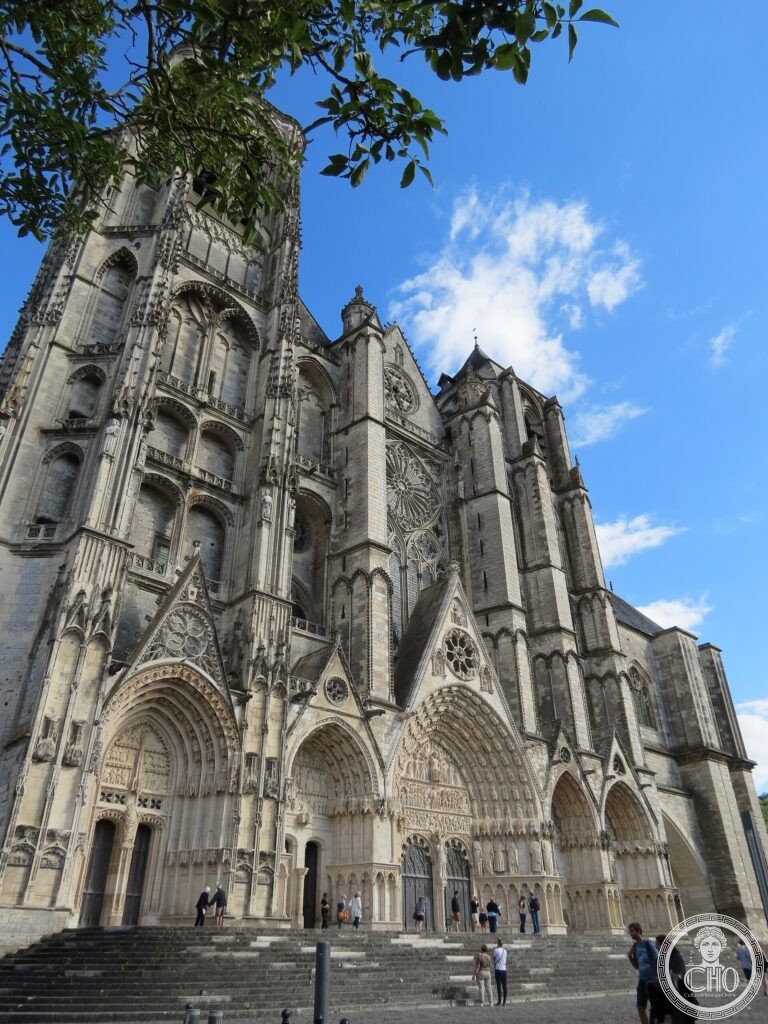
Niente transetto, niente bracci: la cattedrale di Bourges è un’unica grande nave che corre dritta verso l’abside, fiancheggiata da doppie navate digradanti come le ali di una cattedrale che spicca il volo. Sui cinque portali, un Giudizio Universale tra i più vivi del Medioevo; dentro, centottantatré vetrate del Duecento.
At a glance
The cathedral of Saint-Étienne at Bourges, in the Berry region south of the Loire, is one of the great masterpieces of Gothic architecture — and one of the most original. Built between 1195 and 1230, at the same time as Chartres, it dispenses with the usual transept: a single vast space, flanked by double aisles of stepped height, runs uninterrupted from the west front to the apse, giving a unique sense of unity and soaring breadth. Its five sculpted portals, its 13th-century stained glass and the harmony of its design earned it inscription by UNESCO in 1992.
Key facts
- UNESCO: World Heritage since 1992
- Built 1195–1230: begun by Archbishop Henri de Sully at the chevet; High Gothic, contemporary with Chartres
- No transept: a single continuous nave with double side-aisles of graded height — the pyramidal cross-section is the cathedral’s signature, giving exceptional spatial unity
- Five portals: the west front has five sculpted doorways beneath two unequal towers; the central tympanum is a celebrated Last Judgment, vivid and human
- Stained glass: 183 windows, most from the 13th century, peopled by some 2,450 figures — a true encyclopaedia of medieval glass
- Crypt & tomb: a large lower church (crypt) holds the tomb effigy of Duke Jean de Berry, the great medieval patron of the arts
History
Bourges was the seat of an important archbishopric, primate of Aquitaine, and in 1195 Archbishop Henri de Sully launched a cathedral that would rival the new churches of the north. Rather than copy Chartres, his masters devised a daring alternative: no transept, and instead a five-aisled section that steps up toward the central vessel, so that the inner aisles are themselves tall enough for their own clerestory windows. The result is a building of extraordinary height and light, finished in barely a generation and consecrated in 1324.
Bourges later flourished under Duke Jean de Berry and as the “capital” of Charles VII during the darkest years of the Hundred Years’ War, when much of France was held by the English. The cathedral survived the centuries with its medieval glass largely intact, and remains the dominant monument of the Berry.
What you see
The west front spreads wide with its five deep portals: the central one carved with the Last Judgment, where the dead rise from their tombs and the blessed and the damned are sorted with a directness that still startles. Inside, the absence of a transept lets the eye run the full length of the church; the double aisles climb in steps, and light pours through the great 13th-century windows of the ambulatory — deep reds and blues telling the lives of the saints, the parables and the trades of the city.
Below the choir, the spacious crypt (built to level the sloping ground) shelters the recumbent effigy of Jean de Berry and fragments of the medieval rood screen; the climb up the north tower gives a view over the rooftops of the old town and the marshes of the Yèvre.
Practical information
- Visiting: the cathedral is free; the crypt and tower climb are ticketed (Centre des monuments nationaux)
- Nearby in town: the Palais Jacques-Cœur, one of the finest Gothic mansions in France
- Time needed: 1–1.5 hours, more with crypt and tower
Getting there
Bourges is in the Cher, in the centre of France. Direct trains from Paris-Austerlitz reach Bourges in about 2 hours; the cathedral is a short walk from the station. GPS: 47.0822° N, 2.3992° E.
Nearby
- Palais Jacques-Cœur — the 15th-century mansion of Charles VII’s merchant-financier, a Gothic masterpiece
- Marais de Bourges — the network of market-garden canals below the cathedral
- Noirlac — a well-preserved Cistercian abbey to the south
Sources
- UNESCO World Heritage Centre — “Bourges Cathedral” (ref. 635)
- Cathédrale de Bourges / Centre des monuments nationaux (bourges-cathedrale.fr)
- Encyclopaedia Britannica — Bourges Cathedral
Find it on the map
See this place and what’s around it →📷 Become a Cultural Heritage Online photographer
Share your photos of places: they stay published under your name as the author. The more they're seen, the more you get noticed — and soon a contest will reward the most appreciated photos.
Log in or sign up free to add a photoIs this page about you?
This page is read by travellers and heritage enthusiasts who find it on Google. Tell us how you are connected to this place and we will take it from there.