
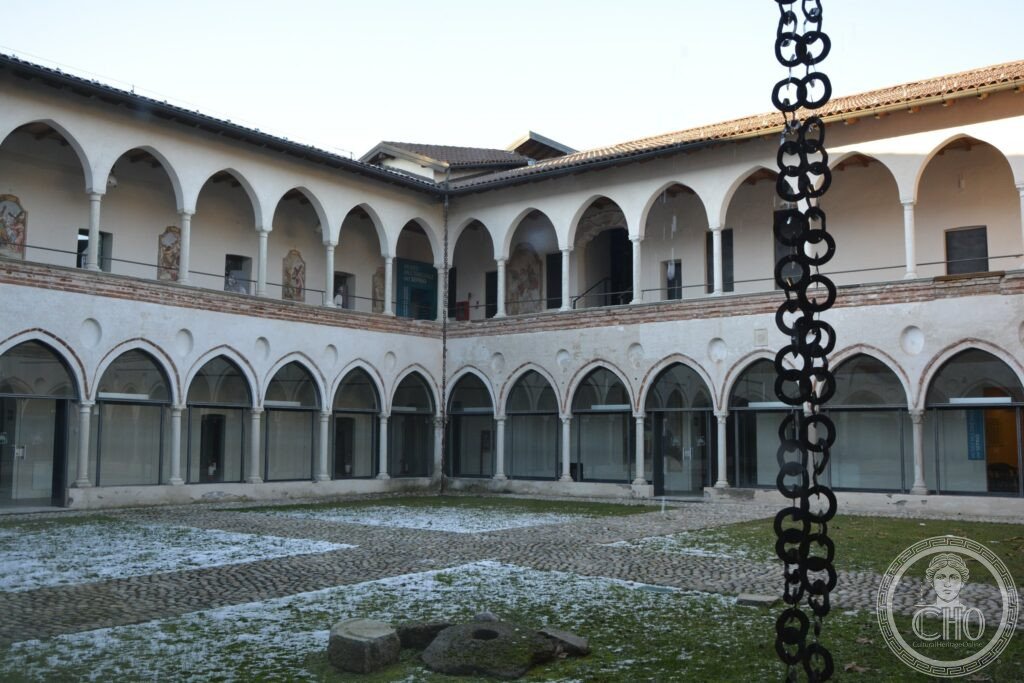
La tradizione vuole che lo abbia fondato nel 737 una nobile longobarda, Manigunda, sciogliendo un voto. Per oltre mille anni qui hanno governato le monache benedettine; oggi il chiostro restaurato è un museo, e la sorpresa è la pittura: un’Assunzione firmata da Aurelio Luini, una Via Crucis dipinta a finto quadro da Biagio Bellotti e una stanza quattrocentesca tappezzata di fiori che nasconde una sirena bicaudata.
At a glance
The Monastero di Santa Maria Assunta sits in the centre of Cairate, in the Olona valley of the province of Varese. For more than a thousand years — from its traditional foundation in the 8th century to its suppression in 1799 — it was a community of Benedictine nuns who administered the lands around them. Today the restored complex is a municipal museum, and its great surprise is the painting: a signed Assumption of the Virgin by Aurelio Luini, son of Bernardino; a trompe-l’oeil Via Crucis by Biagio Bellotti; and, in a small private room, a 15th-century “wall herbarium” of painted flowers that conceals a two-tailed siren. Beneath it all lie the remains of a Roman-era villa.
Key facts
- Founded: by tradition in 737 AD by the Lombard noblewoman Manigunda, during the reign of King Liutprand — a founding legend, not a documented date
- Community: Benedictine nuns, subject to the Bishop of Pavia; the earliest documentary record is a papal bull of John VIII in 877
- Suppressed: on 4 February 1799 under Napoleonic law, with 19 choir nuns and 10 lay sisters; the Comune di Cairate acquired the monastic core in 1976
- Architecture: a 15th-century lower cloister portico and an 18th-century upper level; the church of Santa Maria Assunta in its 16th-century form, built in Viggiù and Saltrio sandstone
- Today: restored by Studio Albini into a museum with an archaeological and art-historical route, over the remains of a Roman villa
History
Tradition holds that Manigunda, a Lombard noblewoman, founded the monastery in 737 to fulfil a vow made during a grave illness, endowing it with her lands at Cairate. Historians treat the date and the figure as legend, but the house is securely documented from the 9th century, when a bull of Pope John VIII (877) placed it under the Bishop of Pavia — a jurisdiction it kept until the end. For a millennium it remained an enclosed community of Benedictine nuns, drawn largely from the leading families of the region.
After the Council of Trent the church was remodelled to monastic norms: reduced toward a single nave, with a partition wall separating the nuns’ enclosure from the part open to the faithful. The community was suppressed on 4 February 1799 under Napoleonic legislation, and its property passed into private hands and decay. The Comune di Cairate bought the monastic core in 1976; a restoration directed by Studio Albini later turned the complex into a museum, opening an archaeological route through the Roman and early-Christian layers beneath the cloister.
What you see
The cloister is the spine of the visit: a lower portico of white 15th-century columns and an 18th-century upper loggia, its plan a slight trapezoid betraying its building phases. The painting is the reason to come. On a wall blocking an older arch, Aurelio Luini signed and dated his Assumption of the Virgin — “Aurelio Luini milanese 1560” — commissioned by Abbess Antonia Castiglioni; it was detached and reset in 1979. Along the upper cloister, Biagio Bellotti (1714–1789) frescoed fourteen Stations of the Cross as trompe-l’oeil framed pictures, and added figures of Saints Benedict and Scholastica below.
The strangest room is the so-called Stanza dei Fiori, probably the abbess’s private parlour: a wall painted like a herbarium of flowers over a faux-marble dado, with a donor portrait and a two-tailed siren, dated by an inscription on a painted carnation — “Ego Nicholaus de Cairate scripsi 1470.” A further apse cycle, God the Father among the Evangelists (c. 1482–1501), and the archaeological route — Roman funerary inscriptions, early-Christian mosaics, monastic burials — complete the museum.
Practical information
- Visiting: the monastery is a museum run by the Comune di Cairate; check the comune website for current opening days and hours
- Address: Via Molina, Cairate (VA)
- Time needed: about one hour for the cloister, frescoes and archaeological route
Getting there
Cairate lies in the Olona valley, about 15 km south of Varese and close to Busto Arsizio and Castellanza. By car it is reached from the A8 Milan–Varese motorway; the nearest railway station is Castellanza. GPS: 45.6920° N, 8.8737° E.
Nearby
- Castiglione Olona — a Renaissance “corner of Tuscany” with the Collegiata and Baptistery frescoed by Masolino da Panicale
- Castelseprio and Torba — UNESCO-listed Lombard sites; Santa Maria foris portas and the FAI monastery of Torba, about 10 km away
- Varese — the Sacro Monte (UNESCO) and the lake town, 15 km north
Sources
- Lombardia Beni Culturali (Regione Lombardia) — SIRBeC architecture and artwork schede on the monastery and its fresco cycles
- Comune di Cairate — monastery pages (comune.cairate.va.it)
- Pro Loco Cairate — “Il Monastero di Santa Maria Assunta”
- Provincia di Varese / MiC — museum catalogue (ed. V. Mariotti and A. Guglielmotti)
Find it on the map
See this place and what’s around it →📷 Become a Cultural Heritage Online photographer
Share your photos of places: they stay published under your name as the author. The more they're seen, the more you get noticed — and soon a contest will reward the most appreciated photos.
Log in or sign up free to add a photoDo you manage this place?
This page is read by travellers and heritage enthusiasts who find it on Google. Keep it accurate — and make it work for you. Free for non-profit heritage institutions.