
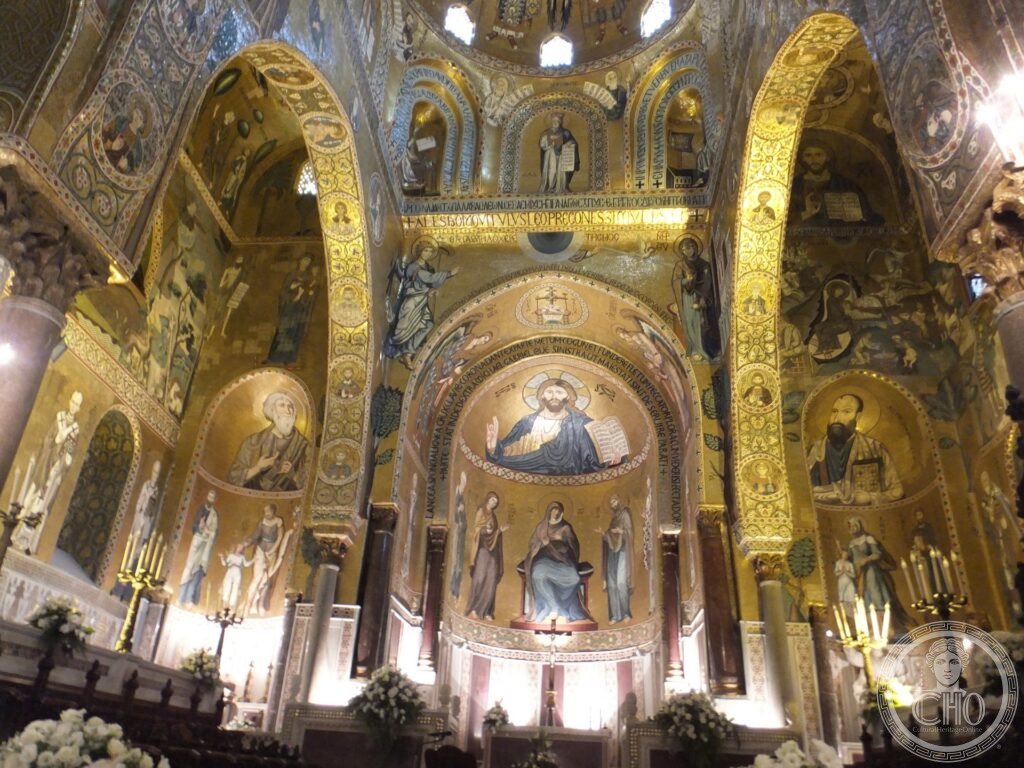
The Cappella Palatina — the royal chapel of the Norman kings of Sicily, built between 1132 and 1143 within the Palazzo dei Normanni in Palermo by order of Roger II — is the single space in the world that most completely preserves the synthesis of Byzantine, Arab-Islamic, and Latin Norman art that made 12th-century Sicily the most culturally syncretic kingdom in Europe: its Byzantine mosaics, its Fatimid muqarnas wooden ceiling (unique in the entire Christian world), and its cosmati marble floor exist not as competing systems but as three elements of a single royal programme of visual magnificence.
At a glance
The Cappella Palatina (province of Palermo, Sicilia; UNESCO 2015, ref. 1487) is one of nine components of the serial inscription “Arab-Norman Palermo and the Cathedral Churches of Cefalù and Monreale.” The inscription recognizes the unique cultural synthesis of the Norman Kingdom of Sicily (1130-1194) under Roger II, William I, and William II, who commissioned buildings that integrated Byzantine mosaic technique, Arab-Fatimid architectural ornament and spatial planning, and Latin Norman Romanesque structure into a hybrid style found nowhere else in Europe. The Cappella Palatina is the most complete expression of this synthesis: its 6,340 square metres of gold-ground Byzantine mosaic, its 16 m-high muqarnas ceiling (the largest collection of medieval Fatimid painting on wood surviving anywhere in the world), and its inlaid marble floors and chancel screens create an interior of overwhelming visual richness in a relatively small space (33 m × 13 m).
Key facts
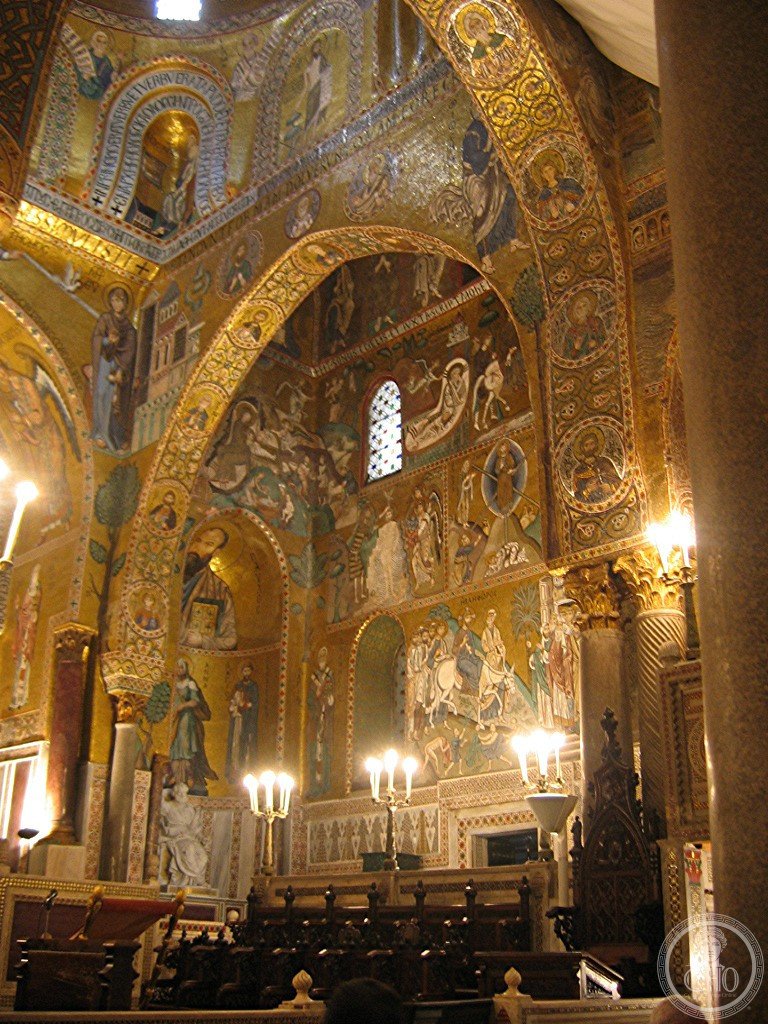
- I mosaici dorati (XII sec., 6.340 m²): The mosaics of the Cappella Palatina (by Byzantine mosaicists working in gold tessera technique) cover 6,340 square metres of the nave walls, apse, and arch soffits; the programme includes the Christ Pantocrator in the apse dome (the standard Byzantine formulaic image in the eastern apses), the New Testament Christological cycle on the nave walls (Annunciation, Nativity, Baptism, Transfiguration, Raising of Lazarus, Entry into Jerusalem), and the Old Testament cycle on the upper nave (scenes from Genesis and Exodus); the gold tessera technique (setting individual gold-coated glass pieces at a slight angle to reflect candlelight from multiple directions) makes the mosaic surfaces shimmer with light in a way that static photographs cannot replicate
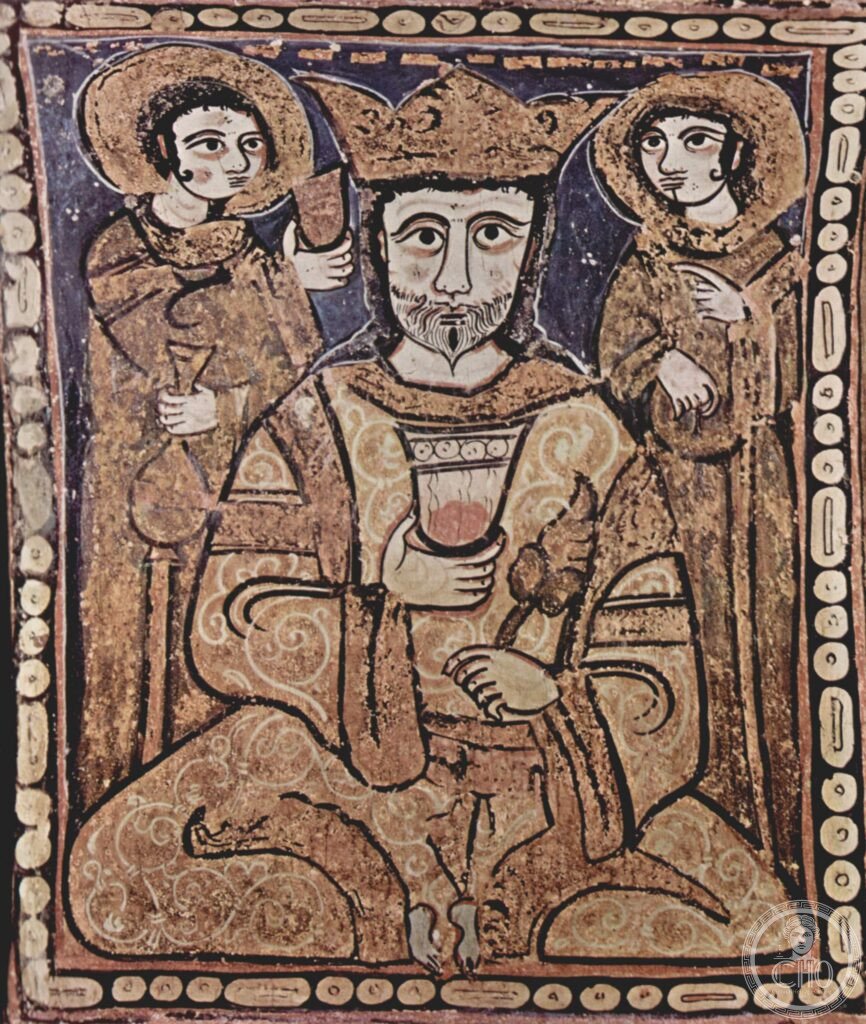
- Il soffitto muqarnas (XII sec., tecnica arabo-fatimide): The wooden muqarnas ceiling of the nave is the most extraordinary element of the Cappella Palatina: muqarnas is a stalactite-form ornamental vault used in Islamic architecture; the Cappella Palatina ceiling (approximately 16 m high, in the central nave) is constructed from carved and fitted wooden panels forming a stalactite dome with 8-pointed star compartments at the apex; the painted decoration inside the wooden cells depicts scenes from courtly and daily life of the 12th-century Norman-Arab court (feasting, hunting, musicians, dancers, astrologers, animals) in a frankly secular pictorial programme executed in the Fatimid style — making this the only surviving example of Fatimid court painting in existence (all equivalent paintings were destroyed in Egypt during the Crusader period or later)
- Roger II e il regno arabo-normanno (1130-1166): Roger II of Sicily (1095-1154) was crowned King of Sicily in 1130 by the antipope Anacletus II; his court at Palermo was the most multilingual and multicultural in Europe: he employed Arab geographers (including Muhammad al-Idrisi, who produced the most accurate world map of the 12th century for Roger in 1154), Byzantine artists, Latin clergymen, and Norman soldiers simultaneously; he spoke Arabic and Greek as well as Norman French and Latin; the silver robe he was crowned in (now in the Vienna Treasury) is embroidered with Arabic text in Kufic script praising its maker (a Muslim craftsman)
- UNESCO: 2015, rif. 1487
- GPS: 38.1117, 13.3521 — Google Maps (Cappella Palatina, Palazzo dei Normanni, Palermo)
History
The Cappella Palatina was begun in 1132 by Roger II and consecrated on April 28, 1143; the Palazzo dei Normanni within which it stands is built over a 9th-century Arab citadel, which was itself built over a Roman building (3rd century BCE). After the Norman kingdom passed to the Hohenstaufen (1194) and then to the Angevins (1266) and Aragonese (1282), the Palazzo dei Normanni continued to serve as the royal palace and the Cappella Palatina as the royal chapel; the Norman mosaics were partially restored in the 17th and 18th centuries. The building is now the seat of the Sicilian Regional Assembly (the Assemblea Regionale Siciliana meets in the former royal hall above the Cappella Palatina), which makes it a living building rather than a museum.
What you see
The Cappella Palatina is in the Palazzo dei Normanni, entered from Piazza del Parlamento. The visit circuit (45-90 min) includes: the main chapel (the nave with the muqarnas ceiling — look up immediately on entering; the gold mosaic apse with the Pantocrator; the side aisles with the lower mosaic cycles; the porphyry throne of Roger II on the north wall); access to the adjacent Sala di Ruggero (the private royal study with Arabic geometric mosaic floors and Byzantine hunt scenes — a secular counterpart to the Cappella’s sacred programme); optionally the Royal Apartments (Appartamenti Reali, available on some days when the Regional Assembly is not in session, with advance booking). The best light for the mosaics is mid-morning (south-facing windows); candlelight mass (occasional, check calendar) is the only way to see the muqarnas ceiling as it was intended to be seen.
Gallery
Practical information
- Cappella Palatina (Palazzo dei Normanni): Piazza del Parlamento 1, Palermo; open Monday-Saturday 08:15-17:40 and Sunday 08:15-13:00 (Regional Assembly days may restrict access — check online before visiting); admission ~€12 (includes the Sala di Ruggero and the Terrazzo). Photography inside is PERMITTED without flash. Advance booking is strongly recommended in peak season (the chapel capacity is limited to 100 visitors at a time).
- Audioguide: Available in Italian, English, French, German, Spanish, and Japanese (~€3 extra); covers the main mosaic scenes and the muqarnas programme; strongly recommended for full comprehension of the iconographic programme.
- Combined ticket: The Palazzo dei Normanni combined ticket with the Cathedral of Monreale is available at the ticket office; allows both sites on the same day (a full day is needed for the combination).
Getting there
Cappella Palatina, Palazzo dei Normanni, Piazza del Parlamento 1, Palermo (PA), Sicilia. GPS 38.1117, 13.3521. By air: Aeroporto di Palermo-Falcone Borsellino (PMO), 35 km from city centre (Trinacria Express train to Palermo Centrale, 45 min, then bus or taxi to Palazzo dei Normanni); direct flights from most Italian airports and European cities. By train: Trenitalia from Messina (3h+ via Catania or 2h30 via north coast); from Rome (Palermo Centrale, 12h overnight Intercity; or fly and take train from airport). By bus from Palermo Centrale: bus 109 or 110 to Piazza del Parlamento (10 min).
Nearby
- Cattedrale di Palermo — 500 m; the Cathedral of Palermo (12th-18th century Arab-Norman-Baroque hybrid), with the Royal Tombs of the Norman kings (Roger II, Frederick II, Constance of Aragon) in porphyry sarcophagi; part of the Arab-Norman UNESCO inscription (ref. 1487)
- Mercato del Capo e Vucciria — 1 km east; the two historic street markets of Palermo (the largest surviving street markets in Italy after the decline of the Rialto market), with the street food tradition of sfincione (Sicilian pizza), pani ca meusa (spleen sandwich), and arancine; the Vucciria market is now primarily an evening drinking destination
- Monreale — 8 km south-west; (CHO card: Monreale UNESCO 2015); the Norman cathedral (1172-1189, William II) with the most extensive Byzantine mosaic programme in the world outside Hagia Sophia (6,340 m²), and the Benedictine cloister with 228 twin columns of carved marble
Sources
- UNESCO: whc.unesco.org/en/list/1487
- Wikipedia EN: Cappella Palatina
- Demus, Otto: The Mosaics of Norman Sicily, London: Routledge and Kegan Paul, 1950
- Fondazione Federico II: federicosecondo.org
Find it on the map
See this place and what’s around it →📷 Become a Cultural Heritage Online photographer
Share your photos of places: they stay published under your name as the author. The more they're seen, the more you get noticed — and soon a contest will reward the most appreciated photos.
Log in or sign up free to add a photoIs this page about you?
This page is read by travellers and heritage enthusiasts who find it on Google. Tell us how you are connected to this place and we will take it from there.