
Cattedrale di Monreale (1172-1189): il Più Grande Ciclo di Mosaici Medievali del Mondo Cristiano e il Chiostro Benedettino con 228 Colonnine Istoriate (UNESCO 2015)
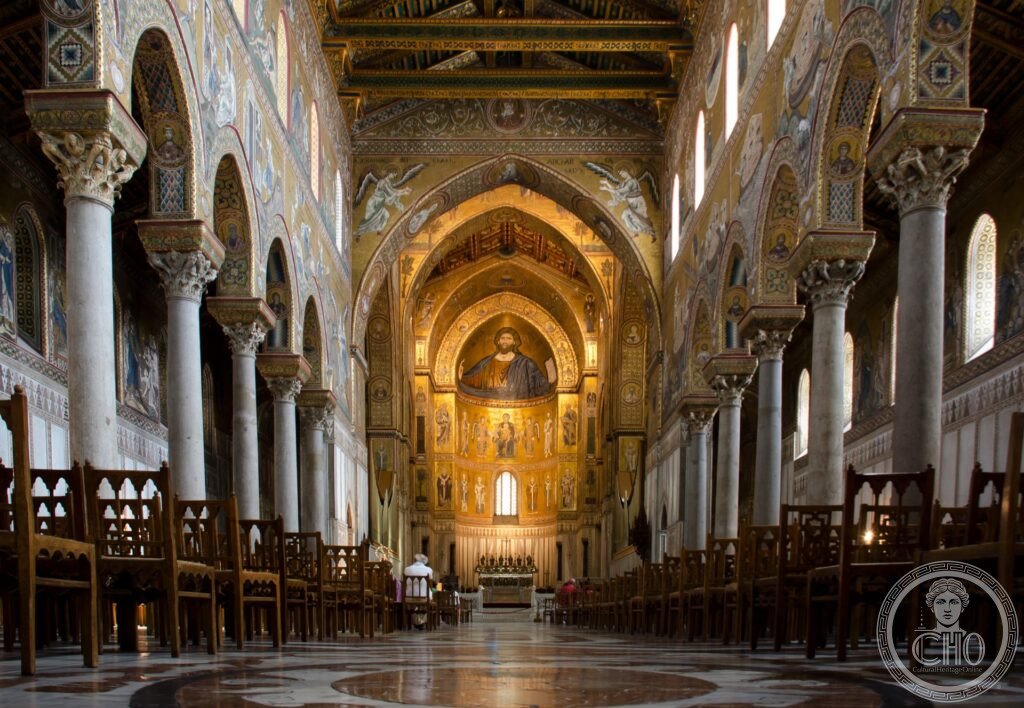
The Cathedral of Monreale — built in just 17 years (1172-1189) on a hillside above Palermo by William II of Sicily as both a royal mausoleum and a deliberate challenge to the power of the Archbishop of Palermo — contains, in its nave, transepts, and apse, the largest single programme of Byzantine-style gold mosaic in the Christian world: 6,340 square metres of narrative iconography that tells the entire Bible in pictures on a scale that dwarfs any comparable programme in Constantinople, Venice, or Rome.
At a glance
The Cathedral of Monreale (province of Palermo, Sicilia; UNESCO 2015, ref. 1487) is one of nine components of the serial inscription “Arab-Norman Palermo and the Cathedral Churches of Cefalù and Monreale.” The Monreale cathedral is the most ambitious building project of the Norman Kingdom of Sicily: built from 1172 to 1189 under William II (William the Good), it combines: (1) a large Latin cruciform basilica plan (3 aisles, 18 ancient columns of granite and marble reused from earlier buildings); (2) the largest programme of Byzantine-style gold mosaic in the entire Christian world (6,340 m², covering virtually every interior wall surface — nave, transepts, apse, choir); (3) a Benedictine cloister (adjacent to the south side of the cathedral) with 228 twin marble columns, each with a different carved capital and many with polychrome mosaic intarsia decoration on the column shafts — the most extensive decorative column programme in medieval Europe.
Key facts
- Il ciclo musivo (6.340 m², XII sec.): The mosaic programme of Monreale is the most extensive in the Christian world: 6,340 m² of gold tessera mosaic covers the nave (Old Testament cycle, from the Creation to Joseph in Egypt — 42 scenes in 2 registers on the nave walls), the transepts (New Testament cycle — 20 scenes), the choir and chancel area (Christ Pantocrator in the apse, 13 m high; Virgin Odigitria enthroned; the Apostles; the Saints; the Norman royal donors — William II receiving the crown directly from Christ, a unique iconographic assertion of divine kingship bypassing papal authority), and the ceiling soffits; the total narrative programme covers more episodes than any other medieval church and was apparently planned as a visual encyclopedia of the Bible for a largely non-literate congregation
- Il Cristo Pantocrator (abside, ~13 m): The apse mosaic of the Monreale Cathedral is dominated by the “Cristo Pantocrator” (Christ Ruler of All) — the standard Byzantine image of Christ enthroned as cosmic judge, rendered at Monreale in gold tessera at a scale of approximately 13 m from crown to waist (the apse arch is 20 m wide); the Pantocrator of Monreale is the largest mosaic image of Christ in the Christian world; it was designed to be visible from the main entrance of the cathedral (70 m away) as the first and dominant image seen on entering; the inscription in the open Gospel book reads “EGO SUM LUX MUNDI” (I am the Light of the World, John 8:12) in Greek and Latin
- Il chiostro benedettino (228 colonnine, XII sec.): The cloister (chiostro) of the Benedictine monastery adjacent to the south side of the cathedral is one of the masterpieces of medieval decorative carving: 228 twin columns (each pair of slender marble columns is unique) supporting pointed arches in the Arab-Norman style; of the 228 columns, 96 have shafts decorated with polychrome intarsia (gold, red, and black Cosmati mosaic inlay); the capitals of the 228 columns are each carved differently with biblical scenes, human figures, animals, and abstract ornament; in the south-west corner of the cloister, the “Fountain Column” — a single palm-tree column with water cascading from its capital through a lion’s head — supplies the cloister garden
- UNESCO: 2015, rif. 1487
- GPS: 38.0820, 13.2910 — Google Maps (Cattedrale di Monreale)
History
The Cathedral of Monreale was founded by William II in 1172 with the deliberate intent of creating a new archbishopric separate from (and superior in prestige to) the existing Archdiocese of Palermo, which was controlled by Gualtiero Offamiglio (Walter of the Mill), William’s political enemy. By founding his own cathedral at Monreale and filling it with monks of the new Benedictine monastery (not the secular canons of Palermo), William was creating a personal royal church outside the established ecclesiastical power structure. The building was consecrated in 1189, only 17 years after its founding — an extraordinary speed that required the simultaneous employment of the largest workshop of Byzantine mosaicists, Arab-Norman stonemasons, and Benedictine craftsmen assembled in 12th-century Sicily. The cathedral was plundered by the mercenaries of Emperor Henry VI in 1194; the mosaic programme was subsequently restored and expanded in the 13th and 14th centuries. A fire in 1811 destroyed parts of the nave ceiling; the nave was restored in the 19th century.
What you see
The Monreale cathedral visit (allow 2 hours minimum) begins at the bronze doors of the main west facade (the left door, by Bonanno da Pisa, 1186, has 42 panels of Old Testament scenes in relief bronze — the “Pisan doors”; the right door, by Barisano da Trani, also 12th century, has 28 panels; both are among the most significant medieval bronze door programmes in existence). Inside: walk slowly down the nave (north side first, then south) reading the Old Testament cycle on the nave walls (created scenes in 2 registers; English-language identification numbers correspond to the museum booklet available at the entrance); the apse with the Pantocrator is the climax — approach slowly toward the chancel step for the full impact of the 13 m figure against gold ground. The cloister (separate entrance, south side of the cathedral, ticket ~€6): the full circuit of the 228 columns takes 30-45 min; the Fountain Column in the south-west corner is the sculptural highlight.
Gallery
Practical information
- Cattedrale di Monreale: Piazza Guglielmo II, Monreale (PA); open daily 08:30-12:30 and 14:30-17:00 (winter) and 08:30-17:30 (summer); admission to the cathedral ~€4; to the terrace (terrazze, roof view) ~€3; to the cloister ~€6 (separate entrance south side); treasury ~€2. Photography is PERMITTED without flash inside (the management actively welcomes documentation of the mosaics for cultural purposes). Dress code: shoulders and knees covered; wraps available at entrance.
- Consiglio orario: Morning (8:30-11:00) before the tour groups arrive for the best experience of the mosaics; midday light through the nave windows (south-facing) illuminates the gold ground of the north nave mosaics most effectively.
Getting there
Cattedrale di Monreale, Piazza Guglielmo II, Monreale (PA), Sicilia. GPS 38.0820, 13.2910. From Palermo: bus 389 from Piazza Indipendenza (at the Palazzo dei Normanni, adjacent to the Cappella Palatina) to Monreale (30 min, every 30-40 min; a combined Cappella Palatina + Monreale visit on the same day uses both the bus and the combined ticket). By car: from Palermo city centre (A19 or Corso Calatafimi), 8 km south-west (20 min); parking in Piazza Guglielmo II or on Via Palermo (200 m from the cathedral entrance).
Nearby
- Cappella Palatina, Palermo — 8 km north-east; (CHO card: Cappella Palatina UNESCO 2015); the royal chapel with the unique muqarnas wooden ceiling, Roger II’s personal commission within the Palazzo dei Normanni
- Cefalù Cathedral — 70 km east; the third component of the Arab-Norman UNESCO inscription (ref. 1487); the Norman cathedral (1131-1240) with the earliest surviving Christ Pantocrator mosaic in the original Norman programme (1148, in the main apse) and the extraordinary Romanesque facade above the beach
- Villa Romana del Casale, Piazza Armerina — 130 km south-east; the late Roman imperial hunting villa (3rd-4th century CE) with 3,500 m² of polychrome floor mosaic; UNESCO 1997
Sources
- UNESCO: whc.unesco.org/en/list/1487
- Wikipedia EN: Monreale Cathedral
- Demus, Otto: The Mosaics of Norman Sicily, London, 1950
- Arcidiocesi di Monreale: cattedraledimonreale.it
Find it on the map
See this place and what’s around it →📷 Diventa un fotografo di Cultural Heritage Online
Condividi le tue foto dei luoghi: restano pubblicate con la tua firma come autore. Più vengono viste, più ti fai conoscere — e presto un concorso premierà le foto più apprezzate.
Accedi o registrati gratis per aggiungere una foto