
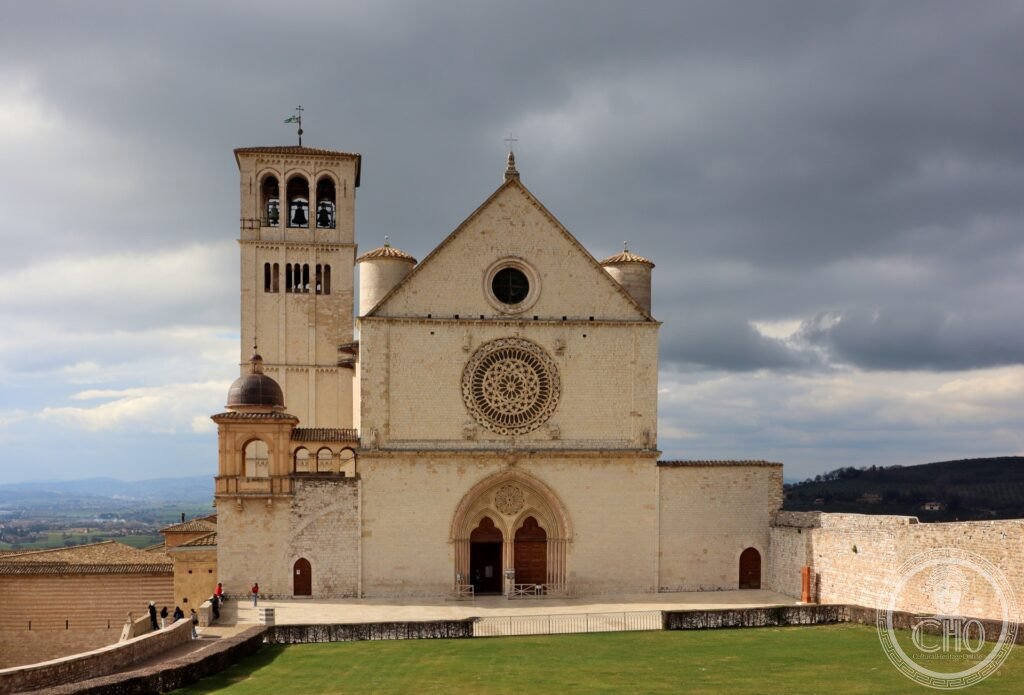
The Basilica of San Francesco in Assisi — built with unseemly haste in the two decades immediately following Francis’s death in 1226, on a hill outside the city walls where convicted criminals were hanged, with a building programme that Francis himself would have opposed as contrary to the ideal of poverty — contains, in its upper nave, the fresco cycle by Giotto (c.1267-1337) that effectively invented the visual language of Western narrative painting: 28 scenes of the Life of Saint Francis in which the figures, for the first time in medieval art, stand in physical space, cast shadows, and register emotions recognizable as human.
At a glance
Assisi (province of Perugia, Umbria; UNESCO 2000, ref. 990) was inscribed as part of the property “Assisi, the Basilica of San Francesco and Other Franciscan Sites.” The inscription covers not only the double basilica (Upper and Lower, built 1228-1253) but also the Eremo delle Carceri (the hermitage in the Monte Subasio forest where Francis retreated for prayer, 4 km from Assisi), the Convento di San Damiano (the church-ruin where Francis heard the voice commanding him to “repair my church,” 1 km from Assisi), the Porziuncola at Santa Maria degli Angeli (the tiny chapel in the plain below Assisi where the Franciscan Order was born, now enclosed within a large 16th-century basilica), and the medieval city of Assisi itself (with the Roman forum beneath the Piazza del Comune, the Rocca Maggiore, and the 13th-15th century Gothic and Romanesque churches).
Key facts
- Il Ciclo di Giotto nella Basilica Superiore (1295-1305, 28 scene): The fresco cycle of the Life of Saint Francis (Storie di San Francesco) in the upper nave of the Basilica Superiore is the most important single commission in the history of Western painting: 28 narrative scenes (each approximately 2.7 m × 2.3 m) painted by Giotto and his workshop between approximately 1295 and 1305 on the lower walls of the four-bay nave; the significance is not primarily iconographic (the cycle illustrates well-known episodes from Bonaventure’s Legenda Maior) but formally: for the first time in medieval painting, the figures exist in convincing three-dimensional space (with recession, foreshortening, and cast shadows); register emotions through body language and facial expression (not just iconographic gestures); and are placed in architectural settings that recede in depth (not in gold-ground flatness). These were the innovations that Cimabue had begun, Giotto systematized, and Masaccio, Leonardo, and Raphael inherited
- La Basilica Inferiore (costruita 1228-1239): Cimabue, Martini, Lorenzetti: The Lower Basilica (below the Upper, connected by a double staircase within the facade) was the first church to be built (1228-1239) and is architecturally darker and more Romanesque than the Gothic Upper Basilica; its walls and vaults are covered with frescoes by Cimabue (the “Crucifixion” in the right transept, c.1280), Simone Martini (the Life of St. Martin cycle in the Chapel of St. Martin, 1312-1317), and Pietro and Ambrogio Lorenzetti (the Life of the Virgin and scenes from the Passion, south transept, c.1310-1320); the Lower Basilica also contains the tomb of Saint Francis (in the crypt, which is accessible from the Lower Basilica through a passage that was only discovered and opened in 1818)
- La Porziuncola a Santa Maria degli Angeli (III sec. – oggi): The “Porziuncula” or “little portion” is a tiny stone chapel (5 m × 9 m) that Francis rebuilt with his own hands in 1208-1209 after hearing the Gospel call to “Go, and sell all you have, and give to the poor”; it became the physical centre of the Franciscan movement; it is now enclosed within the enormous Basilica of Santa Maria degli Angeli (1569-1679, designed by Galeazzo Alessi) in the plain below Assisi; inside the basilica, the Porziuncola stands as a church-within-a-church, its exterior entirely painted with 15th-century frescoes (restored); the medieval rose window on the Porziuncola’s facade survives intact
- UNESCO: 2000, ref. 990
- GPS: 43.0740, 12.6057 — Google Maps (Basilica di San Francesco, Assisi)
History
Francesco Bernardone was born in Assisi in 1181 or 1182, son of a wealthy cloth merchant; after a religious conversion in 1205-1206, he embraced poverty and began preaching; he founded the Franciscan Order (Ordo Fratrum Minorum) in 1209, received papal approval from Innocent III (though the tradition of an actual meeting is disputed), and in 1224 received the stigmata at La Verna (Tuscany); he died at the Porziuncola in October 1226 and was canonized in record time — 2 years after his death — in 1228. The construction of the Basilica began the same year as the canonization, on a hill outside the city walls traditionally used for executions (the “Colle dell’Inferno,” renamed “Colle del Paradiso”), a location that Francis himself would have found theologically inappropriate for an elaborate memorial. The architect was Friar Elias of Cortona (Francis’s controversial successor as minister general of the Order); the building programme, which included the elaborate campanile (1239) and the double-church structure, was financed by Pope Gregory IX and the major donor families of central Italy. The cycle of frescoes in the Upper Basilica (including the Giotto cycle) was painted in the period 1280-1310, under the supervision of the Franciscan patrons. The earthquake of September 26, 1997 damaged both basilicas (4 bays of vault in the Upper Basilica collapsed); the restoration was completed by 1999.
What you see
The Assisi pilgrimage circuit has two distinct nodes: the basilica hill (Piazza Inferiore di San Francesco) and the medieval city (Piazza del Comune). At the basilica: enter the Lower Basilica first (the darker, more intimate space; the Cimabue Crucifixion in the right transept; the Lorenzetti frescoes in the south transept; the tomb of Saint Francis in the crypt via the access from the Lower Basilica); then ascend to the Upper Basilica (the Giotto cycle covers the entire lower nave — begin at the first scene on the south wall, near the altar, and follow the narrative clockwise; the three most important scenes for art history are Scene 1 “The Gift of the Mantle” [iconographic register still traditional but figure scale new], Scene 13 “The Crib at Greccio” [the first convincing interior spatial recession in medieval painting], and Scene 28 “The Canonization” [the first monumental crowd scene in the narrative tradition of Giotto]). Allow 2-3 hours for the basilica alone. For the other Franciscan sites: Eremo delle Carceri (4 km drive east, 45 min circuit through the hermitage and the cave-oratories in the oak forest; extraordinary atmosphere), San Damiano (1 km south of Assisi, 30 min), Porziuncola (2 km below Assisi in Santa Maria degli Angeli, 30 min).
Gallery
Practical information
- Basilica di San Francesco: Piazza Inferiore di San Francesco, Assisi; open daily 06:00-18:45 (Lower Basilica) and 08:30-18:30 (Upper Basilica); free entry; dress code strictly enforced (shoulders and knees covered; scarves/wraps available at the entrance for €1 deposit). Photography without flash is permitted in the Lower Basilica; in the Upper Basilica photography is NOT permitted (out of respect for the artworks and for worshippers). Guided tours of the fresco cycle available from the franciscan brothers (ask at the info desk in the Lower Basilica entrance); language options include English, Italian, French, German, Spanish.
- Eremo delle Carceri: Via Santuario delle Carceri, 4 km east of Assisi; open daily 06:30-19:00 (summer) and 06:30-18:00 (winter); free entry; parking at the lower car park, 10 min walk uphill to the entrance. The forest paths from the hermitage (marked itinerary, 45-90 min) are one of the finest forest walks in Umbria.
- Porziuncola (Santa Maria degli Angeli): Piazza Porziuncola, Santa Maria degli Angeli (adjacent to Assisi train station); open daily 06:15-12:30 and 14:30-19:30; free entry.
Getting there
Piazza Inferiore di San Francesco, Assisi (PG), Umbria. GPS 43.0740, 12.6057. By train: Trenitalia from Perugia to Santa Maria degli Angeli (the Assisi-area station, 15 min on foot from the Porziuncola and 25 min from Assisi city centre by bus); the station is served by Regionale trains from Foligno (20 min), Perugia (20 min), and Ancona. From Rome: Trenitalia from Roma Termini → Foligno (2h, Intercity) + change → Assisi/Santa Maria degli Angeli (25 min); or direct Regionale from Roma Tiburtina (3h). By car: from Perugia, SS75 (25 km, 30 min); from Rome, A1 → A1 diram. → SS75 (200 km, 2h30); from Florence, A1 → E45 (190 km, 2h15). Cars are restricted in Assisi historic centre; park in the Piazzale Elio Vitellozzi car park (escalators to the Basilica). By bus: Sulga buses from Rome (daily, 3h from Piazzale Tiburtina) and Florence.
Nearby
- Perugia — 25 km west; the Umbrian regional capital with the Palazzo dei Priori (one of the finest Italian Gothic civic palaces), the Galleria Nazionale dell’Umbria (the Perugino collection), and the Fontana Maggiore (1278, Nicola and Giovanni Pisano)
- Spello — 12 km south-east; a Roman and medieval hill town with the Pinturicchio fresco cycle in the Baglioni Chapel (1501) and the best-preserved Roman city gates in Umbria (the Porta Venere, 1st century BCE)
- Spoleto — 45 km south-east; (CHO card: Spoleto UNESCO 2011 Longobards); the Basilica di San Salvatore (4th-5th century CE), the Rocca Albornoziana, and the Ponte delle Torri (13th-14th century aqueduct-bridge, 230 m long)
Sources
- UNESCO: whc.unesco.org/en/list/990
- Wikipedia EN: Basilica of San Francesco d’Assisi
- Belting, Hans: Die Oberkirche von San Francesco in Assisi, Berlin: Mann, 1977
- Sacro Convento di Assisi: sanfrancescoassisi.org
Find it on the map
See this place and what’s around it →📷 Become a Cultural Heritage Online photographer
Share your photos of places: they stay published under your name as the author. The more they're seen, the more you get noticed — and soon a contest will reward the most appreciated photos.
Log in or sign up free to add a photoIs this page about you?
This page is read by travellers and heritage enthusiasts who find it on Google. Tell us how you are connected to this place and we will take it from there.