
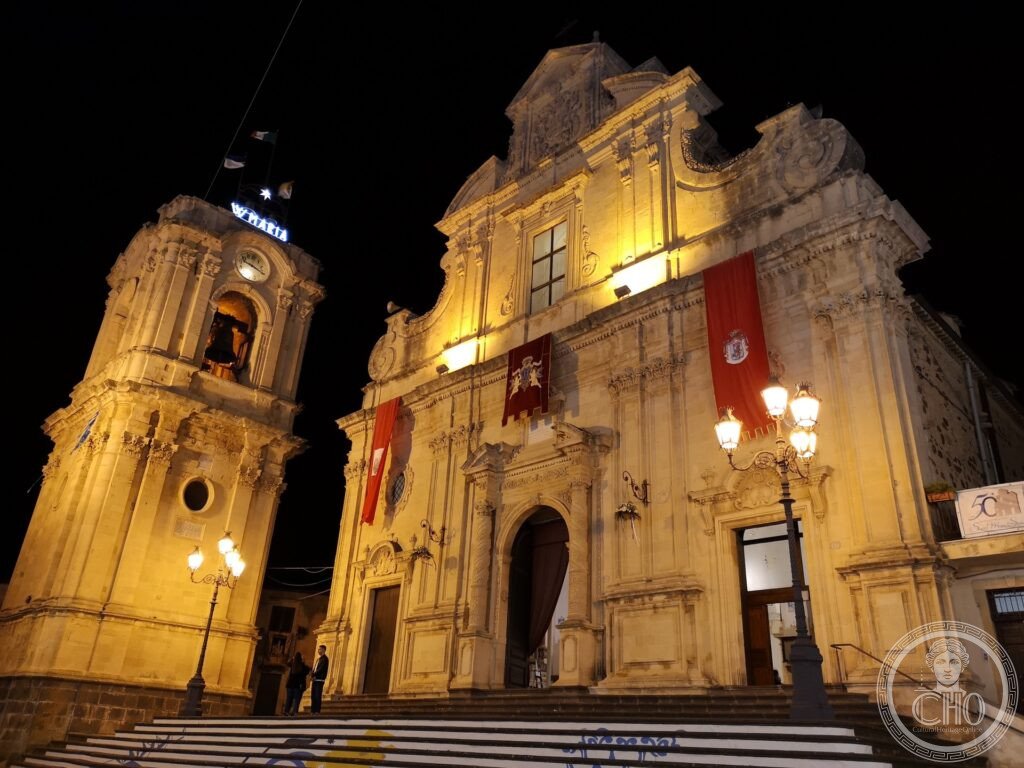
Militello in Val di Catania — the smallest and most rural of the eight UNESCO Late Baroque Val di Noto cities — is exceptional precisely because of its intimacy: patronized in the 16th and early 17th century by the Branciforte princes of Militello (one of the most culturally ambitious aristocratic families of Counter-Reformation Sicily), the city received a programme of church-building and artistic enrichment that was abruptly terminated by the 1693 earthquake but whose best pieces survived and were incorporated into the Baroque reconstruction, giving the rebuilt churches an unusual density of pre-seismic artworks surrounded by newly-cut Baroque stone.
At a glance
Militello in Val di Catania (province of Catania, Sicilia; UNESCO 2002, ref. 1024) is one of eight cities in the serial inscription “Late Baroque Towns of the Val di Noto.” Militello is the smallest of the eight (current population approximately 6,500) and the one farthest from the major tourist circuits. The inscription recognizes the exceptional quality of the Baroque urban fabric rebuilt after 1693 under the patronage of the Branciforte dynasty: particularly the churches of Santa Maria della Stella (with the carved wooden sacristy, considered the finest piece of Sicilian Baroque woodwork in the Val di Noto), San Nicolò (with the Carlo Maratta altarpiece), and the Church of Santa Maria la Vetere (the partially preserved pre-earthquake church, with 16th-century ex-votos still in the niches). The Museo di San Nicolò (the civic museum in the former church of San Nicolò) holds the major Branciforte collection.
Key facts
- Santa Maria della Stella e la sacrestia barocca: The Church of Santa Maria della Stella (rebuilt 1710-1730 on the post-earthquake site) is Militello’s most important Baroque monument: the exterior is relatively restrained (late Baroque proportions, stone facade with pilasters and a bell tower); the interior has a carved wooden sacristy (sacrestia intagliata, 18th century) that is composed of 18 built-in wardrobe/cabinet units entirely carved in walnut with figurative and ornamental relief panels (angels, putti, foliage, and sacred emblems) covering every surface; the programme is the most complete surviving example of Sicilian Baroque intarsia and carved woodwork in any single room in the Val di Noto, and rivals the best sacristies of Palermo and Catania
- Il mecenatismo Branciforte (XVI-XVII sec.): The Branciforte family (Princes of Militello from 1551) commissioned a series of high-quality artistic works for the pre-earthquake town: Carlo Maratta’s “Sacra Famiglia” (c.1680, oil on canvas, now in the Museo di San Nicolò) — a painting by the leading Roman classicist of the late Baroque; a series of silver ex-voto plaques; a rich endowment of embroidered vestments; and the partly-surviving pre-earthquake church of Santa Maria la Vetere (16th century, with several arched niches still containing their original 16th-century majolica ex-votos)
- Santa Maria la Vetere (chiesa del terremoto, XVI sec.): The partially ruined “old” church of Santa Maria la Vetere (the pre-earthquake church that partially survived the 1693 collapse) stands on the edge of town as a picturesque ruin with one complete aisle arch and the apse standing; the 16th-century majolica ex-votos in the niches (small glazed ceramic tiles with hand-painted figures of sailing ships, miraculous escapes, and votive scenes) are among the oldest surviving examples of popular Sicilian ceramic votive art
- UNESCO: 2002, ref. 1024
- GPS: 37.2680, 14.7922 — Google Maps
History
Militello (from the Arabic “Militel”) was a small inland agricultural settlement in the Arab-Norman period; it was elevated to a principality by the Aragonese crown in 1551 when it passed to the Branciforte family, who transformed it into a minor but culturally active court. The earthquake of January 11, 1693 (Val di Noto earthquake, magnitude estimated at 7.4) destroyed the pre-earthquake city; the reconstruction (1693-1750) was financed largely by the surviving Branciforte wealth and by the Church, which produced the current Baroque townscape. The Branciforte family died out in the early 18th century; the town subsequently declined as an agricultural backwater, which ironically preserved its Baroque fabric intact from the 19th-century development pressures that altered larger Sicilian cities.
What you see
Militello is a 30-45 minute experience for the focused visitor: the main circuit starts at the Piazza Vittorio Emanuele (the principal civic space, with the Palazzo Municipale); then the Church of Santa Maria della Stella (the sacrestia intagliata is the primary experience; ask the custodian to open the sacristy if it is locked; there is no fixed admission but a small donation is expected); then the Museo di San Nicolò (the former church now housing the civic collection including the Carlo Maratta canvas and the Branciforte silver); then the 10-minute walk to the ruins of Santa Maria la Vetere on the eastern edge of town (the picturesque collapsed aisle and the 16th-century ex-votos are the main attraction). The whole circuit is walkable in 2 hours and requires no advance booking.
Gallery
Practical information
- Santa Maria della Stella: Via Santa Maria della Stella, Militello in Val di Catania; open daily 9:00-12:00 and 16:00-18:00; the sacristia intagliata is in the annexe to the right of the main nave; ring the bell at the sacristy entrance if the door is locked; donation suggested ~€2-3.
- Museo di San Nicolò: Piazza Luigi Sturzo, Militello in Val di Catania; open Tuesday-Sunday 9:00-13:00 and 15:00-18:00; admission ~€3 (combined with the Parco Archeologico di Caltagirone if booked in advance).
- Santa Maria la Vetere (ruin): Via Santa Maria la Vetere, eastern edge of town; open daylight hours; free access to the exterior; the ex-votos in the niches are accessible from the exterior.
- Practical note: Militello has no tourist infrastructure (no hotels; a few local bars and trattorie); it is best visited as a half-day excursion from Catania, Caltagirone, or Ragusa.
Getting there
Militello in Val di Catania (CT), Sicilia. GPS 37.2680, 14.7922. By car: from Catania, SS192 south-west (40 km, 40 min); from Caltagirone, SP66 north (20 km, 25 min); from Ragusa, SS115 east then north (80 km, 1h15). Public transport: very limited; occasional AST buses from Catania and Caltagirone. Car is essentially required.
Nearby
- Caltagirone — 20 km south; (CHO card: Caltagirone UNESCO 2002); the “city of ceramics” of the Val di Noto inscription, with the famous Scalinata di Santa Maria del Monte (142 steps decorated with hand-painted majolica tiles)
- Catania — 40 km east; (CHO card: Catania UNESCO 2002); the most urban of the Val di Noto cities, with the elephant fountain (Piazza del Duomo), the Via Crociferi Baroque churches, and Vincenzo Bellini’s birthplace
- Enna — 40 km north-west; the highest provincial capital in Italy (931 m asl), with the Lombard Castle (Castello di Lombardia, 14th century) and the dramatic view over the Sicilian interior
Sources
- UNESCO: whc.unesco.org/en/list/1024
- Wikipedia EN: Militello in Val di Catania
- Comune di Militello in Val di Catania: comunemilitellovaldicatania.it
Find it on the map
See this place and what’s around it →📷 Become a Cultural Heritage Online photographer
Share your photos of places: they stay published under your name as the author. The more they're seen, the more you get noticed — and soon a contest will reward the most appreciated photos.
Log in or sign up free to add a photo