
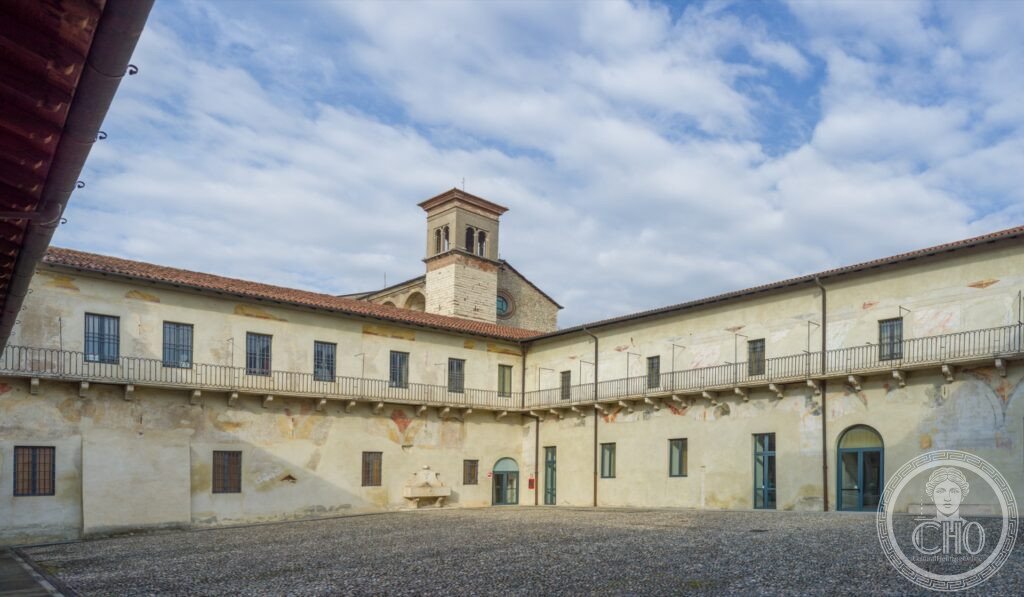
Brescia — Monastero di San Salvatore e Santa Giulia (753-774 d.C. → VIII-XIX sec.): il Più Grande Complesso Conventuale Longobardo Sopravvissuto in Italia e il Museo della Città (UNESCO 2011)
The Monastero di San Salvatore e Santa Giulia in Brescia — founded between 753 and 774 CE by the last Lombard king of Italy, Desiderius, and his queen Ansa — is the most extensive surviving example of Lombard monastic architecture in Europe: a complex of six churches, multiple cloisters, and conventual buildings accumulated across thirteen centuries of continuous use (from the Lombard period through the Carolingian, Romanesque, Gothic, Renaissance, and Baroque phases to the Napoleonic suppression of 1798) that today houses the Museo della Città — Brescia’s civic museum — in 14,000 square metres of space containing the city’s finest Roman, Lombard, Romanesque, and Renaissance collections.
At a glance
Brescia (province of Brescia, Lombardia; UNESCO 2011, ref. 1318) was inscribed as part of the serial property “Longobards in Italy: Places of Power (568-774 AD).” The Brescia component covers the Monastero di San Salvatore e Santa Giulia together with the adjacent archaeological area of the Roman forum and the Capitolium (a Roman temple complex of the 1st century CE that was incorporated into the medieval monastic complex). The WHC citation notes that the Brescia site is “the most important complex of Lombard religious architecture that has survived to the present day” because it contains: (1) the Church of San Salvatore (8th century, with three Lombard-period aisles and original painted decoration); (2) the crypt of San Filastrio (an exceptionally complete 8th-century Lombard crypt); (3) the “Nuns’ Choir” (a 9th-century Carolingian addition with 9th-century frescoes); (4) the Church of Santa Maria in Solario (a 12th-century Romanesque oratory with 16th-century frescoes by Floriano Ferramola); and (5) the New Church of Santa Giulia (16th century Baroque church). The entire complex was the convent of Santa Giulia from the Carolingian period (when the monastery was re-dedicated) to the Napoleonic suppression.
Key facts
- La Croce di Desiderio (IX sec.): The “Cross of Desiderius” (or Croce di Desiderio) is a processional cross commissioned by Abbot Adaloald (not by King Desiderius himself, despite the traditional name) in the 9th century; it is a large wooden cross (136 cm × 115 cm) faced with more than 200 cabochon gems (amethysts, garnets, carnelians, lapis lazuli), cameos (including 3 Roman portrait cameos of the 1st-2nd century BCE-CE), and enamel plaques; the front face has a series of 26 roundel-portrait miniatures in painted vellum from the 8th-10th century inserted into the gem settings; the overall composition is the most technically complex piece of early medieval goldsmiths’ and jewellers’ work surviving in Italy, and one of the most complex in all of Europe; it is now in the Museo di Santa Giulia
- La Vittoria di Brescia (I sec. d.C.): The “Winged Victory of Brescia” (Vittoria Alata, 1st century CE, bronze, height 195 cm) was discovered in 1826 in the ruins of the Roman Capitolium (the temple complex on the adjacent Piazza del Foro Romano); it is the best-preserved large bronze Roman cult statue in northern Italy and the iconic image of the Museo di Santa Giulia; the statue (a Nike/Victoria figure, originally gilt) was adapted for use as a cult image of Isis by the addition of attributes, then found its final form as a “Victoria” in the Capitolium context
- La Chiesa di San Salvatore (VIII sec., struttura longobarda): The Church of San Salvatore (now the core of the Museo della Città permanent display) is a 3-aisled church with 8 original Lombard columns and capitals (some reused from Roman buildings), painted decoration in the apse from the 9th century, and a crypt (the “Crypt of San Filastrio”) below the choir that is one of the most complete surviving Lombard crypts in Italy (with the original stone benches, altar supports, and fresco traces still in place)
- Il complesso romano del Capitolium: Adjacent to the monastic complex (separated by Via dei Musei), the Roman Capitolium of Brescia (69 CE, dedicated by Emperor Vespasian) is a triple-cella temple to the Capitoline triad (Jupiter, Juno, Minerva) built on a high podium; the northern cella has preserved a complete Roman floor mosaic; excavations under the adjacent Piazza del Foro Romano reveal the Republican-era forum (2nd century BCE) beneath the Imperial-era structures
- UNESCO: 2011, ref. 1318
- GPS: 45.5386, 10.2242 — Google Maps (Museo di Santa Giulia, Via dei Musei 81b, Brescia)
History
Brescia (Brixia in Latin) was a Roman colony of the 2nd century BCE; it became a flourishing Imperial-era city with an amphitheatre, a theatre, a forum complex, and the Capitolium (69 CE). Under the Lombards, Brescia became the capital of the Duchy of Brescia (one of the most important northern Lombard duchies); King Desiderius (the last Lombard king, r.757-774 CE) founded the monastery of San Salvatore between 753 and 774 CE as a royal mausoleum and devotional foundation, installing his daughter Anselperga as the first abbess. After the Carolingian conquest (774) the monastery was rededicated to Santa Giulia (an early Christian martyr of the Carthage region whose relics had been brought to Brescia from Corsica) and continued as a royal Carolingian convent; Ermengarda, daughter of Charlemagne and divorced queen of Italy (wife of King Bernardo), died in the convent in 851 (Manzoni used her death in the chorus “Dagli atri muscosi, dai fori cadenti” in his tragedy Adelchi). The monastery was suppressed by Napoleon in 1798 and became a civic museum in the 19th century.
What you see
The Museo di Santa Giulia (Via dei Musei 81b, Brescia) is the largest and most architecturally complex urban museum in Lombardia: the 14,000 m² of exhibition space across 6 churches and 3 cloisters represents thirteen centuries of architectural accretion that is itself part of the experience. Highlights: the permanent collection galleries with the Vittoria Alata (the large Roman bronze) and the Croce di Desiderio (in a dedicated display in the treasury room); the Church of San Salvatore (the Lombard-period church with its original columns and the Crypt of San Filastrio below); the “Coro delle Monache” (Nuns’ Choir, 9th century Carolingian addition with 9th-century fresco fragments); the Oratorio di Santa Maria in Solario (12th century Romanesque oratory with 16th-century Ferramola frescoes on the walls and the Evangeliary of Lobbes in the display case — an 8th-century manuscript); and the large Baroque church of Santa Giulia (16th century, at the far end of the complex). Allow at least 3 hours for the full circuit.
Gallery
Practical information
- Museo di Santa Giulia: Via dei Musei 81b, Brescia; open Tuesday-Sunday 10:00-17:00 (October-May) and 10:00-18:00 (June-September); closed Monday; admission ~€10 (combined ticket with the Roman Capitolium available). Audiogude available in Italian and English (included in admission). The museum is fully accessible (elevators between the different floor levels of the complex).
- Capitolium romano e Piazza del Foro Romano: Via dei Musei, Brescia; open same hours as the museum; included in the combined ticket; the excavated area of the Republican forum and the triple-cella Capitolium temple are adjacent to the museum entrance.
- Pinacoteca Tosio Martinengo: Piazza Moretto 4, Brescia; 15 min on foot from the museum; the city’s painting gallery (Raphael, Moretto, Romanino, Ceruti) has recently been fully restored and reopened; combined ticket available.
Getting there
Museo di Santa Giulia, Via dei Musei 81b, Brescia (BS), Lombardia. GPS 45.5386, 10.2242. By train: Trenitalia from Milan (45-60 min Regionale Veloce / Frecciarossa); from Verona (30 min Frecciarossa); from Venice (1h30 Frecciarossa). Brescia station is 15 min on foot from the Museo di Santa Giulia (Via Tosio → Via dei Musei). By car: from Milan, A4 east (90 km, 50 min); from Verona, A4 west (60 km, 40 min); limited parking near the museum (park in Piazza della Vittoria, 500m away).
Nearby
- Lago di Garda — 30 km east; the western (Lombard) shore of Lake Garda (Desenzano del Garda, Sirmione, Gardone Riviera) is 30-40 min from Brescia by car or local train
- Verona — 60 km east; (CHO card: Verona UNESCO 2000); the Arena di Verona and the Arche Scaligere; high-speed train from Brescia (30 min)
- Bergamo — 50 km west; (CHO card TBD); the Città Alta (upper city, entirely medieval: the Piazza Vecchia, the Duomo, the Cappella Colleoni with the finest Lombard Renaissance funerary chapel in existence) accessible from Brescia by Trenitalia regional (40 min)
Sources
- UNESCO: whc.unesco.org/en/list/1318
- Wikipedia EN: Santa Giulia museum, Brescia
- Museo di Santa Giulia official: bresciamusei.com
- Panazza, Gaetano: Il monastero e la chiesa di S. Giulia a Brescia, Brescia: Ateneo di Brescia, 1984
Find it on the map
See this place and what’s around it →📷 Diventa un fotografo di Cultural Heritage Online
Condividi le tue foto dei luoghi: restano pubblicate con la tua firma come autore. Più vengono viste, più ti fai conoscere — e presto un concorso premierà le foto più apprezzate.
Accedi o registrati gratis per aggiungere una foto