
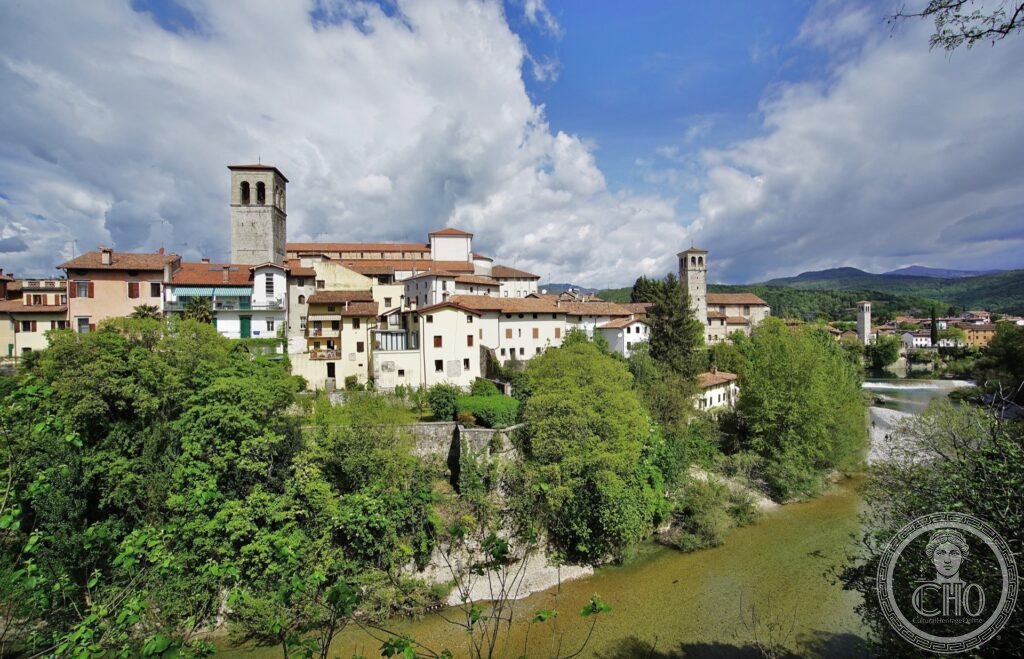
Cividale del Friuli — the Roman Forum Iulii, the first Lombard duchy established in Italy (568 CE, the year the Lombards crossed the Alps), and the city that gave the region “Friuli” its name — contains in its Tempio Longobardo (the oratory of Santa Maria in Valle) the finest surviving example of Lombard decorative stucco work in Europe: a sequence of eight late-antique-style figures in plaster relief, executed with a technical mastery that has no parallel in 8th-century European art.
At a glance
Cividale del Friuli (province of Udine, Friuli-Venezia Giulia; UNESCO 2011, ref. 1318) was inscribed as part of the serial property “Longobards in Italy: Places of Power (568-774 AD).” Cividale was the first Lombard foothold in Italy: in the spring of 568 CE, the Lombard king Alboin and his army crossed the eastern Alps and the first city they captured was Forum Iulii (Cividale), where Alboin installed his nephew Gisulfo as the first Lombard duke (duca) in Italy — establishing the political institution of the Duchy that would be the basic unit of Lombard territorial governance for the following two centuries. The Cividale UNESCO component covers: the Tempio Longobardo (the 8th-century oratory with the stucco figures), the Museo Cristiano e del Tesoro del Duomo (containing the Baptistery of Callisto and the Altar of Ratchis — the two most important Lombard sculptural monuments in Italy outside Rome), and the Ipogeo Celtico (a pre-Roman Iron Age underground chamber associated with Celtic ritual).
Key facts
- Il Tempio Longobardo (VIII sec.) — gli stucchi di Santa Maria in Valle: The Tempio Longobardo (also called “Piccolo Tempio” or “Oratorio di Santa Maria in Valle”) is a small church building (approximately 15 m × 10 m, single nave with an apse) attached to the north side of the monastery of Santa Maria in Valle; it was built in the 8th century (probably c.737-744, under the Lombard king Liutprand or his successors) as a private oratory. The interior west wall has a series of eight stucco figures of extraordinary quality: six standing women (identified in the earlier scholarship as “holy virgins,” possibly representations of the Virtues or of female saints) and two male figures at the corners, all executed in high-relief plaster with fine surface modelling (drapery folds, facial expressions, hands) that recalls late antique ivory carving and anticipates the Carolingian Renaissance. The stucco technique (damp-applied plaster modelled by hand and with small tools, then painted) was a Roman and Byzantine tradition; the Cividale stuccoes are the finest surviving examples of the technique in any post-Roman European context, and the figurative quality of the eight figures has led art historians to describe them as the highest achievement of Lombard visual art
- L’Altare di Ratchis (738-744) e il Battistero di Callisto (730-740): Both are now in the Museo Cristiano del Duomo. The Altar of Ratchis (commissioned by the Lombard duke/king Ratchis, r.744-749) is a monolithic marble altar with three bas-relief panels (Christ in Majesty on the front, the Adoration of the Magi on the left side, the Visitation on the right side) of exceptional iconographic and technical quality; the three panels represent the most complete surviving programme of Lombard stone relief sculpture. The Baptistery of Callisto (commissioned by the Patriarch of Aquileia Callisto, who moved to Cividale from Aquileia c.730-740 after the Lombard-era patriarchal seat transfer) is an 8th-century octagonal font on a single column, with a decorative programme (arcaded niches, vine scroll relief) derived from late antique church furniture
- L’Ipogeo Celtico: An underground chamber cut into the natural rock below the historic centre (Via Monastero Maggiore), associated with a pre-Roman Celtic sanctuary: a sequence of chambers with carved faces and indecipherable inscriptions that have been variously interpreted as a burial site, a sanctuary, and a prison (the traditional name “prison of the Celts” is modern and unfounded). The function remains debated; the archaeological consensus places the use in the Iron Age (4th-2nd century BCE)
- UNESCO: 2011, ref. 1318
- GPS: 46.0953, 13.4300 — Google Maps (Tempio Longobardo)
History
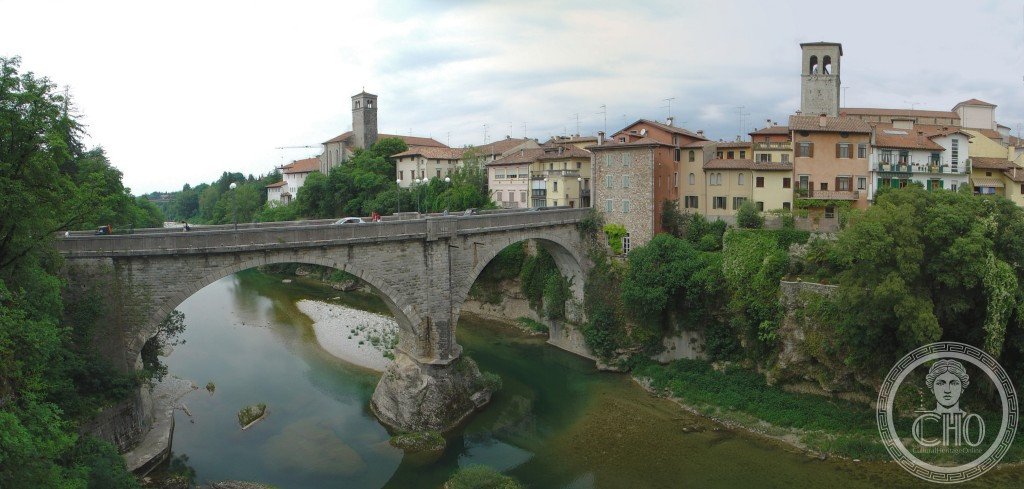
Forum Iulii was established as a Roman military colony by Julius Caesar (56 BCE, during his Gallic campaigns, when the Cisalpine Gaul frontier needed fortification against Alpine incursions). The city was significant under Augustus and the early empire (it appears in the Historia Romana as a prosperous colony on the Natisone river). The Lombard invasion of 568 CE made it the seat of the first Lombard duchy in Italy (Duchy of Friuli, subsequently one of the most important of the northern Lombard duchies). The Lombard period (568-774) saw the construction of the Tempio Longobardo and the Baptistery of Callisto; after the Carolingian conquest (774) Cividale became the patriarchal seat of Aquileia (transferred from the coastal site to the more defensible inland Cividale) and remained so until 1238, when the patriarchate moved to Udine. The Venetian period (1420-1797) left the current historic centre (the Ponte del Diavolo, the cathedral facade, the palazzo facades on the main piazza).
What you see
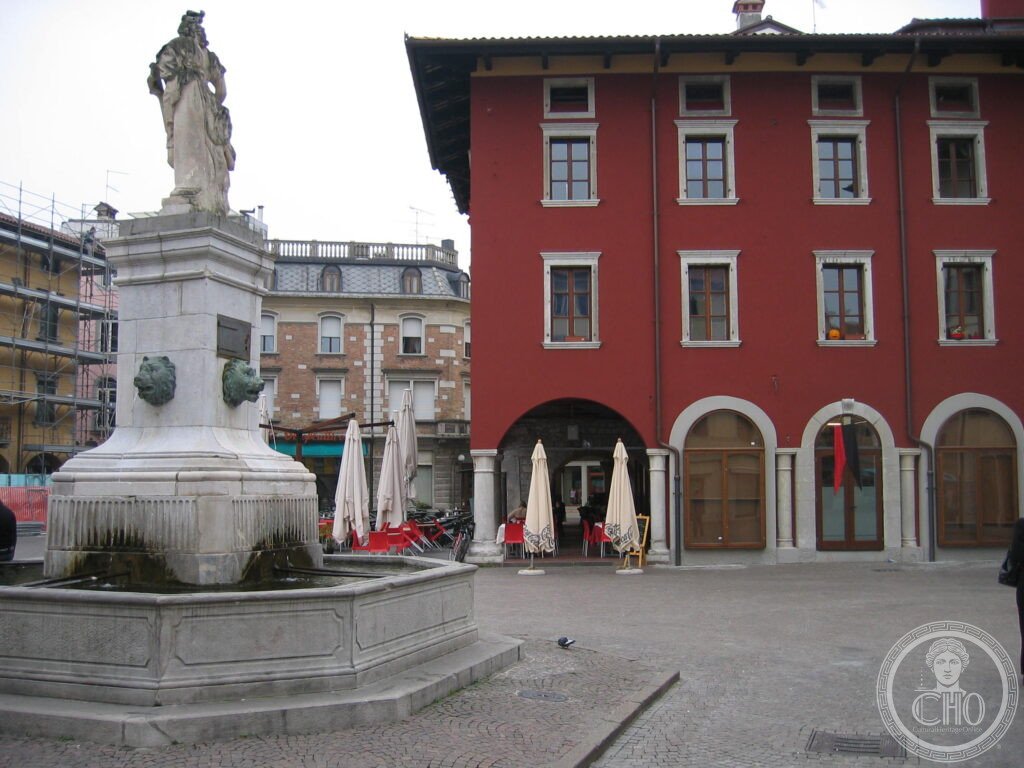
The Cividale UNESCO circuit: Piazza Paolo Diacono (the main civic piazza, named after Paul the Deacon, the 8th-century Lombard historian who wrote the Historia Langobardorum and who was born in Cividale) → Cathedral and Museo Cristiano (the cathedral facade is 16th-century Renaissance; the adjacent Museo Cristiano has the Baptistery of Callisto and the Altar of Ratchis — the single most concentrated holding of Lombard stone sculpture in Europe) → Tempio Longobardo/Santa Maria in Valle (10 min on foot south of the Duomo via Via Monastero Maggiore and Via Cella; the facade is plain; the interior with the stucco figures is the primary experience; admission required; best visited early morning for the light on the stuccoes from the high windows) → Ponte del Diavolo (the 15th-century stone bridge over the Natisone gorge, the most photogenic spot in Cividale, with the river cliff and the overhanging buildings visible from the bridge deck) → Ipogeo Celtico (entrance from Via Monastero Maggiore, 50 m west of the Tempio entrance; underground, guided visit only).
Gallery
Practical information
- Tempio Longobardo/Monastero di Santa Maria in Valle: Via Monastero Maggiore 1, Cividale del Friuli; open Tuesday-Sunday 10:00-13:00 and 15:00-18:00 (summer), 10:00-13:00 and 14:30-17:30 (winter); admission ~€4.
- Museo Cristiano e del Tesoro del Duomo: Piazza del Duomo, Cividale del Friuli; open Monday-Saturday 9:30-12:00 and 15:00-18:00; Sunday 15:00-18:00; admission ~€3 (combined ticket Museo Cristiano + Ipogeo ~€5).
- Ipogeo Celtico: Via Monastero Maggiore, Cividale del Friuli; guided tours only, contact the Museo Cristiano or the tourist office for schedules; admission ~€3.
- Mitmayest (Mittelfeste) festival: The Cividale del Friuli medieval festival (typically July-August) animates the historic centre with medieval markets, costumed processions, and music; the best opportunity to see the Ponte del Diavolo and the piazza in atmospheric evening light.
Getting there
Tempio Longobardo, Cividale del Friuli (UD), Friuli-Venezia Giulia. GPS 46.0953, 13.4300. By train: Trenitalia from Udine (15 min regional; very frequent, approximately every 30 min); from Trieste (1h, change at Udine). From Udine, the Cividale station is 5 min on foot from the historic centre. By car: from Udine, SS54 east (16 km, 20 min); from Trieste, A4 west to Palmanova then north via Udine (100 km, 1h15).
Nearby
- Udine — 16 km west; the principal city of Friuli; the Castello di Udine (with the Galleria d’Arte Antica and the Tiepolo frescoes in the Palazzo Arcivescovile), the Piazza della Libertà (Venice-inspired baroque piazza), and the Duomo (with Tiepolo frescoes in the Cappella dei Sacramenti)
- Aquileia — 55 km south-west; (CHO card TBD); the Roman colony (181 BCE) and early Christian patriarchal city; the Basilica di Santa Maria Assunta (early 4th century) has the largest surviving Roman-era mosaic floor in the Western world (750 m² of early 4th-century floor mosaic in situ); UNESCO 1998 (ref.825)
- Collio Friulano wine country — 20 km north-east; the Collio wine zone (Friulano, Sauvignon Blanc, Ribolla Gialla, Pinot Grigio) along the Slovenian border; winery visits in the Cormons, Dolegna del Collio, and Mossa areas
Sources
- UNESCO: whc.unesco.org/en/list/1318
- Wikipedia EN: Cividale del Friuli
- Paul the Deacon: Historia Langobardorum, c.787-789 CE (critical edition MGH Scriptores rerum Langobardicarum, 1878)
- Museocristiano.it: museocristiano.it
Gallery
Find it on the map
See this place and what’s around it →📷 Become a Cultural Heritage Online photographer
Share your photos of places: they stay published under your name as the author. The more they're seen, the more you get noticed — and soon a contest will reward the most appreciated photos.
Log in or sign up free to add a photo