
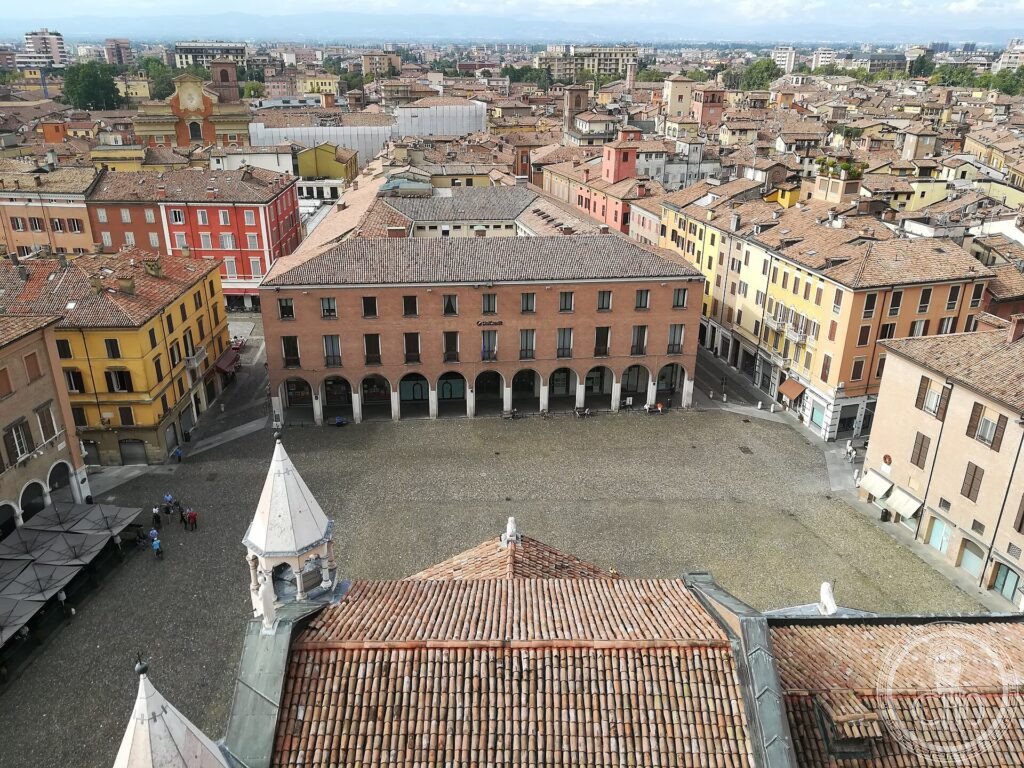
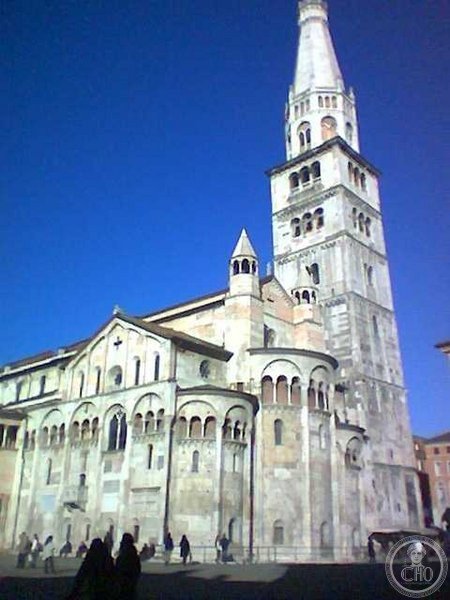
The Cathedral of Modena — begun in 1099 by the architect Lanfranco under the patronage of Countess Matilda of Canossa, with facade sculptures by Wiligelmus that initiated the Romanesque sculptural tradition in northern Italy — together with its 99.4-metre campanile (the “Ghirlandina,” built from 1179 to 1319, the tallest Romanesque tower in Europe) and the Piazza Grande is the finest surviving Romanesque ensemble in Italy and the foundational document of Italian medieval public sculpture.
At a glance
Modena (province of Modena, Emilia-Romagna; UNESCO 1997, ref. 827) was inscribed for the Cathedral, the Torre Ghirlandina, and the Piazza Grande as “an outstanding example of a Romanesque architectural ensemble that exerted a strong influence on art and architecture not only in the Po region but in a wider area.” The inscription covers three related elements: the Cathedral itself (the Duomo di Modena, begun 1099, with the principal facade on the Piazza Grande and the innovative sculptural programme by Wiligelmus); the Torre Ghirlandina (the cathedral campanile, begun 1179, reaching its current height of 99.4 m in 1319); and the Piazza Grande (the civic and religious centre of medieval Modena, shared by the Cathedral facade and the Palazzo Comunale on the opposite side).
Key facts
- Lanfranco and Wiligelmus: The Duomo di Modena was designed by Lanfranco (documented in an inscription on the west facade: LANFRANCUS DOCTUS IN ARTE) and sculpted by Wiligelmus (documented in a second inscription: INTER SCULPTORES QUANTO SIT DIGNUS HONORE / CLARET SCULTURA NUN WILIGELME TUA = “among sculptors, how worthy of honour you are, your sculpture now makes clear, Wiligelmus”); both inscriptions are on the west facade and are the earliest surviving documentary mentions of named architect and sculptor in Italian Romanesque art — a significant departure from the anonymous production of the earlier Romanesque period. Wiligelmus' four relief panels on the west facade (showing scenes from Genesis — the Creation, the Fall, Noah, and Cain and Abel) are the founding works of Romanesque sculpture in Italy: the expressive, three-dimensional figures of Adam and Eve (the expulsion scene) have a psychological weight and physical presence unprecedented in Italian medieval art
- The Porta Regia and the Lion Porch: The main entrance to the Cathedral (the central portal, known as the Porta Regia) is framed by free-standing columns resting on the backs of carved stone lions: this motif (columns supported by lions at the base) was introduced by Wiligelmus and was adopted by virtually every subsequent Romanesque and early Gothic church in northern Italy — it appears in over 100 churches from Sicily to the Alps and is arguably the most widespread single decorative convention in Italian medieval architecture
- Torre Ghirlandina (1179-1319, 99.4 m): The cathedral campanile, begun in 1179 and completed to its current octagonal lantern in 1319; its name (“la Ghirlandina” = the little garland) comes from the decorative architectural garlands visible on the upper octagonal stages; at 99.4 m it is the tallest Romanesque tower in Europe still intact. The tower contains the “secchia rapita” (a wooden bucket, the symbol of Modena's victory over Bologna in the Battle of Zappolino, 1325; stolen from a Bolognese well during the battle and kept in the tower as a trophy; it gave the name to Alessandro Tassoni's 1622 mock-heroic poem “La secchia rapita”)
- UNESCO: 1997, ref. 827
- GPS: 44.6466, 10.9258 — Google Maps
History
Modena was a Roman colony (Mutina) and a significant Lombard and Carolingian city; in the 11th century it came under the control of the Canossa family (the most powerful feudal dynasty of northern Italy in the period of the Investiture Controversy), whose greatest representative, Countess Matilda of Canossa (1046-1115), commissioned the new cathedral in 1099. The medieval Cathedral of San Geminiano (Modena's patron saint) was built to house the relics of Geminianus (4th-century bishop of Modena) in a more prestigious setting; the construction proceeded rapidly and was substantially complete by 1184 (when the Cathedral was consecrated in the presence of Emperor Frederick Barbarossa and Pope Lucius III). The Este dynasty, which ruled Ferrara from 1264 and was forced to relocate to Modena after the Papal annexation of Ferrara in 1598, brought additional cultural prestige to the city and established the Galleria Estense (one of the finest old-master collections in Italy) in the Palazzo dei Musei adjacent to the old Ducal Palace.
What you see
The Piazza Grande circuit in Modena begins with the west facade of the Cathedral: the central Porta Regia (with the lion porch and the Genesis relief panels by Wiligelmus in the lunettes above the three portals) and the north side portal (Porta della Pescheria, with reliefs of Arthurian legend scenes — the most extensive Arthurian narrative cycle in Romanesque sculpture). The interior (three naves, with a raised presbytery over a crypt) has the pulpit (early 13th century, with the Evangelists), the Choir Screen (13th century, with the Passion narrative reliefs), and the original 12th-century choir stalls. The Ghirlandina campanile (entrance from the north side of the Cathedral) can be climbed (242 steps); the upper levels have close views of the octagonal lantern and panoramic views over the Po plain. The Musei del Duomo (housed in the former Chapter library, adjacent to the Cathedral on the south side) display the original Metope reliefs (12th-century carved stone tablets that originally decorated the exterior eaves; removed and replaced with copies) and medieval objects from the Cathedral treasury.
Gallery
Practical information
- Duomo di Modena: Piazza Grande, Modena; open daily 7:00-12:30 and 15:30-19:00; free. The Ghirlandina campanile: open Tuesday-Sunday 9:30-12:30 and 15:00-17:30; admission ~€3 (tower) or ~€5 (tower+Musei del Duomo).
- Galleria Estense: Piazza Sant'Agostino 337 (Palazzo dei Musei, Largo Porta Sant'Agostino), Modena; open Tuesday-Sunday 8:30-19:30; admission ~€4. The collection includes major works by Velázquez (the portrait of Francesco I d'Este, 1638-1639, one of the finest portraits by Velázquez of a non-Spanish subject), Correggio, Titian, and Veronese.
- Ferrari Museum (Maranello): Via Dino Ferrari 43, Maranello (15 km south); open daily 9:00-19:00 (summer), 10:00-18:00 (winter); admission ~€18.
Getting there
Piazza Grande, Modena (MO), Emilia-Romagna. GPS 44.6466, 10.9258. By train: Trenitalia from Bologna (30 min regional; 20 min Intercity; very frequent); from Parma (30 min regional); from Milan (1h30 Frecciarossa). The station is 15 min on foot from the Piazza Grande. By car: from Bologna, A1 north-west (40 km, 30 min); from Parma, A1 south-east (55 km, 40 min); from Milan, A1 south-east (180 km, 1h45).
Nearby
- Ferrara — 50 km north-east; (CHO card: Ferrara Rinascimentale UNESCO 1995); the Addizione Erculea (Biagio Rossetti 1492), Palazzo dei Diamanti, Castello Estense
- Ferrari Museum, Maranello — 15 km south; the Museo Ferrari (Enzo Ferrari birthplace, and the main Ferrari museum with racing cars and road cars from 1948 to the present)
- Parma — 55 km north-west; the Battistero di Parma (Benedetto Antelami, 1196-1307, the finest Romanesque baptistery in Italy, with the cycle of Months sculptures on the exterior and the three-tiered interior of marble reliefs); the Galleria Nazionale di Parma (Correggio's Camera di San Paolo and frescoes in the Cathedral dome and in San Giovanni Evangelista)
Sources
- UNESCO: whc.unesco.org/en/list/827
- Wikipedia EN: Modena Cathedral
- Verzár, Christine B.: Portals and Politics in the Early Italian City-State: The Sculpture of Nicholaus in Context, Parma 1988
- Musei del Duomo di Modena: duomodimodena.it
Find it on the map
See this place and what’s around it →📷 Become a Cultural Heritage Online photographer
Share your photos of places: they stay published under your name as the author. The more they're seen, the more you get noticed — and soon a contest will reward the most appreciated photos.
Log in or sign up free to add a photoDo you manage this place?
This page is read by travellers and heritage enthusiasts who find it on Google. Keep it accurate — and make it work for you. Free for non-profit heritage institutions.