
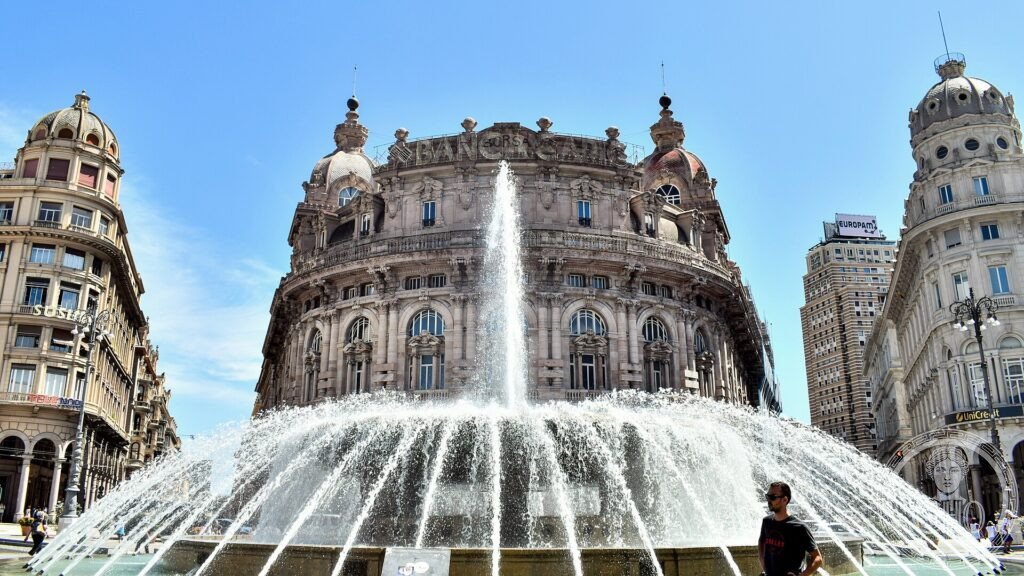
Genova — Le Strade Nuove e i Palazzi dei Rolli (1576-1700): i 42 Palazzi Nobiliari del Sistema Ospitale Ufficiale della Repubblica di Genova — Via Garibaldi, Rubens e l’Unica Rete Alberghiera Protocapitalista d’Europa (UNESCO 2006)
Genoa’s “Strade Nuove” — the three new streets of Renaissance Genoa laid out from 1549 to the 1580s by the city’s banking oligarchy on a hillside outside the medieval centre — and the 42 noble palaces in the “Rolli” system (the official register of palaces required to offer hospitality to state guests by rotation) represent the most direct surviving evidence of the unprecedented financial power of the Genoese banking system in the 16th and 17th centuries: a system that financed the Spanish Empire and made Genoa, briefly, the financial capital of Europe.
At a glance
Genoa (province of Genoa, Liguria; UNESCO 2006, ref. 1211) was inscribed for the Strade Nuove (the three new streets of the 16th century: Via Garibaldi/formerly Via Aurea; Via Cairoli/formerly Via Nuovissima; and Via Balbi) and the 42 palaces in the “Rolli” system — the official civic register of noble palaces whose owners were required by law (the Rolo of 1576) to offer lodging and hospitality to visiting heads of state and important foreign guests on a rotating basis. The Rolli system was the world's first public list of officially certified accommodation for state guests, a proto-hotel industry managed through civic obligation rather than commercial enterprise. The inscription recognizes both the exceptional quality of the architecture (the Genoese palaces represent the most concentrated ensemble of 16th-17th century noble palace architecture in Italy outside Rome) and the unique social and economic institution of the Rolli itself.
Key facts
- Via Garibaldi (formerly Via Aurea/Via Nuova, 1549-1558): Designed by Galeazzo Alessi (the principal architect of Genoa in the 16th century, who had studied in Rome and brought the influence of Michelangelo and Sangallo to the Ligurian context); 250 m long, 7.65 m wide (unusually generous for a 16th-century street); built entirely between c.1550 and 1600 with matching palace facades on both sides, creating the most homogeneous Renaissance streetscape in Italy. The 12 palaces on Via Garibaldi include: Palazzo Bianco (Grimaldi family; now municipal art gallery), Palazzo Rosso (Brignole-Sale family; now municipal art gallery), Palazzo Tursi (Grimaldi family; now the Palazzo Municipale of Genoa; contains the violin of Niccolò Paganini, the “Cannone” Guarneri del Gesù 1743). The two museums on Via Garibaldi (Palazzo Bianco and Palazzo Rosso) together form the Musei di Strada Nuova, with major collections of Genoese, Flemish, and Dutch painting (Rubens, Guercino, Veronese, van Dyck)
- Peter Paul Rubens and the Genoese palaces: Rubens visited Genoa three times (1600, 1603, and 1607) and was deeply influenced by the architecture of the Strade Nuove; in 1622 he published I Palazzi di Genova (a book of engraved architectural drawings of the main Genoese palaces), the first publication by a major European artist specifically dedicated to the architectural documentation of a single city; it was widely used by northern European architects (in Flanders, England, and the Netherlands) as a pattern book for palatial architecture, spreading the Genoese palace typology throughout northern Europe
- The Rolli system (1576): The “Rolo degli Aggregati” was a civic register established in 1576 (updated in 1588, 1599, 1614, and 1664) that listed 42 noble palaces (ranked in three categories based on size and prestige) whose owners were required to offer hospitality to visiting dignitaries according to the importance of the guest (a king required a Category I palace; an ambassador could be housed in a Category III palace). The system meant that each Genoese noble had to maintain his palace in a condition suitable for royal visitors at any time — a civic obligation that drove the continuous architectural upgrading of the Genoese palace stock for over a century
- UNESCO: 2006, ref. 1211
- GPS: 44.4096, 8.9338 — Google Maps (Via Garibaldi)
History
Genoa's wealth in the 16th and 17th centuries derived from its position as the primary banker of the Spanish Empire: Genoese banking families (the Doria, Grimaldi, Spinola, Pallavicino, Lomellini) provided credit to the Spanish Crown at interest rates that made Genoa the de facto financial capital of Europe from approximately 1550 to 1650. This extraordinary wealth was displayed in the building programme that created the Strade Nuove: the decision to build the new streets outside the medieval city was an urban planning choice as much as an architectural one — the hillside site (impossible to build on with medieval technology) was opened up with the new engineering capabilities of the 16th century, and the resulting palaces could not be confused with medieval merchant houses in the old port area. The Genoese Republic declined in the 18th century (the French Revolution and Napoleon's transformation of Genoa into a French satellite state ended the Republic in 1797) but the palaces survived as private residences, bank headquarters, and eventually public museums and civic buildings.
What you see
The Strade Nuove circuit begins at the west end of Via Garibaldi (entrance from Piazza Fontane Marose): a straight 250-m walk past 12 palazzo facades (the most photogenic sequence in Genoa), ending at the Palazzo Doria-Tursi (now the Municipio, with the Paganini Cannon violin on display inside) at the east end. The Palazzo Rosso (right/north side, near the east end) and the Palazzo Bianco (left/south side, facing the Rosso) are the most accessible interior palace experiences: both are municipal art museums with excellent collections; the piano nobile (principal reception floor) interiors — frescoed ceilings, hall enfilades, painted overdoors — give the best sense of the Genoese palatial interior at the height of its splendour.
The historic caruggi (the narrow alleys of the medieval Genoese port district, south of Via Garibaldi and the Cathedral) offer a completely different urban experience: the medieval fabric of the port area (the densest medieval street network in any Italian city) is disorienting by design, full of food shops (focaccia shops, pesto producers, dried cod merchants, fresh pasta shops), and provides the most vivid contrast with the palatial orderliness of the Strade Nuove.
Gallery
Practical information
- Musei di Strada Nuova (Palazzo Bianco + Palazzo Rosso): Via Garibaldi 11 (Bianco) and Via Garibaldi 18 (Rosso); open Tuesday-Friday 9:00-19:00, Saturday-Sunday 10:00-19:30; admission ~€9 (combined ticket for both museums + Palazzo Tursi). The combined ticket also covers the Palazzo Tursi (Via Garibaldi 9, the Municipio) for visits to the Paganini violin and the historic reception rooms.
- Rolli Days: The City of Genoa organizes the “Rolli Days” (two weekends per year, May and October) when all 42 Rolli palaces are open for free visits — the only opportunity to see private palaces not normally accessible; book in advance at rollidays.it.
- Caruggi (medieval alleys): The medieval port district is always accessible; the best entry points from Via Garibaldi are via Via Luccoli (heading south from the Via Garibaldi midpoint).
Getting there
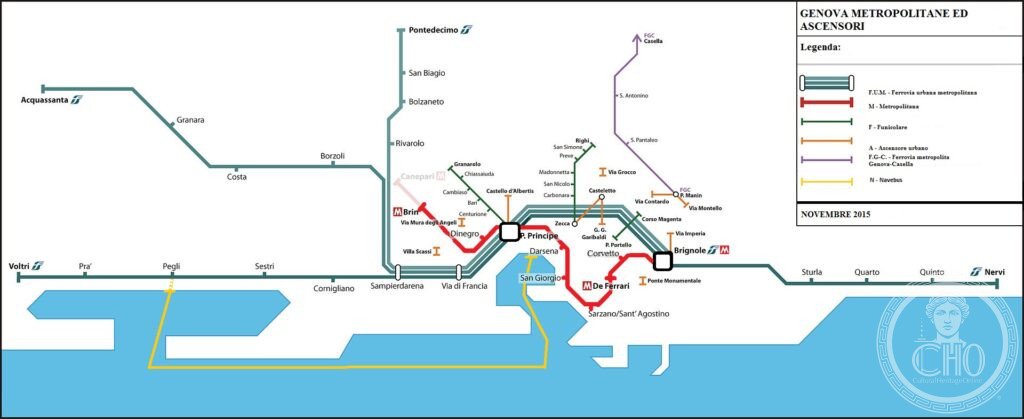
Via Garibaldi, Genova (GE), Liguria. GPS 44.4096, 8.9338. By train: Trenitalia from Milan (1h30-2h depending on route; direct Intercity; 8+ trains/day); from Turin (1h45 direct); from Florence (3h with change at Pisa); from Rome (5h with changes). Genova Piazza Principe or Brignole stations; both are 20-30 min on foot from Via Garibaldi (or bus/metro). By car: from Milan, A7 south to Genova (150 km, 1h30); from Turin, A26 south (175 km, 1h45). The historic centre is a Limited Traffic Zone; park at Genova Piazza della Vittoria (outside ZTL).
Nearby
- Portofino e Cinque Terre — 30-70 km east; the Ligurian Riviera coast; Portofino is 32 km east (car+ferry or coastal road; the village is car-free with a beautiful harbour); Cinque Terre UNESCO 1997 (ref.826) are 90 km east (accessible by Trenitalia regional train from Genova Piazza Principe, approx 1h15-1h45 to La Spezia/Riomaggiore)
- Savona — 45 km west; the Fortezza del Priamar (16th-century Genoese sea fortress, now a museum of Ligurian archaeology); the Pinacoteca Civica has a notable Luca Cambiaso (the principal Genoese painter of the 16th century) collection
- Pavia — 130 km north-east; the Certosa di Pavia (1396-1501, the grandest Lombard Gothic monastery, with a Carrara marble facade completed in the Renaissance by Giovanni Antonio Amadeo)
Sources
- UNESCO: whc.unesco.org/en/list/1211
- Wikipedia EN: Genoa
- Rubens, Peter Paul: Palazzi di Genova, Antwerp, 1622 (facsimile: Olms, 1969)
- Musei di Strada Nuova: museidigenova.it
Find it on the map
See this place and what’s around it →📷 Diventa un fotografo di Cultural Heritage Online
Condividi le tue foto dei luoghi: restano pubblicate con la tua firma come autore. Più vengono viste, più ti fai conoscere — e presto un concorso premierà le foto più apprezzate.
Accedi o registrati gratis per aggiungere una foto