
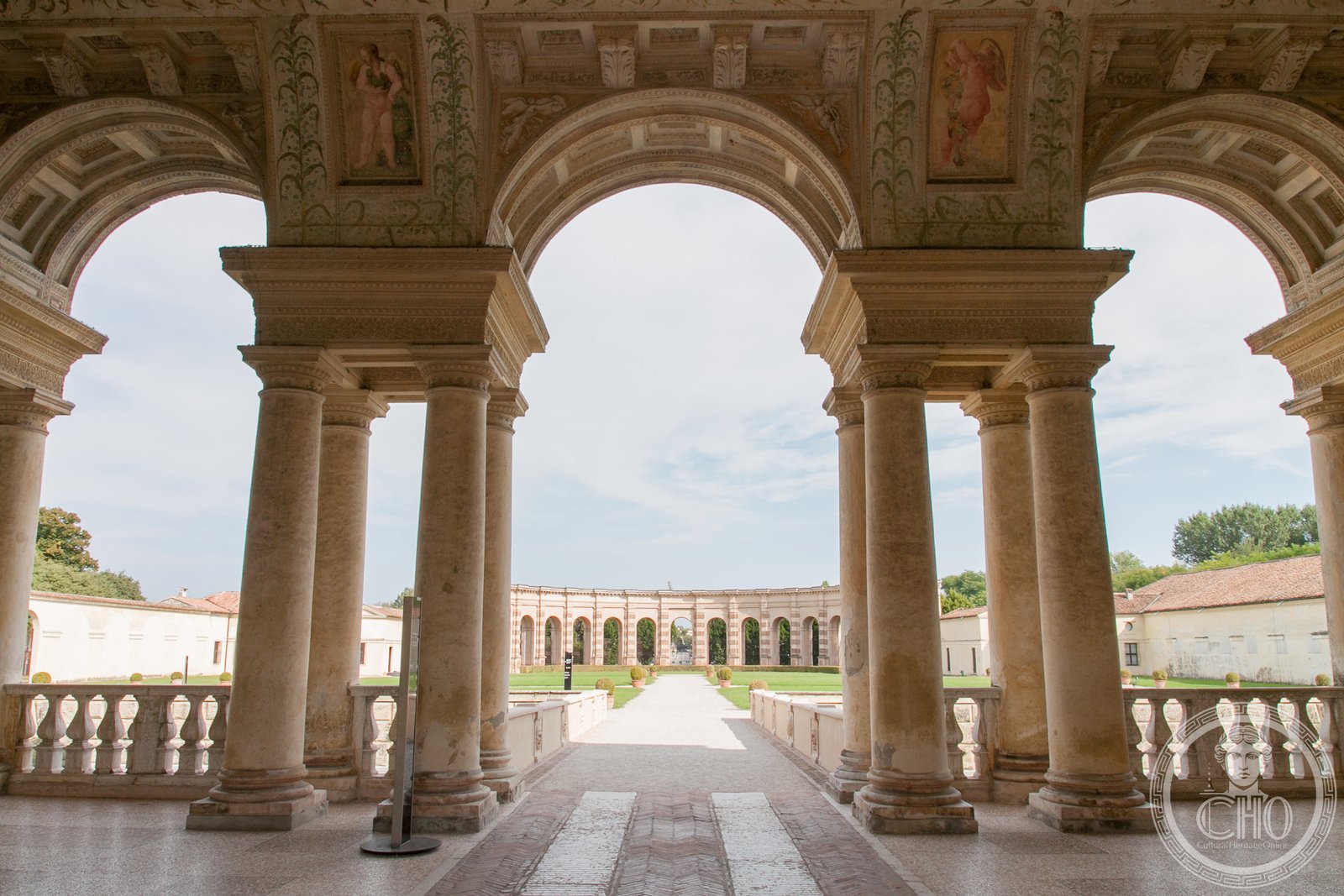
A Renaissance masterpiece commissioned by Federico II Gonzaga, Te Palace stands as the crowning achievement of architect Giulio Romano—a virtuoso retreat designed for pleasure, festivity, and escape from court duties.
At a glance
Te Palace is a monumental Renaissance residence built between 1524 and 1534 on an island reclaimed from swampland outside Mantua’s walls. Originally conceived as a private villa for the Gonzaga lord and his lover Isabella Boschetti, it now houses the civic museum and the International Center of Art and Culture, hosting exhibitions of ancient and modern art.
History
The site’s history begins with a tea factory documented in 1526, located on marshy ground between Mantua’s lakes. The Gonzagas drained the wetland, and Francesco II converted it into a training ground for his horses. When his son Federico II inherited Mantua, he envisioned the island as a sanctuary for leisure and celebration. Giulio Romano was tasked with creating a palace that would reflect the refined Roman villa culture Federico had admired since childhood.
The project became more elaborate when Emperor Charles V announced a visit; Romano was commissioned to connect the palace with the city castle through a series of new rooms, galleries, staircases, loggias, and courtyards. This expansion transformed the complex into one of the Renaissance’s most ambitious secular buildings.
What you see
Giulio Romano orchestrated a sophisticated dialogue between architectural design and the natural landscape, sublimely decorating rooms and façades to showcase his imagination and mastery. His work was enhanced by collaborators including Raffaellino del Colle, with whom he had worked in Rome under Raphael’s influence.
Numerous painters contributed to the palace’s decoration: Raffaele Albarini, Giorgio Anselmi, Francesco Primaticcio, Fermo Ghisoni, Giovan Francesco Penni, Gerolamo Staffieri, Benedetto Pagni, Rinaldo Mantovano, and Giovan Battista Mantovano. Their combined artistry created interiors of exceptional richness and visual coherence across the palace’s numerous rooms.
Cultural significance
Te Palace represents a pivotal moment in Renaissance architecture, marking the shift from purely functional fortified structures to palatial villas designed as total works of art. Giulio Romano’s design anticipated the Mannerist departure from High Renaissance restraint, establishing principles that influenced European palace architecture for generations.
Since 1990, the International Center of Art and Culture has positioned the palace as an active venue for contemporary artistic dialogue, hosting exhibitions that examine both historical and modern artistic practice within these Renaissance walls.
Key facts
- Built: 1524–1534
- Architect: Giulio Romano
- Patron: Federico II Gonzaga
- Address: Viale Te, 13, 46100 Mantua
- Coordinates: 45.147640714437564, 10.78584372997284
- Phone: +39 376 323266
- Website: palazzote.it
Practical information
Te Palace is open to the public as a museum and exhibition venue. For current hours and admission prices, consult the official website or call the number above. The palace hosts rotating exhibitions of ancient and modern art throughout the year.
Getting there
The palace is located on Viale Te, approximately one kilometer south of Mantua’s historic center. You can reach it on foot (15–20 minutes from the Piazza Sordello) or by local bus. Parking is available near the entrance.
See the place
Sources & resources
Find it on the map
See this place and what’s around it →Historical events at this place (1)
📷 Become a Cultural Heritage Online photographer
Share your photos of places: they stay published under your name as the author. The more they're seen, the more you get noticed — and soon a contest will reward the most appreciated photos.
Log in or sign up free to add a photoIs this page about you?
This page is read by travellers and heritage enthusiasts who find it on Google. Tell us how you are connected to this place and we will take it from there.