
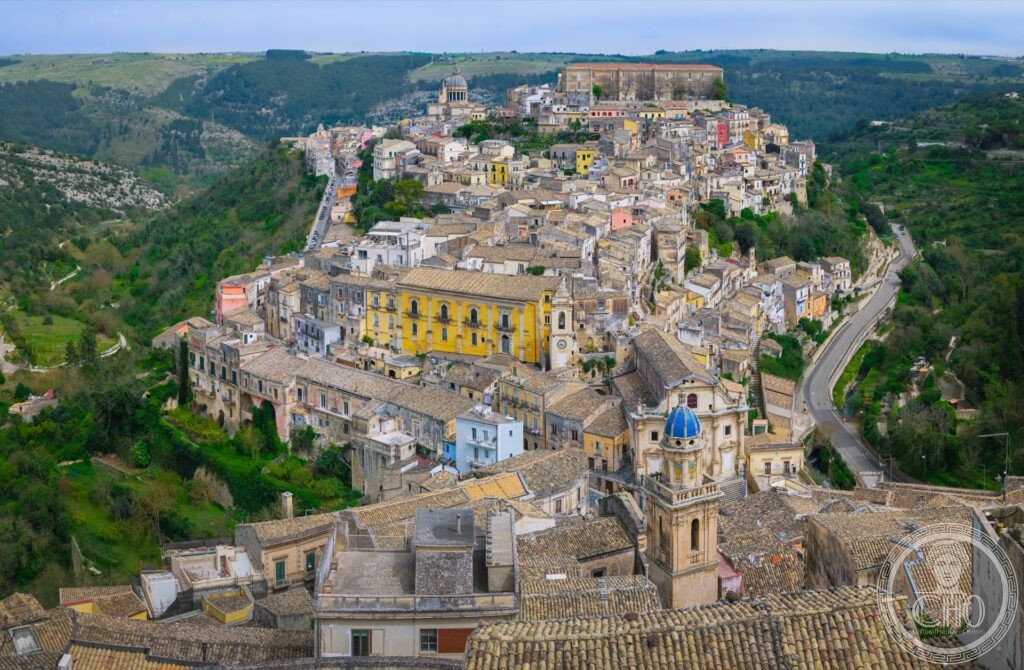
Ragusa Ibla — the medieval lower city rebuilt after the earthquake of 11 January 1693 destroyed almost all of southeastern Sicily — preserves the most complete ensemble of late Baroque urban architecture in Italy: streets, piazzas, palaces, churches, and garden terraces all built within a single 60-year period (1693-1750) in a unified style that mingles the Baroque monumentality of Rome with the local quarry stone (the golden Ragusa limestone, calcarenite, that takes the light differently at each hour of the day) and the specifically Sicilian tradition of lavishly decorated balcony corbels.
At a glance
The Late Baroque Towns of the Val di Noto (UNESCO 2002, ref. 1024) is a serial property covering eight towns in southeastern Sicily that were destroyed or severely damaged by the earthquake of 11 January 1693 (estimated M 7.4, one of the most destructive earthquakes in European history: 54,000-60,000 deaths, entire towns flattened across a 250 km radius) and rebuilt in the decades immediately following in a uniformly high-quality late Baroque architectural style. The eight towns are: Caltagirone, Militello in Val di Catania, Catania, Modica, Noto, Palazzolo Acreide, Ragusa, Scicli. Ragusa has a special situation within the eight: the 1693 earthquake destroyed the medieval city on the ibla (the rocky spur between two deep gorges), and the population split: some rebuilt on the same site (Ragusa Ibla, the lower city, the historic centre), while others built a new city on the higher plateau (Ragusa Superiore, today the administrative centre of the province). This CHO card focuses on Ragusa Ibla, the more historically and architecturally significant of the two.
Key facts
- The 1693 earthquake: On 11 January 1693, a magnitude 7.4 earthquake (the Val di Noto earthquake, also called the 1693 Sicilian earthquake) struck southeastern Sicily at approximately 21:00 local time; the main shock followed a smaller foreshock of approximately M 6.2 earlier in the day; the destruction was catastrophic — Catania was 90% destroyed, Noto was completely destroyed and rebuilt 8 km from its original site, Ragusa was destroyed to the foundations; the death toll (54,000-60,000 in Sicily alone) was the largest of any European earthquake until 1755 Lisbon. The 1693 earthquake provided the opportunity for a wholesale architectural renewal of southeastern Sicily in the latest Roman Baroque style — the rebuilding became one of the most coherent urban-planning exercises in Italian history, producing eight cities that share a unified architectural vocabulary while each maintaining individual character
- Ragusa Ibla (the lower city): The medieval city on the ibla (the rocky limestone spur between the Vallone di S. Leonardo and the Vallone S. Domenica gorges) was maintained at its original location; the street plan of Ragusa Ibla preserves the medieval grid in many areas, with Baroque facades applied to the new buildings; the city is accessible from Ragusa Superiore by a staircase (the Scalinata Commendatore) or by bus (5 min)
- Duomo di San Giorgio (Rosario Gagliardi, 1738-1775): The most important Baroque church in Ragusa Ibla; the concave facade (three tiers of columns with increasingly complex decorative orders, narrowing to the bell tower above) is the finest architectural composition by Rosario Gagliardi (1698-1762, the principal Baroque architect of the Val di Noto, also responsible for the Duomo of Modica and the church of San Giuseppe, Ragusa Ibla). The dome (1775, by an anonymous continuator after Gagliardi’s death) is the dominant visual feature of the Ibla skyline from the belvedere above
- The balcony tradition: The most distinctive Sicilian Baroque architectural element is the balcony corbel (the sculpted bracket supporting the balcony floor slab): in the Val di Noto cities, the corbels are carved with grotesque figures, human faces, horses, sea monsters, lions, and hybrid creatures in a profusion that has no parallel in other Italian Baroque traditions; the finest examples in Ragusa Ibla are on the Palazzo Cosentini (Via del Mercato; four balconies with corbels of musicians, grotesque faces, and animals)
- UNESCO: 2002, ref. 1024
- GPS: 36.9262, 14.7411 — Google Maps (Ragusa Ibla centre)
History
The site of Ragusa Ibla (the rocky spur between two gorges, 470m above sea level) has been continuously inhabited since the Bronze Age (the Sicanian/Sicel culture had a settlement here before Greek colonization); the Greek city was called Hybla Heraia (one of the three Hybla cities in Sicily); the Romans renamed it Herbita (though this identification is contested); the medieval city (after the Byzantine and Arab periods) was known as Ragusa from at least the 11th century. The 1693 earthquake destroyed the medieval structures but the population (those who did not move to Ragusa Superiore) rebuilt on the same site, largely following the medieval street pattern. The rebuilding was completed with exceptional speed and architectural quality for a small provincial city: the Duomo di San Giorgio (designed by Gagliardi, begun 1738, consecrated 1775) took 37 years to build; the smaller churches (San Giuseppe, Santa Maria dell’Itria, the Annunziata) were mostly completed by 1720-1730. The Baroque city survived largely unchanged because Ragusa Ibla’s economic decline in the 19th-20th centuries (as the administrative and commercial focus shifted to Ragusa Superiore) meant there was no incentive for demolition and rebuilding. It was “rediscovered” by architects and tourism in the late 20th century and became famous internationally through the television series Inspector Montalbano (Il Commissario Montalbano), filmed partly in Ragusa Ibla from 1999 to 2021.
What you see
Ragusa Ibla is best explored on foot from the Giardino Ibleo (the public garden at the eastern tip of the ibla, with views over the gorges and the surrounding hills). From the garden, the main corso (Corso XXV Aprile) leads west through the centre of the medieval-Baroque city to the Piazza del Duomo (the main square, with the Duomo di San Giorgio at its head and the palaces of the local aristocracy on the sides). The most important stops along the corso are: Palazzo Cosentini (the finest balcony corbels in Ragusa; the four balconies on Via del Mercato, the side street just before the main piazza); the church of Santa Maria dell’Itria (with its Majolica-tiled dome in blue and yellow); the church of San Giuseppe (Gagliardi, 1750s, oval interior with highly decorated stucco, one of the finest Rococo church interiors in Sicily). The Piazza del Duomo provides the main photographic composition: the three-tiered concave facade of San Giorgio, the broad staircase with 250 steps leading up to the portal, and the adjacent palaces constitute one of the most complete Baroque piazza ensembles in Italy.
Gallery
Practical information
- Duomo di San Giorgio: Piazza del Duomo, Ragusa Ibla; open daily 9:00-12:30 and 15:30-19:00. Free entry. The interior has a single broad nave with lateral chapels and the original 18th-century wooden furnishings.
- Giardino Ibleo: The eastern tip of the spur; open daily; free; the best views of the Ibla skyline and the surrounding valleys; three smaller Baroque churches (San Giacomo, the Cappuccini, the Carmine) are accessible within or adjacent to the garden.
- Palazzo Cosentini (exterior): Via del Mercato; the four balconies with carved grotesque corbels are accessible from the street at all times; no interior visit.
- Montalbano sites: Fans of the Montalbano television series will recognize many locations in Ragusa Ibla (Montalbano’s house, the questura); self-guided maps available at the tourist office (Corso Italia 60, Ragusa Superiore).
- Season: Spring and autumn are ideal; July-August is hot (38-40°C inland); Ragusa Ibla receives year-round visitors but is at its most atmospheric in the low season when the streets are quiet.
Getting there
Piazza del Duomo, Ragusa (RG), Sicilia. GPS 36.9262, 14.7411 (Ragusa Ibla). By train: Trenitalia from Syracuse (97 km, 1h30-2h regional; not all services go to Ragusa; check Trenitalia schedules); from Catania (95 km, 1h30-2h via Canicattini Bagni; limited service). By car: from Catania, A19 then SS194 then SS514 south (95 km, 1h15); from Syracuse, SS115 then SP17 west (97 km, 1h30). Ragusa Ibla is not directly accessible by car (the ibla streets are too narrow); park in the main parking areas of Ragusa Superiore and take the bus (line 1, 3 min) or walk down the Scalinata Commendatore (10 min descent).
Nearby
- Modica — 15 km south-east; the second most important Val di Noto city; the Duomo di San Giorgio (Ragusa-based Gagliardi was also responsible here, but the Modica version has a different character — the 250-step staircase leading to the facade, aligned with the main corso, creates one of the most dramatic urban axes in Baroque Sicily); Modica chocolate (produced according to the ancient Aztec cold-process method brought to Sicily by the Spanish in the 16th century; no cocoa butter added; granular texture; sold throughout the town)
- Noto — 60 km north-east; the most famous and most photographed of the Val di Noto cities; completely rebuilt from scratch at a new site after 1693 (the original Noto Antica was abandoned entirely); the main corso (Corso Vittorio Emanuele) is entirely lined with Baroque palaces and churches in the golden Noto limestone; particularly beautiful at sunset
- Scicli — 25 km south; the smallest and least visited of the Val di Noto UNESCO towns; Palazzo Beneventano (18th century, with spectacular carved balcony corbels) and the church of San Matteo (ruined, on the cliff above the town, with excellent views) are the highlights; also a Montalbano filming location
Sources
- UNESCO: whc.unesco.org/en/list/1024
- Wikipedia EN: Ragusa, Sicily
- Blunt, Anthony: Sicilian Baroque, Weidenfeld and Nicolson, 1968
- Comune di Ragusa: comune.ragusa.gov.it
Find it on the map
See this place and what’s around it →📷 Become a Cultural Heritage Online photographer
Share your photos of places: they stay published under your name as the author. The more they're seen, the more you get noticed — and soon a contest will reward the most appreciated photos.
Log in or sign up free to add a photo