
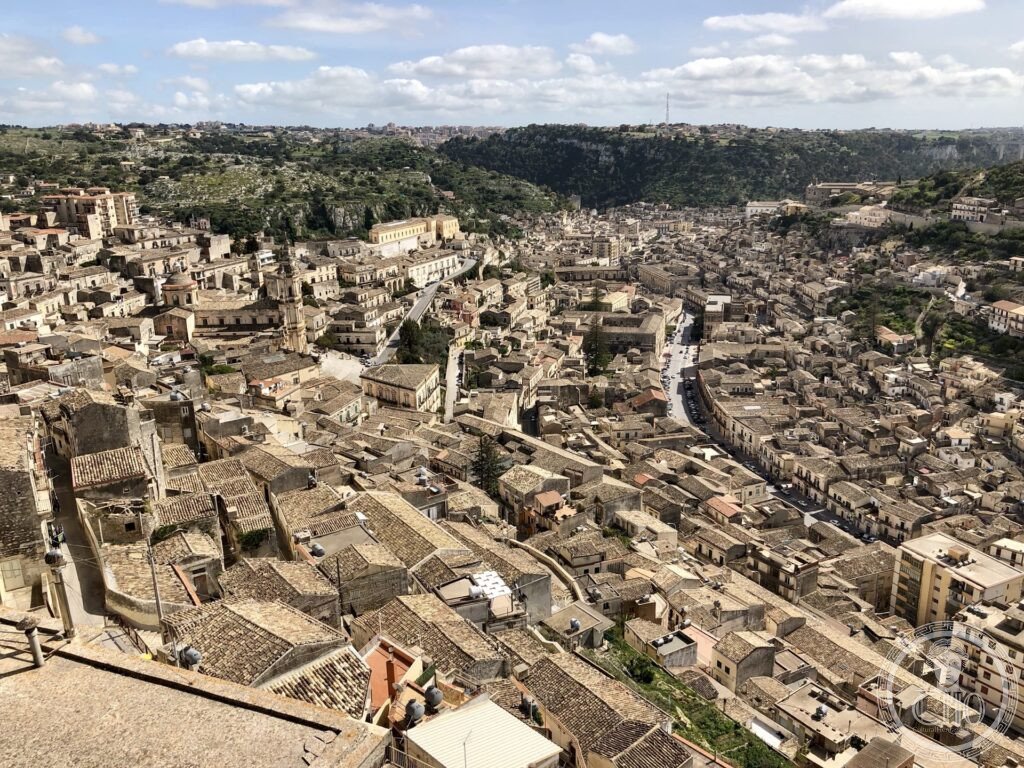
Modica, divided between a lower district (Modica Bassa, in the ravine at the confluence of two river valleys) and an upper district (Modica Alta, on the ridge above), was rebuilt after the earthquake of 11 January 1693 with a concentrated programme of Baroque architecture that produced the grandest single church composition in the Val di Noto: the Duomo di San Giorgio (Rosario Gagliardi, 1702-1738), approached by a 250-step monumental staircase aligned with the entire length of the Corso Umberto I, its three-tiered concave facade dissolving the distinction between church front and urban stage set.
At a glance
Modica (province of Ragusa, Sicilia) is one of eight towns inscribed in the UNESCO serial property “Late Baroque Towns of the Val di Noto” (2002, ref. 1024), covering eight cities in southeastern Sicily rebuilt after the earthquake of 11 January 1693 in a unified high-quality late Baroque architectural style. Modica has a particular claim to architectural importance within the eight: the Duomo di San Giorgio (Gagliardi, 1702-1738) with its 250-step approach staircase aligned along the city's main street is the most dramatic urban-Baroque composition in the group, and the city as a whole has the most complex topography — straddling two ravines at different levels — which gives the Baroque facades and staircases of Modica a theatrical verticality not found in the flatter terrain of Noto or Scicli. Modica is also internationally known for its traditional chocolate-making (the “cioccolata di Modica” or “Modica chocolate”), produced by a pre-industrial cold-process technique introduced to Sicily by the Spanish in the 16th century and inherited from the pre-Columbian Aztec cacao preparation method.
Key facts
- The 1693 earthquake and rebuilding: The Val di Noto earthquake (11 January 1693, estimated M 7.4) destroyed Modica almost entirely: the death toll in Modica itself was approximately 4,000 out of a pre-earthquake population of about 15,000; the rebuilding was organized by the local nobility (whose palace-palazzi line the Corso Umberto I) and the ecclesiastical authorities (who commissioned the major churches) and was substantially complete by 1750
- Duomo di San Giorgio (1702-1738): The principal monument of Modica, designed by Rosario Gagliardi (1698-1762), the dominant architect of the Val di Noto reconstruction; the 250-step staircase (running the full length of the lower Corso Umberto I from the street level to the church portal) was completed after the church; the three-tiered convex-concave facade (the central bay concave, the outer bays projecting) is the finest Gagliardi composition and the most scenographic facade in Sicily; the campanile (the bell tower rising above the central bay) is Gagliardi's most elegant vertical composition. The church interior (a single wide nave with lateral chapels) has an important polyptych of the Madonna della Neve (1513, Antonello Gagini) above the main altar
- Cioccolata di Modica (Modica chocolate): The traditional Modica chocolate is produced by a cold-process method in which roasted cacao mass is mixed with sugar (and sometimes vanilla, cinnamon, or spices) at a temperature that prevents the cocoa butter from separating; no milk, no vegetable fat, no emulsifiers are added; the result is a granular, dry, crumbly tablet with a strong, pure cacao flavour and a sandy texture (the sugar crystals remain intact). This is substantially the same process described in the first European accounts of Aztec cacao preparation (16th century); the Spanish brought it to Sicily where it survived as a local tradition after it was superseded by the cooked-process methods developed in the Netherlands and England in the 19th century
- UNESCO: 2002, ref. 1024
- GPS: 36.8608, 14.7740 — Google Maps
History
Modica (ancient Motycai) was an indigenous Sicel settlement before Greek colonization; it was one of the most important cities of the interior in the medieval period (Arab, Norman, Swabian, Angevin, and Aragonese), with a large Jewish community (expelled in 1492 with the other Spanish territories) and a substantial Muslim population (absorbed or expelled after the Norman conquest). The medieval county of Modica — a feudal title that encompassed a vast territory in southeastern Sicily — was one of the most important in Sicily from the 12th to the 17th centuries; the Cabrera and Enriquez families (Aragonese) held it from 1392 to 1702, maintaining Modica as one of the most populous cities in Sicily. The 1693 earthquake forced the rebuilding of practically the entire city on the same site (Modica was not relocated, unlike Noto): the two ravines and the ridge between them determined the distinctive dual-level structure (Modica Alta and Modica Bassa) that gives the city its character.
What you see
The walk through Modica proceeds along the Corso Umberto I (the main street of Modica Bassa, running through the ravine bottom) from east to west: the street is flanked by baroque palaces (Palazzo Nicolaci di Villadorata, Palazzo dei Mercedari) and lined with the chocolate shops for which Modica is famous. At the western end, the 250-step staircase of San Giorgio rises above the street end — the facade is visible from the beginning of the Corso, creating an axial perspective composition that draws the eye toward the church throughout the 600m walk. The staircase itself (two flights converging at a landing, then rising again to the portal) is a Baroque theatrical device: climbing the steps in stages, with the facade dissolving and reassembling at each landing, produces an experience of the building in motion that flat photographs cannot capture.
Modica Alta (the upper city on the ridge) is reached by stairs or by car and contains the second major church: the Duomo di San Pietro (14th century, rebuilt 1699-1730, with the late apostles' statues on the facade balustrade), the Museo Civico (with archaeological finds from the pre-earthquake Modica), and the surviving Jewish quarter (the Cartellone, with the remains of the pre-1492 synagogue converted to a church after the expulsion). The view from Modica Alta over the ravine — looking down at the rooftops of Modica Bassa with the dome of San Giorgio in the middle distance — is the principal panoramic viewpoint of the city.
Gallery
Practical information
- Duomo di San Giorgio: Piazza San Giorgio, Modica; open daily 8:00-13:00 and 15:30-20:00. Free. The polyptych (Madonna della Neve, Gagini 1513) is in the north transept apse; the panoramic views from the terrace behind the church look over the Val di Noto hills.
- Cioccolata di Modica: Numerous historical cioccolaterie in the Corso Umberto I; the most historically important is the Antica Dolceria Bonajuto (Corso Umberto I 159, founded 1880, the oldest chocolate shop in Sicily); cold-process tablets are sold in flavours including cinnamon, vanilla, chili, and carob. The Protected Geographic Indication (IGP) “Cioccolato di Modica” was registered in 2018.
- Museo Civico: Corso Umberto I 149; open Tuesday-Sunday 9:00-13:00 and 16:00-19:00; admission ~€3.
- Season: Modica is crowded July-August and during the annual Eurochocolate festival (Modica Chocolate Festival, typically late November-December). Best April-June and September-October.
Getting there
Corso Umberto I, Modica (RG), Sicilia. GPS 36.8608, 14.7740. By train: Trenitalia from Syracuse (1h45-2h, regional with change at Canicattini Bagni or direct service on some schedules; limited service — check Trenitalia in advance); from Ragusa (15 km, 20 min, more frequent). By car: from Ragusa, SS115 south-east (15 km, 20 min); from Catania, A19 then SP17 south (95 km, 1h20); from Syracuse, SS115 west (97 km, 1h30). Parking at Piazza Medaglie d'Oro (Modica Bassa, near the start of the Corso).
Nearby
- Ragusa Ibla — 15 km north-west; (CHO card: Ragusa Ibla — Barocco Val di Noto UNESCO 2002); the Duomo di San Giorgio Ragusa (also Gagliardi, 1738, slightly later than Modica) and the Palazzo Cosentini balcony corbels
- Scicli — 20 km south-west; the smallest and least visited Val di Noto UNESCO town; Palazzo Beneventano and the ruined church of San Matteo above the valley; also an Inspector Montalbano filming location
- Pozzallo e Marina di Modica — 20 km south; the beach towns on the southern Sicilian coast near the Capo Passero lighthouse (the southernmost point of Sicily); the ferry port for Malta (80 km south; 1.5h hydrofoil)
Sources
- UNESCO: whc.unesco.org/en/list/1024
- Wikipedia EN: Modica
- Blunt, Anthony: Sicilian Baroque, Weidenfeld and Nicolson, 1968
- IGP Cioccolato di Modica: consorziotutelacioccolatodimodica.it
Find it on the map
See this place and what’s around it →📷 Become a Cultural Heritage Online photographer
Share your photos of places: they stay published under your name as the author. The more they're seen, the more you get noticed — and soon a contest will reward the most appreciated photos.
Log in or sign up free to add a photo