
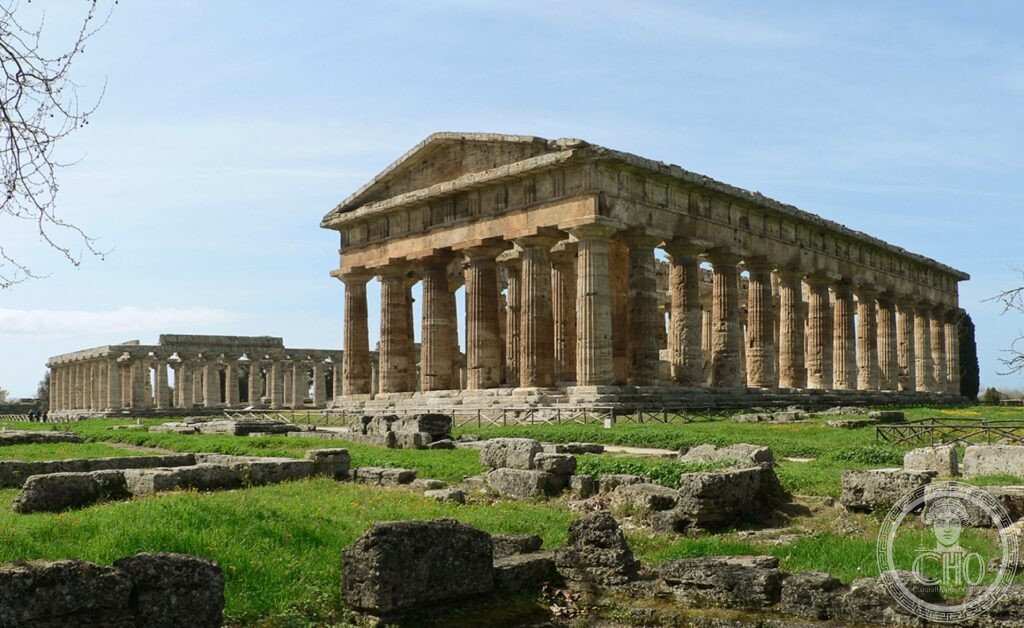
The three Greek temples at Paestum (ancient Poseidonia) are the best-preserved Doric temples in the world — better preserved than any in Greece itself — standing in a flat coastal plain south of Naples where the ancient city of the Achaean colonists has never been built over, leaving the temples isolated in an open archaeological park with their full height intact, their columns pink in the afternoon light from the iron content of the local travertine.
At a glance
The Cilento, Vallo di Diano and Alburni National Park (UNESCO 1998, ref. 842) covers approximately 181,000 hectares in the province of Salerno (Campania), including the coastal Cilento peninsula, the Vallo di Diano valley, and the Alburni massif. The UNESCO inscription covers not only the natural landscape (the park itself, designated 1991) but three principal archaeological and cultural sites within it: the ancient Greek colonial city of Poseidonia/Paestum (with its three temples and extensive archaeological area), the ancient Hellenistic city of Elea/Velia (with its Porta Rosa, the oldest barrel-vaulted arch in Italy, c.4th c. BCE), and the Certosa di San Lorenzo at Padula (the second-largest Baroque monastery in Italy). This CHO card focuses on the Paestum archaeological area, which is the most visited and most architecturally significant component.
Key facts
- Foundation: Poseidonia was founded c.600 BCE by Achaean colonists from Sybaris (the great Achaean colony in Calabria) as a sub-colony; the three surviving temples were built over 100 years: the Basilica (Hera I, c.550 BCE), the Temple of Athena (c.510 BCE), and the Temple of Poseidon (Hera II, c.450 BCE); the city was renamed Paestum by the Romans after its incorporation in 273 BCE and remained inhabited until it was abandoned in the 9th century CE (malaria from the silted-up rivers of the coastal plain ended continuous occupation)
- Temple of Neptune/Hera II (c.450 BCE): The best-preserved Doric temple in the world: 6 × 14 columns, all standing to full height; all three pediment cornices surviving; the cella interior walls and inner colonnades partially surviving; the travertine stone has turned golden-rose with age — on the Paestum plain in late afternoon, the temple glows. Despite its common name “Temple of Neptune,” the most recent scholarship identifies it as the second temple of Hera (Hera I/Basilica having been built 100 years earlier and Hera being the principal deity of Poseidonia)
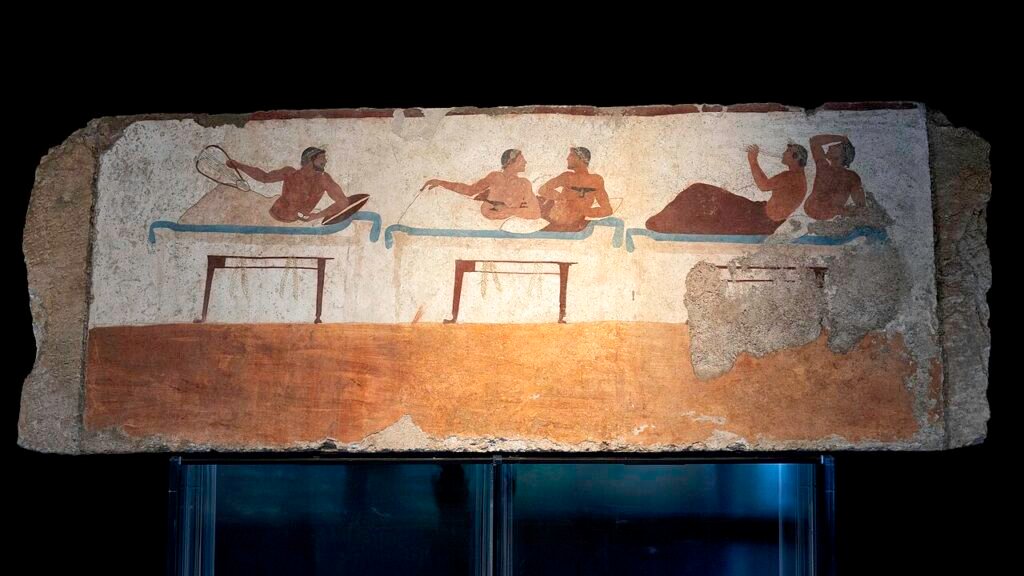
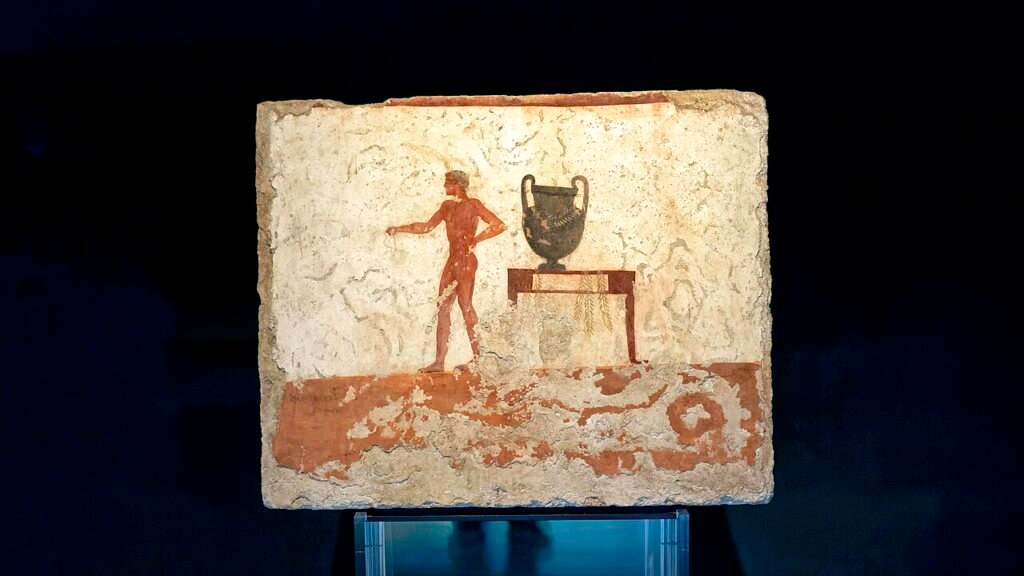
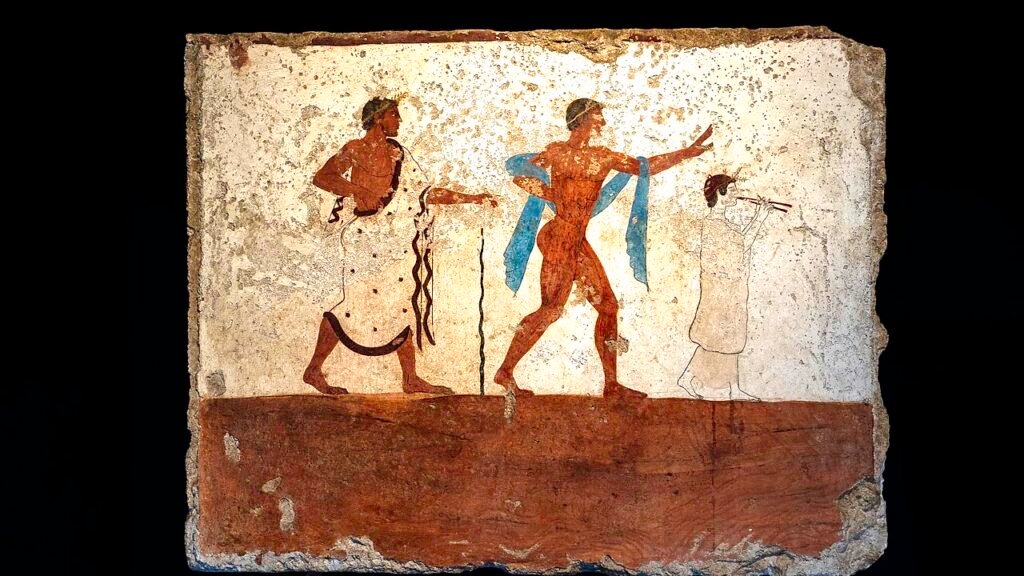
- The Tomb of the Diver (Tomba del Tuffatore, c.480 BCE): A unique Greek painted tomb found in 1968 in the necropolis south of the city; five limestone slabs painted with a symposium scene (the four sides) and a young man diving into a pool (the cover slab — the only surviving example of classical Greek figurative painting on panel from Italy, representing either the journey to the afterlife or a pure athletic scene); displayed in the Museo Nazionale di Paestum (recommended strongly)
- UNESCO: 1998, ref. 842
- GPS: 40.4219, 15.0036 — Google Maps (Paestum temples)
History
Poseidonia was founded c.600 BCE as one of a chain of Achaean Greek colonies on the Tyrrhenian coast of southern Italy (the region the Greeks called Magna Graecia — “Greater Greece”); the Achaean motherland on the Gulf of Corinth contributed settlers and civic institutions, but the colony developed its own identity, expressed most vividly in the temple construction programme of c.550-450 BCE. The city was conquered by the Lucanians (an Oscan-speaking Italic people from the interior of Campania) around 400 BCE and renamed Paiston; it became Roman in 273 BCE (renamed Paestum) after the defeat of Pyrrhus of Epirus, and received a Latin colony of Roman veterans that transformed its urban fabric: the Greek temples were maintained as religious monuments but the city around them was thoroughly Romanized (the forum, the amphitheatre, the comitium, and the porticoed streets all from the Roman period are partly visible). Abandoned progressively from the 6th century CE as the coastal plain became malarial, rediscovered by Grand Tour travellers in the 18th century — the painters Jacob Philipp Hackert and Giovanni Battista Piranesi produced the first accurate drawn records of the temples (Piranesi’s “Differentes vues de quelques restes de trois grands edifices qui subsistent encore dans le milieu de l’ancienne ville de Pesto,” 1778) that made the Paestum temples known throughout Europe.
What you see
The archaeological area of Paestum (entrance on Via Magna Graecia, 1 km from the main railway station) covers approximately 120 hectares, of which the central sacred area with the three temples is about 1 km across. The visit begins at the south entrance (near the museum) with the Basilica/Hera I temple (c.550 BCE — the oldest, with the unusual characteristic that the columns narrow not just upward but also at the middle, producing a swelling “entasis” more extreme than later Greek temples; 9 × 18 columns); the Temple of Neptune/Hera II (c.450 BCE, 6 × 14 columns, all standing; the finest single ancient building in Italy south of Rome) is 200 m north; the Temple of Athena (c.510 BCE, 6 × 13 columns) is 500 m further north across the Roman forum. The walk between the three temples provides a physical experience of the city’s scale: the flat plain, the long straight roads, the isolated temples against the blue Cilento mountains are an experience impossible to replicate in photographs.
The Museo Nazionale di Paestum (on the access road, 200m from the south entrance) is essential: it contains the Tomb of the Diver (the unique Greek painted tomb, c.480 BCE, the only surviving example of classical Greek figurative painting in Italy — the diving youth on the tomb cover is one of the most evocative images in ancient art), extensive finds from the temple precincts (bronze armour, terracotta votives, carved metopes), and the reconstructed panels of the metopes from the Foce del Sele sanctuary (6th-5th c. BCE).
Gallery
Practical information
- Parco Archeologico di Paestum: Via Magna Graecia 919, Capaccio Paestum; open daily 9:00 to 1 hour before sunset. Admission ~€16 (includes the museum). Book online at museopaestum.beniculturali.it. Visit the museum BEFORE the archaeological area: the Tomb of the Diver and the metopes provide essential context for the temples.
- Season: October-April (less crowded; the morning light on the temples is extraordinary in autumn and winter; summer midday heat can be extreme on the exposed plain). Mosquitoes in August and September evenings near the coastal areas.
- Duration: Museum (45-60 min) + archaeological area (2-3 hours, walking 2-3 km on unpaved paths). Total: 3-4 hours for the full site.
Getting there
Via Magna Graecia 919, Capaccio Paestum (SA), Campania. GPS 40.4219, 15.0036. By train: Trenitalia from Naples (90 km; 1h30 regional direct to Paestum station, 1 km from the site; frequency 5-6/day — check Trenitalia schedules as services are reduced outside summer); from Salerno (40 km; 1h regional). By car: from Naples, A3 south to Battipaglia then SS18 south (90 km, 1h30); from Salerno, A3 south to Battipaglia then SS18 south (40 km, 40 min).
Nearby
- Velia (ancient Elea) — 40 km south; the Greek philosophical city founded c.540 BCE by Phocaean refugees (Parmenides and Zeno of Elea, founders of the Eleatic philosophical school, lived here); the Porta Rosa (c.4th c. BCE, the oldest barrel-vaulted arch in Italy); partially excavated, less visited than Paestum
- Certosa di Padula (Certosa di San Lorenzo) — 50 km east in the Vallo di Diano; the second-largest Baroque monastery in Italy after the Certosa di Pavia; founded 1306, rebuilt in Baroque 17th-18th c.; the famous octagonal kitchen (400 m² floor area); the 320 m × 150 m cloister; open for visits
- Costiera Cilentana and Costa del Cilento — south of Paestum; the southern Campania coast with the sandy beaches of Marina di Camerota, Pisciotta, and Palinuro (Capo Palinuro, where Virgil’s Palinurus, the Trojan helmsman, was said to have drowned)
More photographs
Sources
- UNESCO: whc.unesco.org/en/list/842
- Wikipedia EN: Paestum
- Rouveret, Agnès: La Tombe du Plongeur: À propos du Codex de Cobos et de Paestum, Editions de l’Ecole française de Rome, 1989
- Museo Nazionale di Paestum: museopaestum.beniculturali.it
Find it on the map
See this place and what’s around it →📷 Become a Cultural Heritage Online photographer
Share your photos of places: they stay published under your name as the author. The more they're seen, the more you get noticed — and soon a contest will reward the most appreciated photos.
Log in or sign up free to add a photo