
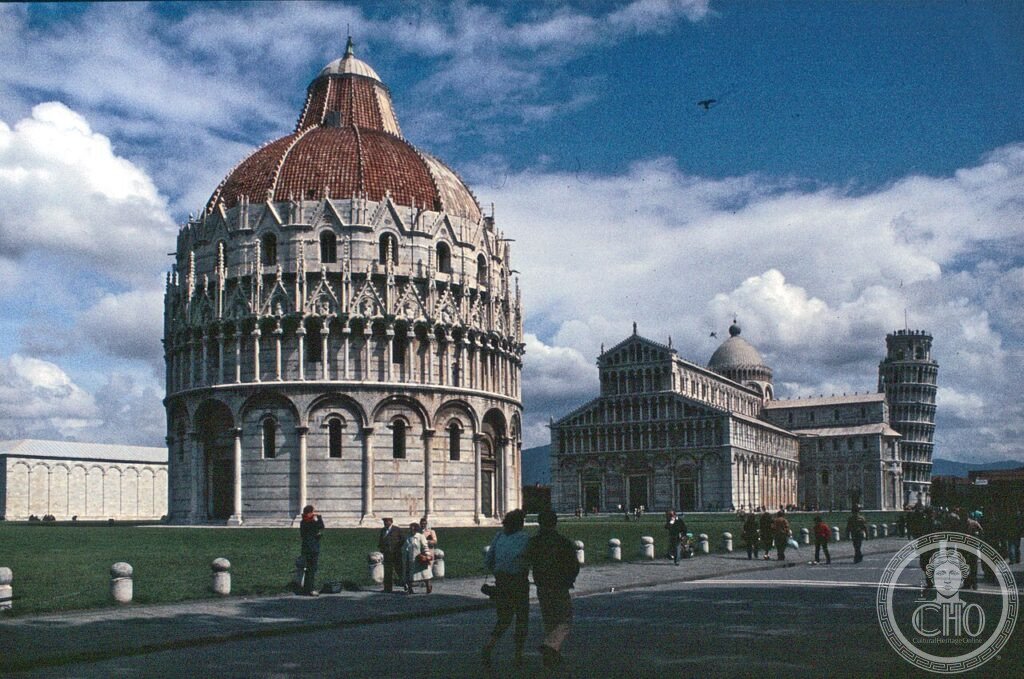
Piazza del Duomo di Pisa — la Piazza dei Miracoli (1063-1350): il Duomo Romanico, il Battistero, il Campanile Pendente e il Camposanto nelle 8 Ettari di Marmo Bianco (UNESCO 1987)
The Piazza del Duomo of Pisa — the “Field of Miracles” — is the most complete ensemble of medieval Romanesque architecture in white marble in the world: four extraordinary buildings (the Cathedral, the Baptistery, the Leaning Tower, and the monumental cemetery of the Camposanto) constructed over three centuries on a single field of grass outside the medieval city, all in the white Carrara marble that defines the Pisan Romanesque style and influenced Romanesque architecture from Sardinia to the Crusader kingdom of Jerusalem.
At a glance
Pisa (province of Pisa, Toscana) is a UNESCO World Heritage Site inscribed in 1987 (ref. 395) as “Piazza del Duomo, Pisa.” The inscription covers the four buildings of the Piazza dei Miracoli (the popular nickname of the Piazza del Duomo) plus the surrounding lawns and the medieval city walls that frame the piazza on the north side: the Cathedral of Santa Maria Assunta (1063-1350), the Baptistery (1152-1363), the Campanile (the Leaning Tower, 1173-1372, with the construction interrupted for nearly 100 years and then resumed at a compensating angle), and the Camposanto Monumentale (the monumental cemetery cloister, 1277-1464). All four buildings are in the distinctive Pisan Romanesque style: white Carrara marble with blind arcades, colonnaded galleries, and geometric inlay decoration in dark green serpentino marble from Prato.
Key facts
- Duomo di Pisa (1063-1350): Built to commemorate the Pisan naval victory over the Saracens at Palermo (1063); architect Buscheto (a Greek or Eastern Roman architect, possibly from Durazzo); the Latin-cross plan with five naves is unusual for a Romanesque church; the facade (Rainaldo, 1261-1272) has three tiers of colonnaded galleries; the interior contains the bronze doors by Bonanno Pisano (south transept, 1180), the pulpit by Giovanni Pisano (1302-1311, 12 marble reliefs with unprecedented emotional power), a Cimabue mosaic of Christ in Majesty (1302, in the apse), and Galileo’s legendary lamp (a bronze lamp hanging from the nave ceiling whose oscillation Galileo is said to have timed with his pulse in 1583, leading to his discovery of the isochronal property of pendulums)
- Battistero (1152-1363): The largest baptistery in Italy (outer diameter 107.24 m; height 55 m); begun by Diotisalvi in 1152 in Romanesque; the upper part added by Nicola Pisano and his son Giovanni Pisano in Gothic style from 1260 onward; the interior is famous for the pulpit by Nicola Pisano (1260 — the first pulpit in Italy to use classical-style figures, marking the beginning of the Italian Renaissance in sculpture), and for the extraordinary acoustic resonance of the dome (the interior can produce a continuous harmonic chord that lasts 10-15 seconds; demonstrated by guides at intervals during the day)
- Torre Pendente (Campanile, 1173-1372): Begun in 1173 (architect: Bonanno Pisano or Diotisalvi — disputed); after completing three storeys, construction stopped in 1178 because the soft alluvial subsoil was already causing a tilt; resumed in 1272 (Giovanni di Simone) building the next four storeys at a compensating angle (creating the characteristic “banana” curve); completed with the belfry in 1372; the tower leans at approximately 3.97° from vertical (before the 1990-2001 consolidation, it was 5.5°; 47 tonnes of lead counterweights were installed on the north side and soil was extracted from the north side to reduce the lean to the current stable angle). Height: 56 m (south side) to 56.7 m (north side). Weight: approximately 14,500 tonnes. Open for guided visits of the 294 steps to the summit (30-min timed slots)
- Camposanto (1277-1464): Monumental cemetery on the north side of the piazza; a rectangular colonnaded cloister with a Gothic marble arcade (the architect Giovanni di Simone, 1277, was killed in the Battle of Meloria 1284, halting construction; resumed mid-14th century); the earth floor is traditionally said to be filled with sacred soil brought from Calvary by the Archbishop of Pisa during the Third Crusade (a claim used to justify the privilege of burial there). The Camposanto contained the most complete collection of medieval frescoes in Italy until a WWII Allied incendiary bomb hit the roof on 27 July 1944: the burning lead of the roof fell on the fresco surface, destroying 24 of the 40 bays and severely damaging the remaining 16. The survivng frescoes (particularly the “Triumph of Death” cycle, c.1338-1341, attributed to Buonamico Buffalmacco) were detached and restored, and are now displayed in the Camposanto museum
- UNESCO: 1987, ref. 395
- GPS: 43.7230, 10.3966 — Google Maps
History
The Piazza del Duomo was built during Pisa’s period of maximum maritime power: in the 11th and 12th centuries, Pisa was one of the four great Italian maritime republics (with Venice, Genova, and Amalfi), with trading posts across the Mediterranean and a powerful fleet that conducted successful raids against Saracen strongholds in North Africa and Sicily. The Cathedral was funded by spoils from the 1063 sack of Palermo; the Baptistery and Campanile were begun when Pisan trade was at its height. The construction of the Piazza del Duomo ensemble was thus an act of civic-religious commemoration of Pisa’s maritime wealth and military power, displayed in the most expensive material available — pure Carrara marble — on the most prominent possible site, just inside the north gate of the city. The Camposanto was begun in 1277, just seven years before the catastrophic defeat of the Pisan fleet by Genova at the Battle of Meloria (1284), which ended Pisan maritime supremacy. After 1284, Pisa declined rapidly and was conquered by Florence in 1406; the Piazza del Duomo buildings were completed over the following centuries as gestures of civic memory, not as expressions of current power.
What you see
The four buildings are visited with a combined ticket (sold at the Opera della Primaziale Pisana ticket offices at Piazza dei Miracoli 17 and Piazza dei Miracoli 2). The Leaning Tower requires advance booking for the timed ascent (294 steps to the summit, 30 min slot); book at opapisa.it at least a week in advance in summer. The Baptistery’s acoustic demonstration (every 30 min by the ticket-taker, who sings a sustained note into the dome) is genuinely extraordinary — worth timing your visit around it. The Camposanto is the least crowded building at most hours (an advantage over the Cathedral and Tower, which have queues) and contains the restored “Triumph of Death” frescoes, which despite the WWII damage are among the most emotionally powerful works of 14th-century Italian painting.
Gallery
Practical information
- Opera della Primaziale Pisana (combined ticket): Includes access to the Cathedral, Baptistery, Camposanto, and Museo dell’Opera del Duomo. The Leaning Tower requires a separate timed ticket (~€20; advance booking essential). The combined ticket for the other three buildings: ~€7-10. Book at opapisa.it. The Cathedral alone is free with a free ticket from the ticket offices.
- Hours: All buildings open 9:00-20:00 (April-September), 9:00-18:00 (October-March). The Leaning Tower has the shortest opening windows (9:00-22:00 in summer).
- Duration: The full Piazza dei Miracoli circuit (all four buildings) requires 3-4 hours. Add 1 hour for the Tower ascent.
- Note: The piazza is pedestrian-only; leave bags in lockers at the ticket offices if they are too large for the Leaning Tower visit (bag size restrictions apply).
Getting there
Piazza del Duomo, Pisa (PI), Toscana. GPS 43.7230, 10.3966. By train: Trenitalia from Florence (80 km; 1h regional; direct services); from Genova (160 km; 1h30); from Rome (330 km; 2h30 Freccia to Florence then change). Pisa Centrale station is 1.5 km south of the Piazza dei Miracoli (20-25 min walk or bus). By car: from Florence, A11 then FI-PI-LI motorway (80 km, 50 min); from Genova, A12 south (160 km, 1h40); paid parking near the piazza walls. By air: Pisa Galileo Galilei airport is 3 km from the city centre (the only major airport in northern Tuscany; connections from all Italian cities and many European destinations); local bus or taxi to the city centre (~€10).
Nearby
- Lucca — 25 km north-east; one of the best-preserved intact medieval city walls in Italy (the 16th-century bastioned walls converted into a 4-km public park promenade in the 19th century); the Duomo di Lucca (Romanesque, 1060; Tintoretto altarpiece; the Volto Santo wooden crucifix, 8th c. CE, an important medieval pilgrimage object); Puccini’s birthplace (the composer was born in Lucca in 1858)
- Volterra — 55 km south-east; the best-preserved Etruscan city in Tuscany (partially inhabited since at least 700 BCE); the Guarnacci Etruscan Museum (300 alabaster cinerary urns, including the “Ombra della Sera” elongated bronze figure, 3rd-2nd c. BCE); the alabaster workshops in the medieval streets
- Firenze — 80 km east; (Historic Centre of Florence, UNESCO 1982 ref.174)
Sources
- UNESCO: whc.unesco.org/en/list/395
- Wikipedia EN: Piazza dei Miracoli
- Caleca, Antonino and Nenci, Elio (eds.): Pisa. Piazza dei Miracoli, Franco Maria Ricci, 1988
- Opera della Primaziale Pisana: opapisa.it
Find it on the map
See this place and what’s around it →📷 Diventa un fotografo di Cultural Heritage Online
Condividi le tue foto dei luoghi: restano pubblicate con la tua firma come autore. Più vengono viste, più ti fai conoscere — e presto un concorso premierà le foto più apprezzate.
Accedi o registrati gratis per aggiungere una foto