
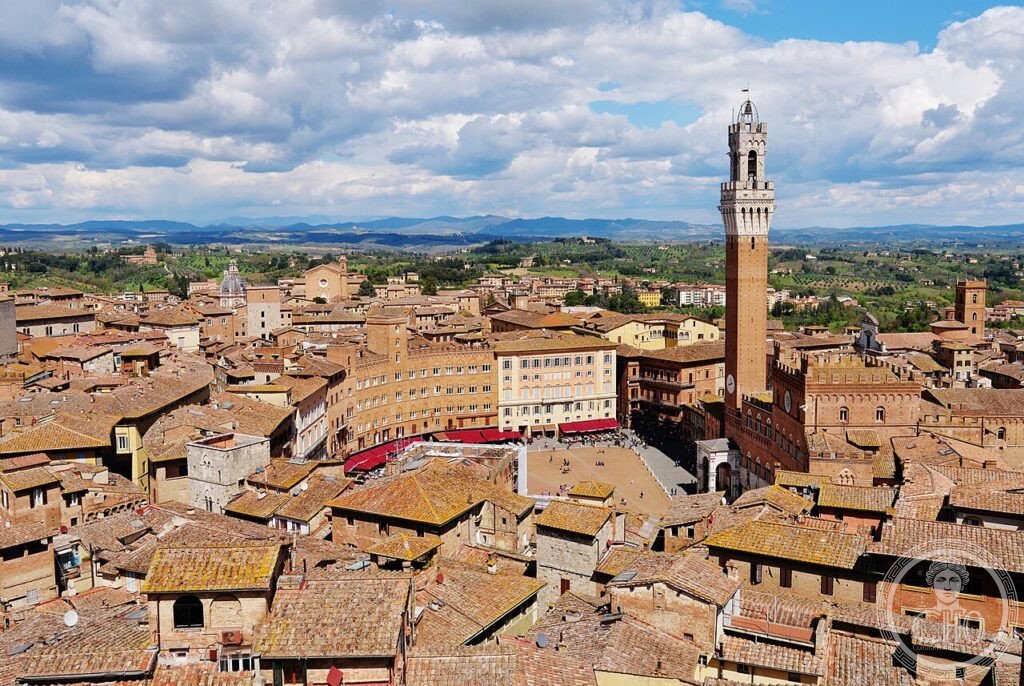
Siena — il Centro Storico Medievale: la Piazza del Campo (XII sec.), il Duomo (1215-1380) e il Palio (1633) nella Più Compiuta Città Gotica d’Italia (UNESCO 1995)
Siena is the most completely preserved medieval city in Italy: its Gothic urban fabric, its division into seventeen competing neighbourhoods (contrade), and its unfinished Gothic Cathedral — abandoned at the death of one-third of its population in the Black Death of 1348, when the city’s most ambitious building project was left as a ruin — create a city whose medieval identity is still a lived reality, expressed twice a year in the Palio horse race around the Piazza del Campo, whose psychological intensity and parochial loyalty have barely changed in 390 years.
At a glance
Siena (province of Siena, Toscana) is a UNESCO World Heritage Site inscribed in 1995 (ref. 717) as “Historic Centre of Siena.” The inscribed area covers the entire historic centre of Siena — the three hills (terzi) on which the medieval city was built (Terzo di Camollia, Terzo di San Martino, Terzo di Città), the Piazza del Campo, the Cathedral complex, and the streets and palaces of the medieval fabric, surrounded by the 13th-16th-century walls. Siena reached its greatest extent and population (approximately 50,000-60,000 people) in the early 14th century, before the Black Death of 1348 reduced its population by approximately a third and ended the great building programme that had produced the Duomo, the Palazzo Pubblico, and the beginning of the new, much larger cathedral (the Duomo Nuovo). After 1348, Siena declined progressively: conquered by Florence in 1555, incorporated into the Medici Grand Duchy, the city was never again the rival of Florence, and its medieval character was never disrupted by the Renaissance and Baroque rebuilding that transformed other Italian cities.
Key facts
- Piazza del Campo: The central piazza of Siena, shell-shaped, on the valley floor between the three hills of the medieval city; the paved surface is divided by eight marble ribs into nine segments (the “terzo” pattern), corresponding to the nine governors (the “Governo dei Nove”) who ruled Siena from 1287-1355; the Palazzo Pubblico (the communal palace, 1297-1310, with the Gothic Torre del Mangia, 1338-1348, 102 m) forms the south flank; on the piazza itself, the Fonte Gaia (the “Joyful Fountain,” original marble reliefs by Jacopo della Quercia 1409-1419, now in the Complesso Museale Santa Maria della Scala; the current fountain is a 19th-century copy) marks the arrival of water via the medieval underground aqueduct (the “bottini,” 25 km of tunnels that still supply Siena’s public fountains)
- Palazzo Pubblico + Museo Civico: The communal palace (open daily 10:00-18:00) contains the greatest concentration of 14th-century Italian civic painting: the Sala del Mappamondo (Simone Martini, “Maestà,” 1315-1321, the first monumental depiction of the Virgin as the ruler of a city; and “Guidoriccio da Fogliano at the Siege of Montemassi,” attributed to Simone Martini, 1328-1330, one of the first large-scale equestrian portraits in Italian painting); the Sala della Pace (Ambrogio Lorenzetti, “Allegorie del Buono e del Cattivo Governo,” 1337-1340, the first painted landscape in Italian art and the most important civic fresco cycle of the medieval period)
- Duomo di Siena (1215-1380): The cathedral on the Terzo di Città hill is one of the most important Gothic buildings in Italy: the facade (the lower portion by Giovanni Pisano, 1285-1300; the upper portion by Gano di Fazio and Camaino di Crescentino, 1376-1382) is the most elaborate Gothic marble facade south of the Alps; the interior contains 56 panels of the famous inlaid marble floor (opus sectile, a polychrome intarsia technique; most panels from 1369 to 1547, many by Beccafumi and Matteo di Giovanni); Nicola Pisano’s octagonal pulpit (1266-1268, the most important Gothic pulpit in Italy, directly preceding his son Giovanni’s pulpit in Pisa); the Piccolomini Library (Pinturicchio, 10 fresco cycles of the life of Pope Pius II, 1502-1508)
- The Palio di Siena: A bareback horse race run twice a year (July 2 and August 16) around the perimeter of the Piazza del Campo, between ten of the seventeen contrade (the neighbourhood organizations that divide the city into competing loyalties); the race lasts approximately 90 seconds and has been run in its current form since 1633; the passion of the contrade (each with its own church, museum, fountain, banner, and society) is the dominant social fact of Siena’s public life
- UNESCO: 1995, ref. 717
- GPS: 43.3186, 11.3307 — Google Maps (Piazza del Campo)
History
Siena is documented as a Roman colony (Saena Julia, founded c.30 BCE) but the city’s significant urban development begins in the early medieval period (8th-9th centuries CE) under the Lombards and then the Carolingians. The commune of Siena emerged in the late 11th century and became a significant banking and trading centre in the 12th-13th centuries, competing directly with Florence: Sienese bankers (the “Caorsines” who handled papal finances from the 1200s onward) were the principal financiers of the medieval papacy, and Siena’s wealth from banking and the via Francigena (the main pilgrimage road from France to Rome passed through Siena) funded the great building programme of 1250-1350. The Sienese Republic reached its political peak under the Nine (1287-1355), whose good government provided both the stability for the major building projects and the political ideology expressed in Ambrogio Lorenzetti’s frescoes.
The Black Death of 1348 killed approximately 30,000-40,000 of Siena’s 60,000 inhabitants, ending the Nine’s government and leaving the great Duomo Nuovo (begun 1339 as a new, much larger cathedral that would have been the largest in Europe, with the existing Duomo as its transept) permanently unfinished. The facade of the Duomo Nuovo — completed only to 2 m above the ground level — survives as the “Facciatone,” a roofless Gothic skeleton visible from the Piazza del Campo, one of the most poignant monuments of medieval ambition and catastrophe in Italy.
What you see
The essential circuit covers the Piazza del Campo (approach from the north via the Via Banchi di Sopra/Via Banchi di Sotto axis to reach the campo suddenly from one of the twelve radial alleys — never arrive by car); the Palazzo Pubblico (Sala del Mappamondo: Simone Martini; Sala della Pace: Ambrogio Lorenzetti “Good Government” — buy the Museo Civico combined ticket, ~€12); the Cathedral (the marble floor is uncovered for limited periods each year — check the dates at operaduomo.siena.it; the Piccolomini Library with Pinturicchio frescoes always accessible, separate ticket); the Facciatone (the roofless facade of the unfinished Duomo Nuovo, reached via the Museo dell’Opera del Duomo; the view from the top of the Facciatone is the best panoramic view of Siena and the surrounding countryside).
Gallery
Practical information
- Museo Civico (Palazzo Pubblico): Piazza del Campo 1; open daily 10:00-19:00 (summer), 10:00-18:00 (winter). Admission ~€10 (combined with Torre del Mangia: ~€15). The Torre del Mangia (505 steps, 102 m, panoramic terrace): advance booking recommended in summer.
- Cattedrale di Siena (Duomo OPA): Piazza del Duomo 8; open Monday-Saturday 10:30-19:00, Sunday 13:30-18:00. The inlaid marble floor is usually uncovered from mid-August to end of October (dates vary year to year). Full OPA SÌ Pass (~€22; includes Cathedral, Library, Battistero di San Giovanni, Cripta, Museo dell’Opera del Duomo, Facciatone): best value for a complete visit.
- The Palio: Tickets for the grandstands of the Piazza del Campo during the Palio (July 2 and August 16) are nearly impossible to obtain; the centre of the campo (standing, free, but requiring arrival 8+ hours early) is the traditional way to experience it. Many hotels in Siena organise packages with grandstand seats.
- Duration: Full day for the essential Siena circuit (Campo + Palazzo + Cathedral complex). 2 days for a complete experience including the Pinacoteca Nazionale (Duccio, Martini, Lorenzetti — the full Sienese Gothic school).
Getting there
Piazza del Campo, Siena (SI), Toscana. GPS 43.3186, 11.3307. By train: Trenitalia from Florence (90 km; 1h30 regional, no direct Freccia; change at Empoli for direct Siena service, or take direct bus); from Rome Termini (250 km; 3h via Florence or direct regional to Chiusi-Chianciano Terme + Siena bus). The train station is 1.5 km north of the Campo (bus or 25-min walk). By bus: FlixBus and Sena/TiemmeToscana from Florence (90 km; 1h15-1h30, frequent service, arriving at Piazza Gramsci in the historic centre — faster and more convenient than the train). By car: from Florence, Superstrada Fi-Si (90 km, 1h); from Rome, A1 to Val di Chiana exit then SS326 (250 km, 2h30); historic centre is ZTL (residents-only); park outside the walls and walk in (Parcheggio il Campo, Parcheggio Stadio — €1.50/h).
Nearby
- San Gimignano — 40 km north-west; (UNESCO 1990 ref.550, see CHO card) — the “medieval Manhattan” with 14 surviving towers
- Montalcino — 40 km south; (Brunello di Montalcino, see Pienza CHO card for brief)
- Pienza — 55 km south-east; (see CHO card: Pienza UNESCO 1996 ref.789)
Sources
- UNESCO: whc.unesco.org/en/list/717
- Wikipedia EN: Siena
- Bowsky, William M.: A Medieval Italian Commune: Siena under the Nine, 1287-1355, University of California Press, 1981
- Museo dell’Opera del Duomo: operaduomo.siena.it
Find it on the map
See this place and what’s around it →📷 Diventa un fotografo di Cultural Heritage Online
Condividi le tue foto dei luoghi: restano pubblicate con la tua firma come autore. Più vengono viste, più ti fai conoscere — e presto un concorso premierà le foto più apprezzate.
Accedi o registrati gratis per aggiungere una foto