
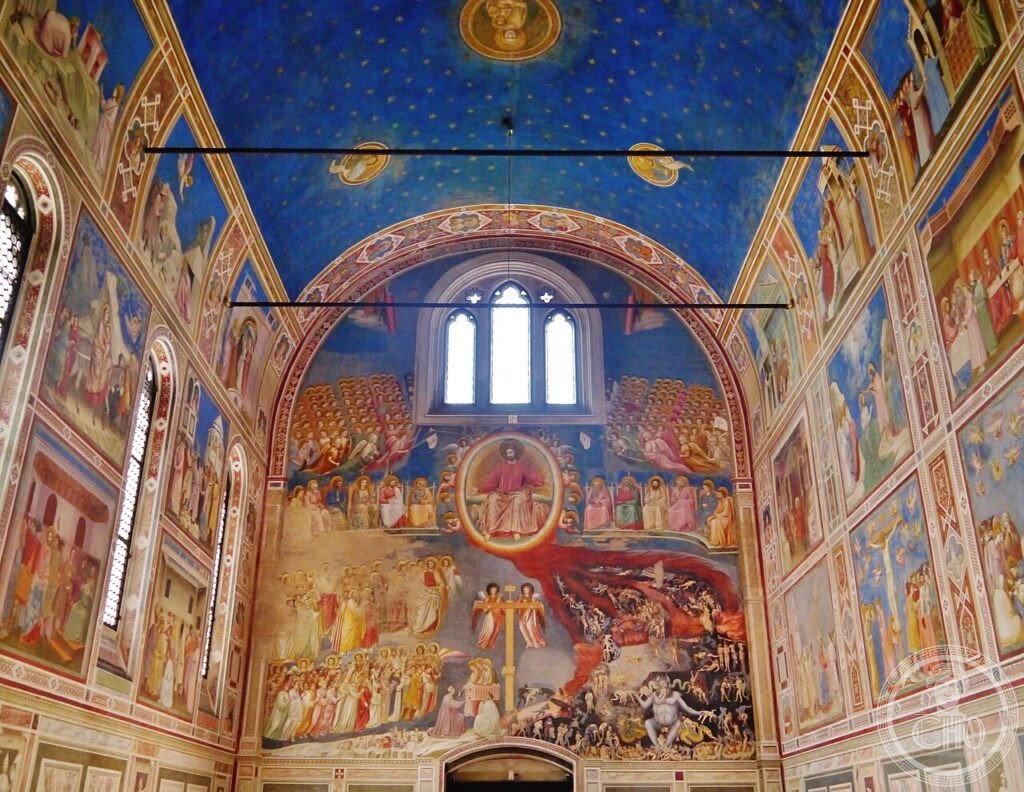
The eight fresco cycles inscribed as UNESCO World Heritage in Padova in 2021 document, in a single city, the 100-year period (c. 1290-1390) in which Italian painters — led by Giotto di Bondone — invented the formal vocabulary of naturalistic painting that all subsequent western art inherited: the consistent rendering of three-dimensional space, the expression of individual emotion on faces, the use of cast shadows, and the integration of figures with landscape and architecture in a single coherent pictorial world.
At a glance
Padova (province of Padova, Veneto) is a UNESCO World Heritage Site inscribed in 2021 (ref. 1545) as “Padua’s fourteenth-century fresco cycles.” The inscription covers eight separate fresco cycles in eight buildings in the historic centre, dating from approximately 1290 to 1397: the Cappella degli Scrovegni (Giotto, 1304-1305), the Baptistery of the Cathedral (Giusto de’ Menabuoi, 1375-1376), the Palazzo della Ragione (cycle attributed to Giotto’s design, with surviving 15th-century repainting by Niccolò Miretto 1420-1425), the Oratorio di San Michele (1397), the Basilica di Sant’Antonio (multiple cycles, 14th century), the Oratorio di San Giorgio (Altichiero da Zevio and Jacopo Avanzi, 1377-1384), the Cappella della Reggia Carrarese (Giusto de’ Menabuoi, 1397), and the Museum (Musei Civici agli Eremitani, with the fragment-remnants of the Mantegna frescoes in the Eremitani church, largely destroyed in the 1944 Allied bombing).
Key facts
- Giotto di Bondone (c. 1267-1337): Born near Vicchio (Mugello, Tuscany); trained in Florence (probably in the workshop of Cimabue); painted the Cappella degli Scrovegni frescoes in Padova in 1304-1305, commissioned by Enrico Scrovegni (a Paduan banker who built the chapel in expiation of his father Reginaldo Scrovegni’s usury — Dante had placed Reginaldo Scrovegni in the Seventh Circle of Hell in the Inferno, Canto XVII); Giotto also worked in Naples (for the Angevins), Rimini, Assisi (the Upper Church of San Francesco — disputed), and Rome (the “Navicella” mosaic in St Peter’s, 1298, partially surviving). Giorgio Vasari (in the Vite de’ più eccellenti pittori, 1550/1568) identified Giotto as the founder of modern painting, a judgment that has been continuously endorsed by subsequent art historians
- Cappella degli Scrovegni (1303-1305): A single-nave chapel (20 m × 8.5 m × 12.8 m) with a single apse; frescoed by Giotto on all walls and the ceiling: the ceiling (dark blue with gold stars and tondi containing Christ, Mary, and Prophets); the north and south walls (three rows of narrative scenes: Life of Joachim and Anna / Life of the Virgin / Life and Passion of Christ — 37 scenes total); the entrance wall (the Giudizio Universale, Last Judgment, covering the entire west wall from floor to ceiling); the dado zone below the narrative scenes (grisaille painted architectural niches with figures of Vices and Virtues); a total fresco area of approximately 1,000 m²
- Battistero della Cattedrale (1375-1376, Giusto de’ Menabuoi): A 14th-century baptistery with a complete fresco programme by Giusto de’ Menabuoi covering all surfaces including the dome (60 medallions with Christ at the apex, the 24 Elders of the Apocalypse below, the 12 Apostles, scenes from the Old and New Testament in concentric rings); the programme is the most complete intact 14th-century fresco cycle in northern Italy after the Scrovegni, and the most fully Byzantine in character (Giusto de’ Menabuoi was trained in Florence but worked in the Byzantine visual tradition in Padova)
- UNESCO: 2021, ref. 1545
- GPS: 45.4068, 11.8771 — Google Maps (Cappella degli Scrovegni)
History
Padova in the 13th and 14th centuries was one of the most important cities of northern Italy: it had been an independent commune since the 12th century, was the site of one of the oldest universities in Europe (the University of Padova, founded 1222 — the second oldest in Italy after Bologna), and hosted the basilica of Saint Anthony of Padova (built 1232-1310, one of the most visited pilgrimage destinations in medieval Europe). The concentration of ecclesiastical patronage, university wealth, and civic ambition created the conditions for the remarkable artistic flowering of 14th-century Padova: the Scrovegni Chapel (1304-1305), Giotto’s most completely preserved cycle; the Oratorio di San Giorgio (1377-1384, Altichiero da Zevio and Jacopo Avanzi); and the Baptistery cycle (1375-1376) were all produced within a 80-year period by patrons competing to commission the most innovative painters available.
The intellectual context of Padova at this period was also important: the University of Padova was the centre of Aristotelian natural philosophy in northern Europe, and the specific tradition of Paduan Aristotelianism (with its emphasis on empirical observation of the natural world as the basis of knowledge) may have created a cultural climate receptive to Giotto’s naturalistic approach to painting. Francesco Petrarca (Petrarch), who spent time in Padova, owned a painting by Giotto and described it as the greatest painting he had seen; Giovanni Boccaccio set the story in the Decameron (Day VI, novella 5) in which Giotto is described as having “brought back to light an art which had been buried for many centuries.”
What you see
The Cappella degli Scrovegni requires advance booking — mandatory for visits in groups of 25 (the maximum) at 15-minute intervals, with a 15-minute “decontamination” in a climate-controlled anteroom before entering the chapel. The visit time inside the chapel is strictly 15 minutes. The booking system is available at cappelladegliscrovegni.it up to 2 months in advance. The chapel is extremely busy from March to October; booking 3-4 weeks in advance is essential. The best time of day is morning (the light from the small windows on the south wall illuminates the north-wall scenes in the morning).
The Battistero della Cattedrale (Piazza del Duomo) is open without advance booking and is usually less crowded than the Scrovegni. The dome fresco (Giusto de’ Menabuoi, 1375-1376) can be seen by looking upward from the centre of the building — bring binoculars to examine the individual medallions in the outer rings. The Oratorio di San Giorgio (Piazza del Santo) is adjacent to the Basilica di Sant’Antonio and open daily; the Altichiero and Avanzi frescoes (1377-1384) are the finest 14th-century frescoes in Padova after the Scrovegni and Battistero, less well known and significantly less crowded.
Gallery
Practical information
- Cappella degli Scrovegni: Piazza Eremitani 8; open daily 9:00-19:00 (last slot 18:00); mandatory advance booking required; 15 min inside the chapel; 15 min anteroom. Admission ~€15 (includes Musei Civici agli Eremitani next door). Book at cappelladegliscrovegni.it.
- Battistero della Cattedrale: Piazza del Duomo; open daily 10:00-18:00; admission ~€4 (combined with Cattedrale: ~€6). No advance booking required.
- Oratorio di San Giorgio (+ Scuola di Sant’Antonio): Piazza del Santo 11; open Tuesday-Sunday 9:00-13:00, 14:00-17:00 (October-March), 9:00-13:00, 14:00-19:00 (April-September). Admission ~€5.
- Duration: Scrovegni Chapel visit: 30-40 min (including anteroom wait). Battistero: 30 min. Oratorio di San Giorgio: 20 min. Basilica di Sant’Antonio (free entry): 40 min. Full Padova fresco circuit: full day.
Getting there
Piazza Eremitani 8, Padova (PD), Veneto. By train: Trenitalia from Venezia Santa Lucia (38 km; 20-30 min Freccia or regional, high frequency); from Verona (80 km; 40-55 min); from Bologna (105 km; 1h with Freccia); from Milan (240 km; 1h45-2h with Freccia). Padova station is 1 km north-east of the Scrovegni Chapel (15-20 min walk along Corso del Popolo and Via Altinate, or bus). By car: from Venice, A4 west to Padova Est exit (38 km, 30 min); from Verona, A4 east (80 km, 50 min). Paid parking near Piazza degli Eremitani.
Nearby
- Venezia — 38 km east; (see CHO card for Venice and its Lagoon, UNESCO 1987 ref.394)
- Vicenza — 30 km west; (see CHO card for Vicenza e le Ville Palladiane, UNESCO 1994/1996 ref.712)
- Colli Euganei (Euganean Hills) — 20 km south; a cluster of volcanic hills rising from the Po plain; the Terme Euganee (Abano Terme, Montegrotto Terme, Battaglia Terme — the largest thermal spa district in Europe, with natural water at 87°C used continuously since Roman times); the Castello di Catajo (1570-1570, Pio Enea I Obizzi, a theatrical castle visible from afar with panoramic terraces and 16th-century frescoes); Petrarch’s house at Arquà Petrarca (where the poet lived from 1370 to his death in 1374, preserved as a museum)
Sources
- UNESCO: whc.unesco.org/en/list/1545
- Wikipedia EN: Scrovegni Chapel
- Altshuler, Bruce (ed.): Giotto and His Age, Skira, 2009
- Cappella degli Scrovegni: cappelladegliscrovegni.it
Find it on the map
See this place and what’s around it →📷 Become a Cultural Heritage Online photographer
Share your photos of places: they stay published under your name as the author. The more they're seen, the more you get noticed — and soon a contest will reward the most appreciated photos.
Log in or sign up free to add a photoIs this page about you?
This page is read by travellers and heritage enthusiasts who find it on Google. Tell us how you are connected to this place and we will take it from there.