
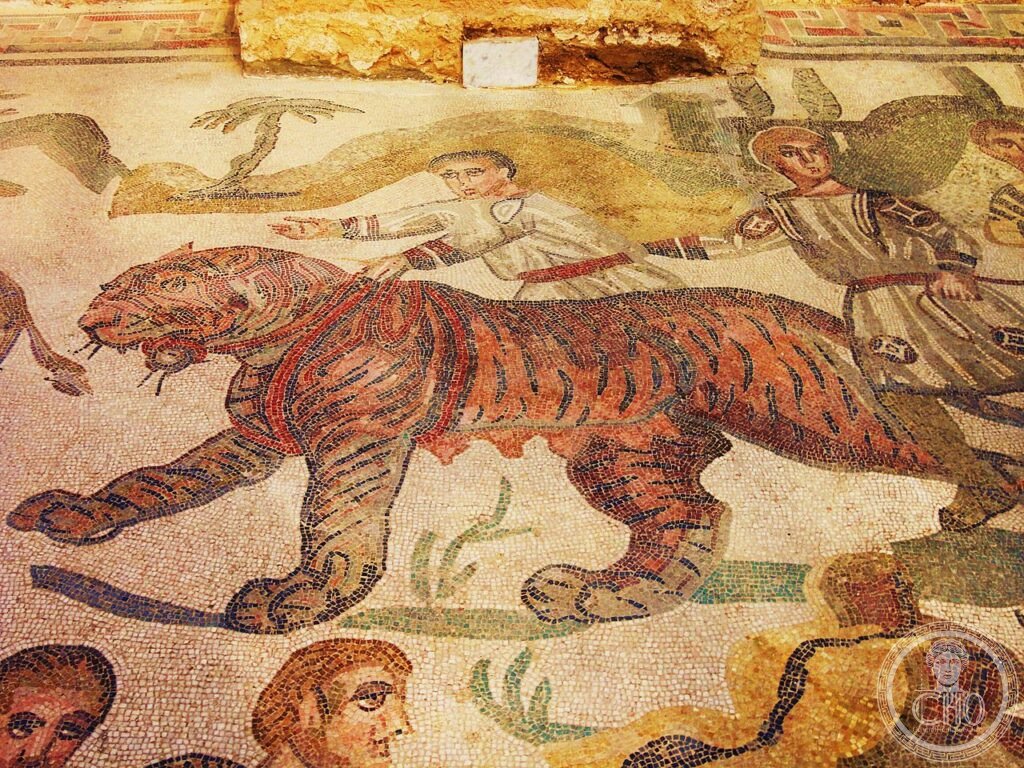
The Villa Romana del Casale is the most important Roman mosaic site in the world — not because it has the largest single mosaic, but because it has the most: 3,500 square metres of polychrome floor mosaic covering virtually every room in a villa of more than 50 rooms, with a pictorial programme of such variety and richness (hunting scenes, circus games, mythological subjects, geographic representations, erotic scenes, the famous “bikini girls” exercising) that it constitutes the most complete surviving record of Roman pictorial art in any single location.
At a glance
The Villa Romana del Casale is a Roman villa of the late imperial period (approximately 310-370 CE) near Piazza Armerina, in the province of Enna, Sicily, inscribed on the UNESCO World Heritage List in 1997 (ref. 881). The villa was buried by a landslide in the 12th century CE and not excavated until 1929-1950 (main excavations) and 1961-1970 (extension). The approximately 60 rooms of the villa are covered with approximately 3,500 m² of polychrome floor mosaics — the largest single collection of in-situ Roman mosaics in the world — executed by a North African workshop (from Carthage or Alexandria) in a style strongly influenced by the pictorial traditions of Roman North Africa. The identity of the owner remains unknown; the scale and richness of the decoration suggest an owner of imperial-senatorial rank.
Key facts
- Scale: The villa covers approximately 3,500 m² of floor area (the largest Roman villa in Sicily) plus an approximately 3,500 m² of mosaics — an extraordinary coincidence; the villa complex includes peristyle courts, baths (a large thermae suite), a basilica (reception hall), dining rooms (triclinia), corridors, private apartments, and a large antechamber
- Corridor of the Great Hunt (Corridoio della Grande Caccia): A long corridor (approximately 60 m × 5 m) entirely covered with a mosaic depicting the capture and transportation of exotic animals (lions, tigers, elephants, rhinoceroses, antelopes, ostriches, hippos) from Africa and Asia for the Roman amphitheatre; the scene shows the animals being loaded onto ships on the left (Africa) and right (Asia) shores; the geographic allegory of the continents in the centre shows “Africa” and “India” personified; the mosaic is the primary source for knowledge of how animals were captured for the Roman arena
- “Bikini Girls” (Sala delle Fanciulle in Bikini): A room near the baths depicting ten young women exercising (running, throwing a discus, using weights, playing ball) in garments that closely resemble a modern bikini (two-piece: bra top and brief-style bottom); the most famous image of the villa and the most reproduced Roman mosaic in popular culture; the context (near the baths, adjacent to the gymnasia) suggests the scene is of athletic training, not theatrical display
- Hunting and fishing mosaics: Multiple rooms with scenes of small game hunting (in the Peristyle corridor), fishing from boats (in the ambulacrum), and children’s circus games (Circus of the Children, where small children pursue hares and birds in chariot-pulled boxes)
- UNESCO: 1997, ref. 881 — “Villa Romana del Casale”
- GPS: 37.3692, 14.3362 — Google Maps
History
The identity of the owner of the Villa Romana del Casale has been debated since the first excavations in 1929. The most widely held hypothesis in 20th-century scholarship attributed the villa to Maximian (the co-emperor of Diocletian, 285-305 CE and again 307-308 CE), who had a connection to Sicily and would have had the rank and resources for a villa of this scale. More recent scholarship (Carandini, Wilson, Pensabene) dates the main phase of mosaic production to approximately 330-370 CE (after the death of Maximian in 310) and favours an owner of senatorial rank rather than imperial. The villa was in use as an aristocratic residence until approximately the 6th century CE; it was partially rebuilt in the 12th century (the Norman tower, visible in the southwest corner, is the only above-ground survival); it was then buried by the landslide of 1161 CE and remained under a 2-3 m deposit until the excavations of the 20th century.
What you see
The visit to the Villa Romana del Casale follows a raised walkway (passerella) above the mosaic floors — a system installed during the 1961-1970 excavations to allow visitors to walk through the rooms without damaging the mosaics. The walkway system has been updated with a new protective glass roof (2012) that provides natural light while protecting the mosaics from rainfall; the combination of the elevated walkway and the glass roof creates an unusual viewing experience, with the visitor looking down at the mosaic surfaces from above and approximately 1.5-2 m away — closer than most museum display conditions but different from the original floor-level experience.
The most important rooms for a first visit are: (1) the Corridor of the Great Hunt (the longest single continuous mosaic in the Roman world and the most spectacular overall view); (2) the Sala delle Fanciulle in Bikini (the “Bikini Girls” room, the most famous single image from the villa); (3) the Triclinium (the main dining room, with the Hercules Labours mosaic — 12 panels showing the 12 labours of Hercules, extremely detailed and well-preserved); (4) the Ambulacrum (surrounding the central peristyle, with a long fishing-and-sea-life mosaic); and (5) the Basilica (the reception hall, with a portrait of the owner and family in the centre of the mosaic — the only portrait in the villa, unfortunately damaged).
Gallery
Practical information
- Opening: Daily 9:00-17:00 (October-April); 9:00-19:00 (May-September); last entry 1 hour before closing. Closed 25 December and 1 January.
- Tickets: ~€10 full; ~€5 reduced (EU citizens 18-25); free under 18 (EU).
- Photography: Permitted (no flash; tripods not allowed). The mosaic colours under the natural light from the glass roof are significantly better in morning light (before noon).
- Duration: 1.5-2 hours for the complete walkway circuit. The villa has no food service on site; bring water (Piazza Armerina is 5 km from the site — take a packed lunch in summer).
Getting there
Contrada Casale, Piazza Armerina (EN), Sicilia. By car: from Palermo, A19 east to Enna exit then SS117bis south to Piazza Armerina (130 km, 1h40); from Catania, A19 west to Dittaino exit then SS117bis south (60 km, 1h). By bus: SAIS bus from Enna (40 min) or Catania (1h30) to Piazza Armerina; local Autoservizi Ditta Gesualdi bus from Piazza Armerina to the villa (5 km). The villa is not accessible by rail; the nearest station is Enna (35 km).
Nearby
- Piazza Armerina centro storico — 5 km north; the Baroque city on the hill; the Cathedral of Maria Santissima delle Vittorie (1719; the statue of Maria on the facade is by Ignazio Marabitti, 1764); the Aragonese castle (14th century) above the city; the medieval quarter of Casalotto (the oldest part of the city, 11th-12th century Norman settlement)
- Morgantina — 14 km north-east; an ancient Sicilian-Greek city (6th-3rd century BCE) on a hilltop; the agora (the largest known Greek agora in Sicily), the theatre, and the macellum (market building with unique circular plan); the silver of Morgantina (a group of 16 silver vessels looted in the 1980s and returned to Italy by the Metropolitan Museum of Art and the Getty Museum between 2006-2010) is now in the site museum
- Agrigento, Valle dei Templi — 60 km south-west; the Greek temples of the 5th century BCE (UNESCO 1997); the Tempio della Concordia (450-440 BCE, the best-preserved Greek temple in the world outside Thessaly); the Tempio di Ercole (520 BCE); the museum with the Efebo di Agrigento (c. 480 BCE)
Sources
- UNESCO: whc.unesco.org/en/list/881
- Wikipedia EN: Villa Romana del Casale
- Wilson, Roger J.A.: Piazza Armerina, Austin, University of Texas Press, 1983
- Parco Archeologico della Villa Romana del Casale: villaromanadelcasale.it
Find it on the map
See this place and what’s around it →📷 Become a Cultural Heritage Online photographer
Share your photos of places: they stay published under your name as the author. The more they're seen, the more you get noticed — and soon a contest will reward the most appreciated photos.
Log in or sign up free to add a photo