
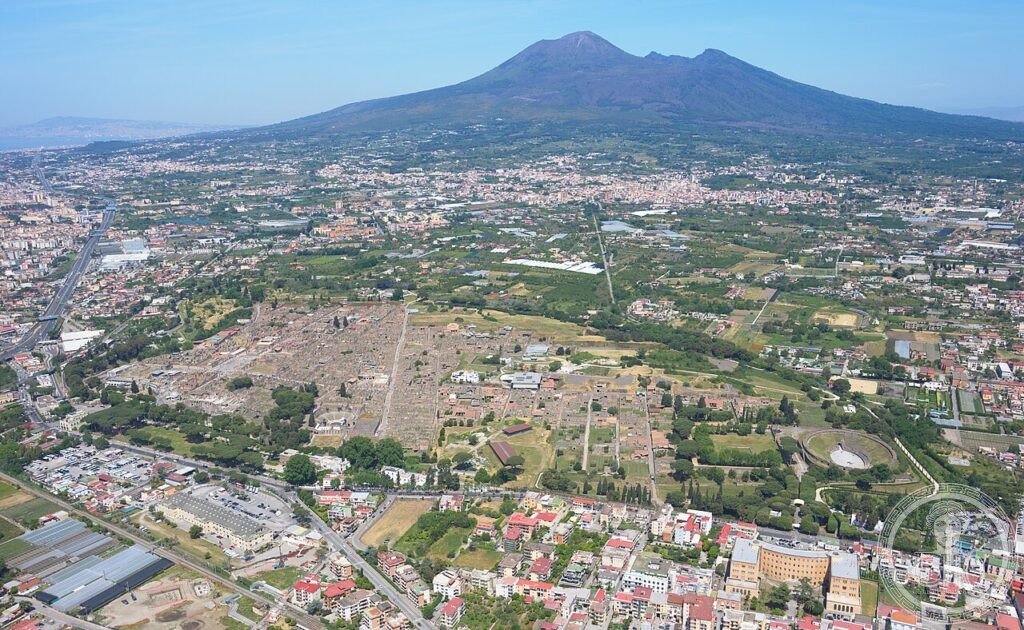
Pompei — la Città Sepolta dal Vesuvio (79 d.C.) e Riscoperta nel 1748: il Più Grande Sito Archeologico Romano al Mondo (UNESCO 1997)
Pompeii is the only ancient Roman city preserved in its original state — streets, buildings, wall paintings, shops, gardens, graffiti, human casts — because in 79 CE, twelve hours of ash and six metres of pumice from the eruption of Vesuvius buried it so completely, so suddenly, and so hermetically that when excavations began in 1748, the city was found intact under a uniform blanket of volcanic deposit: a time capsule, not a ruin.
At a glance
Pompei (ancient Pompeii) is a UNESCO World Heritage Site inscribed in 1997 (ref. 829) as part of the “Archaeological Areas of Pompei, Herculaneum and Torre Annunziata.” The site covers approximately 66 hectares of an ancient Roman city of approximately 11,000-20,000 inhabitants, buried by the eruption of Mount Vesuvius on 24 August 79 CE (or possibly 24 October, per re-dating of some evidence) and systematically excavated since 1860 (under the direction of Giuseppe Fiorelli) from an initial discovery in 1748. Approximately two-thirds of the city area has been excavated; the remaining third is preserved unexcavated as a resource for future archaeological methods. The site is the most visited archaeological site in Italy (approximately 3-4 million visitors annually) and the primary source for knowledge of daily life, domestic architecture, commercial organisation, and wall painting in the Roman world.
Key facts
- The eruption (79 CE): The eruption of Vesuvius on 24 August 79 CE was a Plinian eruption — a vertical column of ash and pumice reaching approximately 30 km altitude, depositing approximately 6 m of pumice on Pompeii in the first 12 hours; the following pyroclastic surges and flows (6 in total over the next 12 hours) killed those who had not evacuated and buried the remaining structures; the historian Pliny the Younger witnessed the eruption from Misenum (30 km north) and wrote a detailed description in two letters to Tacitus — the foundational texts of volcanology
- The human casts: In 1864, Giuseppe Fiorelli invented the technique of pouring plaster into the voids left by the decomposed bodies of victims buried in the ash; the resulting casts show the posture, clothing, facial expressions, and physical characteristics of the victims at the moment of death; approximately 1,150 casts have been produced; the most famous groups are in the Antiquarium (on site), in the Garden of the Fugitives, and in the Forum
- Wall paintings: Approximately 1,500 rooms with surviving wall paintings have been recorded at Pompeii; the paintings are classified into four “Pompeian styles” (First Style: false marble panelling, 2nd–1st c. BCE; Second Style: architectural trompe-l’oeil, 80-15 BCE; Third Style: black and red panels with central picture, 15 BCE-60 CE; Fourth Style: complex architectural fantasy with inset pictures, 60-79 CE); the paintings provide the most complete record of Roman domestic decoration in the 1st century CE
- Villa dei Misteri: A large suburban villa outside the city walls (500 m west of the Porta Ercolano); the Dionysiac Mysteries frieze in the triclinium (60 BCE, 17 figures, original size 1:1, red ground with figures in naturalistic movement) is the most important surviving Roman wall painting; the subject is the initiation of a young woman into the Dionysiac mysteries — the interpretation has been debated since the fresco’s discovery
- UNESCO: 1997, ref. 829 — together with Herculaneum and Torre Annunziata (Oplontis)
- GPS: 40.7490, 14.4989 — Google Maps
History
The city of Pompeii was founded in the 7th or 6th century BCE by the Oscans (the indigenous pre-Roman Italic people of Campania); it was colonised by the Greeks and later by the Samnites (the mountain Italic people who dominated Campania in the 4th century BCE) before becoming a Roman ally after the Social War and then a Roman colony in 80 BCE (under Sulla, who settled 4,000-5,000 Roman veterans in the city). The colony was named Colonia Veneria Cornelia Pompeianorum; Latin replaced Oscan as the official language; the city was laid out on a Hellenistic grid plan with two main streets (the Decumanus Maximus and the Cardo Maximus) intersecting at the Forum, the commercial and political centre of the city.
The first systematic excavations at Pompeii were ordered by the Bourbon king of Naples, Charles III, in 1748 — initially unsystematic and focused on the recovery of objects for the royal collection (now in the Museo Nazionale di Napoli). The scientific phase of excavation began in 1860 under Giuseppe Fiorelli, who invented the numbering system for houses (regiones, insulae, ostia) still used today and the plaster-casting technique for human remains. The Parco Archaeologico di Pompei, the managing body since 2014, runs the site as an autonomous museum and has accelerated both conservation and new excavation in the “Pompeii Regio V” project (2017-present), which has produced major new discoveries in the north-western section of the city still unexcavated.
What you see
The visit to Pompeii is organised around two main axes: the Via dell’Abbondanza (the main east-west commercial street, with shops, thermopolia — ancient Roman fast food — and houses lining both sides) and the Foro (Forum, the political, religious, and commercial centre). The most important buildings around the Forum are: the Tempio di Giove (the principal Capitoline temple, 2nd century BCE), the Basilica (law court and financial exchange, 2nd century BCE — the oldest surviving example of the building type that became the model for Christian churches), and the Tempio di Apollo (6th century BCE foundation, rebuilt 2nd century BCE, with a standing colonnade).
The Villa dei Misteri (accessible via a separate entrance 500 m outside the city walls) requires a specific detour but is the single most important artwork in the site — the Dionysiac Mysteries frieze is a painting of extraordinary quality and scale (17 m long, approximately 1.6 m high) that has no parallel in the surviving record of ancient wall painting. The colour (the specific “Pompeii red” — Egyptian red pigment mixed with lead white — has not faded in 2,000 years), the scale of the figures (life-size), and the movement across the frieze (from right to left, depicting the stages of a religious initiation) make this a painting that cannot be understood from photographs.
Gallery
Practical information
- Opening: Daily 9:00-19:00 (April-October); 9:00-17:00 (November-March). Last entry 1.5 hours before closing. The site is large (66 hectares, approximately 7 km of internal roads); comfortable footwear on cobblestones is essential; no shade in summer; bring water.
- Tickets: ~€16 full; ~€2 reduced (EU citizens 18-25); free EU citizens under 18 and over 65 (EU passports only). The Villa dei Misteri requires a separate entrance ticket (same price). Combined ticket with Herculaneum, Torre Annunziata, Stabiae, Baia: ~€22 for 1 day or ~€30 for 3 days (highly recommended).
- Season: April-May and September-October are best (cooler, fewer crowds). July-August: extremely hot (no shade, temperatures 35-40°C), very crowded (7,000+ visitors/day); arrive at opening and leave by noon.
- Duration: Minimum 3 hours; recommended 5-6 hours for a complete visit including Villa dei Misteri; a full day with the Antiquarium and specific house visits.
Getting there
Via Villa dei Misteri 2, Pompei (NA), Campania. Main entrance: Porta Marina entrance (also Anfiteatro and Piazza Esedra entrances). By train: Circumvesuviana from Napoli Garibaldi station to “Pompei Scavi – Villa dei Misteri” (35 min; trains every 30 min) — the station is adjacent to the Porta Marina entrance. From Sorrento, Circumvesuviana north to “Pompei Scavi” (30 min). By car: from Naples, A3 south to “Pompei Ovest” exit (23 km, 35 min); parking on Via Villa dei Misteri (€4-6/day).
Nearby
- Ercolano (Herculaneum) — 17 km north on the coast; a smaller Roman city (approximately 4,000 inhabitants) also buried by the 79 CE eruption, but by pyroclastic flow rather than ash — which carbonised organic materials (wooden beams, furniture, food, papyri, human remains) rather than destroying them; the site is better preserved than Pompeii in many respects; the Villa dei Papiri (2nd century BCE, with the largest library of ancient texts found in any Roman site — 1,800 papyri, still being digitally unrolled) is the most important unexcavated building in the Roman world
- Torre Annunziata (Oplontis) — 6 km west; the Villa di Poppea (1st century CE, the largest suburban villa in the Vesuvius area — 13,000 m², 50+ rooms, 87 surviving wall paintings of the Second Style, 1st century BCE); the attribution to Poppaea Sabina (Nero’s wife) is conventional, not proven; included in the combined Vesuvius ticket
- Museo Nazionale di Napoli — 23 km north; the collection from Pompeii and Herculaneum (the majority of the most important portable objects from both sites are here, not at the sites): the Alexander Mosaic (100 BCE, from the House of the Faun, Pompeii), the Gabinetto Segreto (erotica and cult objects), the 17 Doryphoros replica copies, the Pompeian still-life mosaics
Sources
- UNESCO: whc.unesco.org/en/list/829
- Wikipedia EN: Pompeii
- Berry, Joanne: The Complete Pompeii, Thames & Hudson, London, 2007
- Parco Archeologico di Pompei: pompeiisites.org
Find it on the map
See this place and what’s around it →📷 Diventa un fotografo di Cultural Heritage Online
Condividi le tue foto dei luoghi: restano pubblicate con la tua firma come autore. Più vengono viste, più ti fai conoscere — e presto un concorso premierà le foto più apprezzate.
Accedi o registrati gratis per aggiungere una foto