
Piazza dei Miracoli, Pisa — Torre Pendente, Duomo e Battistero: il Campo dei Miracoli che Cambiò la Storia dell’Architettura (XI–XIV Secolo, UNESCO 1987)
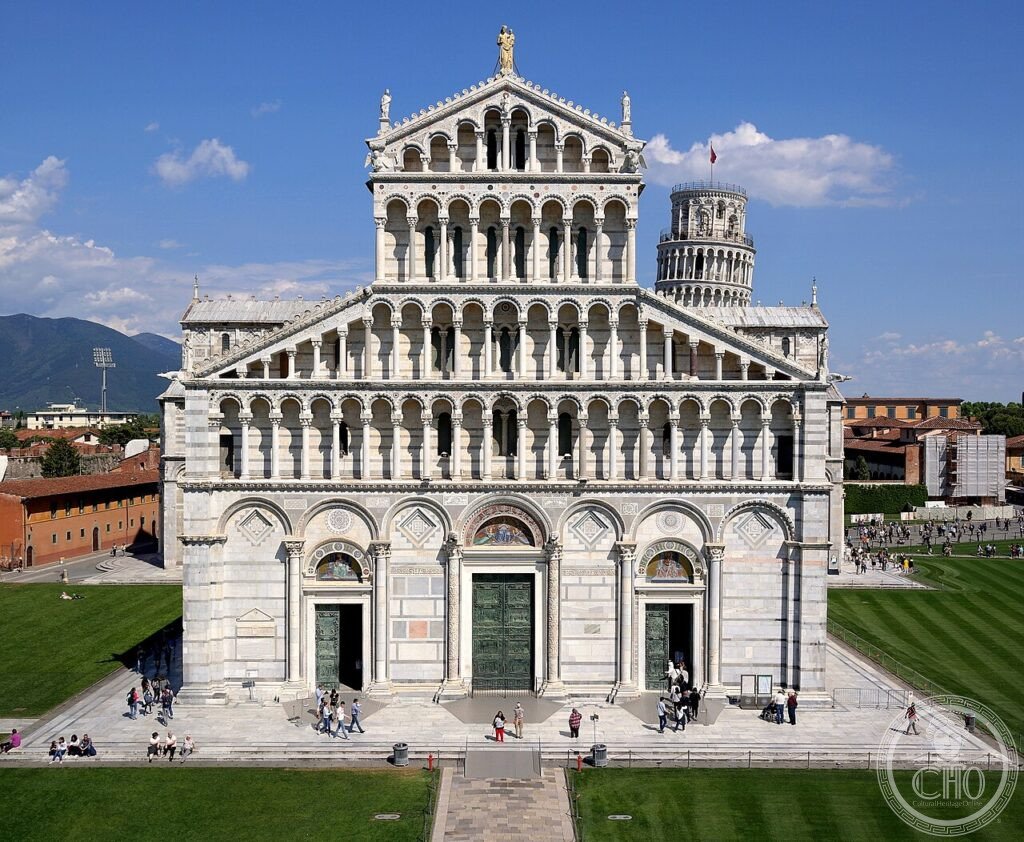
The four marble buildings of the Piazza dei Miracoli — the Cathedral, the Baptistery, the Campanile (the Leaning Tower), and the Camposanto (monumental cemetery) — define not just a square but an entire tradition of Italian Romanesque architecture: the Pisan Romanesque style, with its characteristic blind arcading, alternating bands of coloured marble, and open-air loggia galleries, spread from Sardinia to Apulia, from Genoa to Lucca, making this piazza the single most imitated architectural complex in medieval Italy.
At a glance
The Piazza dei Miracoli (officially Piazza del Duomo, also known as the Campo dei Miracoli) in Pisa, Toscana, is a UNESCO World Heritage Site (1987, ref. 395), containing four exceptional Romanesque monuments: the Cathedral (Duomo) of Santa Maria Assunta (begun 1064); the Baptistery of San Giovanni (begun 1152); the Campanile (the Leaning Tower, begun 1173, completed 1372); and the Camposanto Monumentale (begun 1277). The complex is built on a large meadow (the “Campo”) at the north edge of the medieval city, on an axis perpendicular to the River Arno. The uniform use of Carrara marble (white with grey stripes), the distinctive Pisan Romanesque colonnaded arcade style, and the precision of the spatial relationships between the four buildings make this the most coherent monumental ensemble in medieval Italian architecture.
Key facts
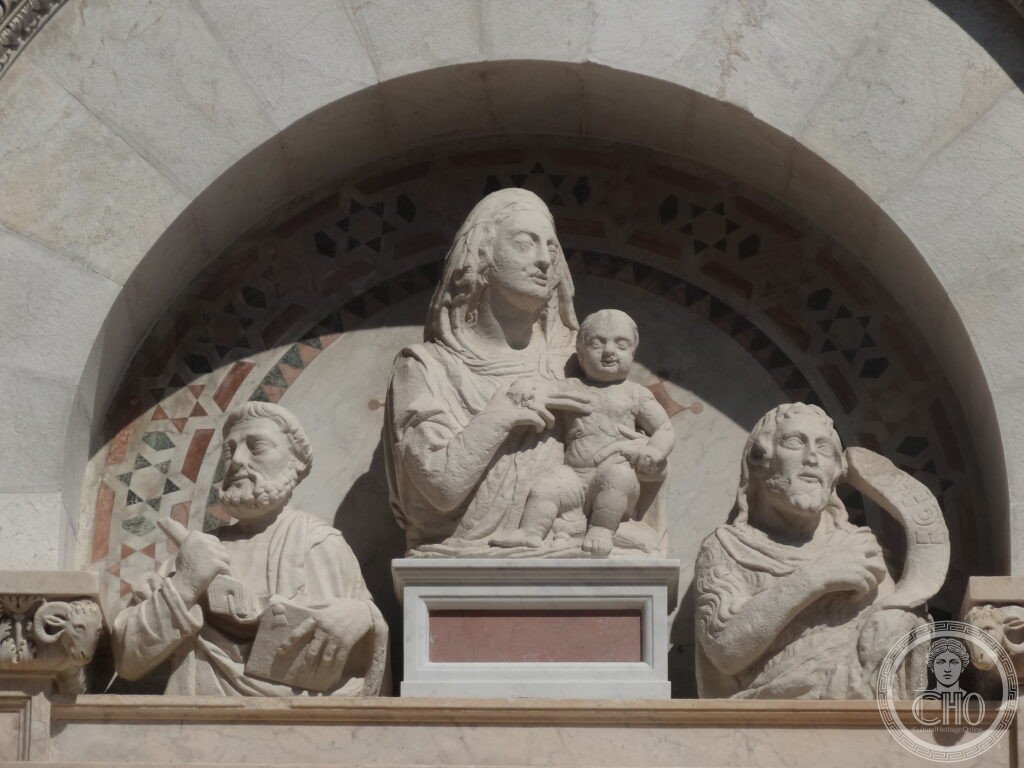
- Cathedral (Duomo) di Santa Maria Assunta: Begun 1064 by the architect Buscheto (one of the first named architects in medieval Italian history); the ground plan is a Latin cross with a five-nave nave and a three-nave transept — a plan derived from the great basilicas of Rome; the Romanesque exterior is articulated by six registers of open arcaded galleries on the facade (added in the 12th century by Rainaldo) and bands of alternating green and white marble; the bronze doors (Bonanno Pisano, 1186) and the pulpit (Giovanni Pisano, 1302–1310) are the major movable artworks inside
- Campanile (Leaning Tower): Begun 1173 (attributed to Bonanno Pisano and Gerardo di Gherardo); construction was suspended 1178-1272 and again 1278-1319 due to the inclination developing; the lean is approximately 3.97° from the vertical (as of 2001, after partial correction); the tower is 56 m tall on the low side and 56.7 m on the high side; the inclination began during construction due to the soft subsoil on the south side; corrective engineering between 1990 and 2001 reduced the inclination from 5.5° to 3.97° and is expected to be stable for at least 300 years
- Battistero di San Giovanni: Begun 1152 by Diotisalvi; the lower register (Romanesque) is by Diotisalvi; the upper registers (Gothic) were added in the 13th-14th centuries by Nicola Pisano and Giovanni Pisano; the pulpit inside (Nicola Pisano, 1260) is the foundational work of the Italian Gothic sculptural tradition — the starting point for the entire Pisano dynasty of sculptors that reshaped Italian art between 1260 and 1314
- Camposanto Monumentale: Begun 1277 (Giovanni di Simone); a rectangular cloister surrounding a central open lawn; the walls under the portico were covered with approximately 600 m² of 14th-15th century frescoes (most famously the “Triumph of Death” and the “Last Judgement”) which were severely damaged in a fire caused by an Allied artillery shell in 1944; the damaged sinopie (under-drawings) were removed and are now displayed in a separate museum on the piazza
- UNESCO: 1987, ref. 395 — “Piazza del Duomo, Pisa”
- GPS: 43.7228, 10.3966 — Google Maps
History
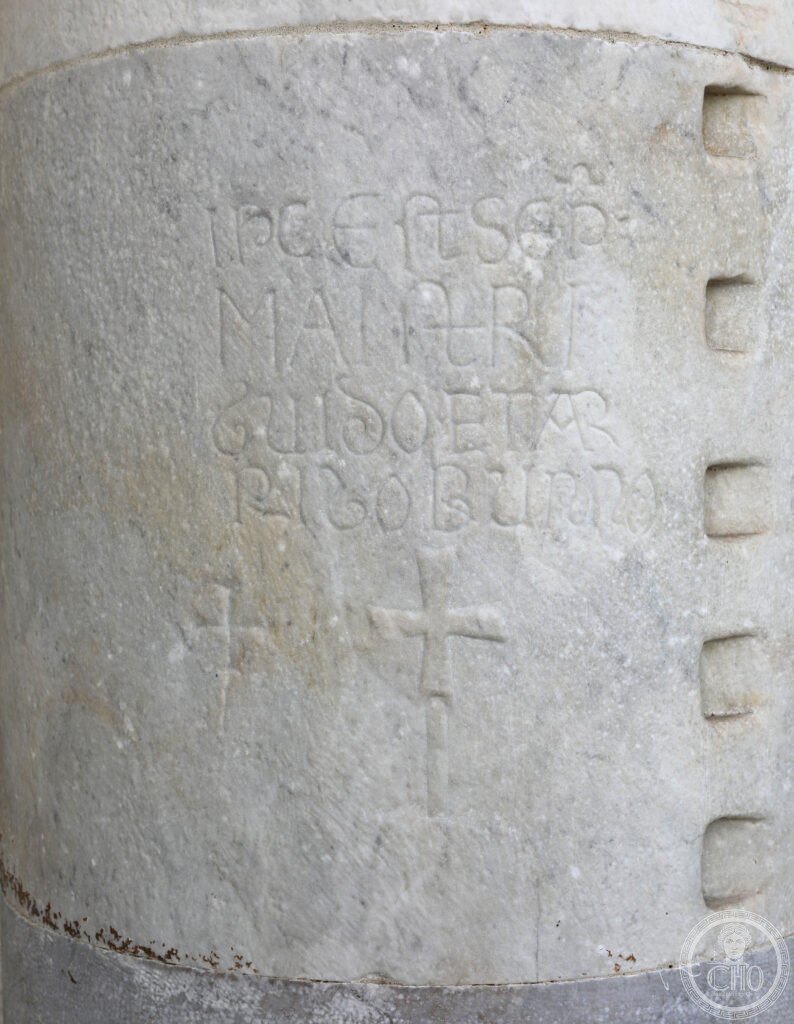
Pisa in the 11th century was one of the three great maritime republics of Italy (alongside Genoa and Venice) — a major naval and commercial power in the Tyrrhenian and Mediterranean, with colonies and trading posts from Sardinia to Syria. The wealth generated by Pisan maritime trade in the 10th and 11th centuries funded a programme of monumental construction that began with the Cathedral (1064) and continued over three centuries to produce the Baptistery (1152-1363), the Campanile (1173-1372), and the Camposanto (1277-). The Duomo was built as an ex-voto for the Pisan victory over the Saracens at Palermo (1063), funded in part by spoils from the raid, and the architect Buscheto was given the extraordinary honour of burial inside the Cathedral facade — an inscription on the facade still reads “Busketus” and describes him as “renowned in the entire world.”
The “Pisan Romanesque” style developed at the Duomo — characterised by the open loggia arcading on the facade, the alternating coloured marble bands, the bronze casting, and the narrative relief sculpture — became the most widely copied architectural style in medieval Tuscany and was exported to Sardinia (where Pisa controlled much of the island in the 12th-13th centuries), Apulia, Sicily, and Liguria. The Pisano sculptors — Nicola Pisano (who signed the Baptistery pulpit, 1260) and his son Giovanni (Duomo pulpit, 1302-1310) — represent the first evidence of ancient Roman sarcophagus reliefs being studied as models for Christian narrative sculpture, a decisive step toward the Renaissance.
What you see
The Piazza dei Miracoli presents a visual experience that is among the most studied in the history of Western art — the “problem of the piazza,” as architectural historians have framed it since Erwin Panofsky: the four buildings are not on a common axis, not symmetrically arranged, not aligned on a grid, and yet the spatial relationship between them (studied and confirmed by the architect Giovanni Michelucci in the 1930s) follows precise geometric proportions. The visitor approaching from the south (the main entrance) sees first the Baptistery dome, then the Cathedral, and finally (and most unexpectedly) the Leaning Tower behind the apse — not beside the Cathedral facade as is conventional for Italian campanili, but behind it, revealing itself progressively as the visitor walks across the lawn.
Inside the Cathedral, the most important surviving original object is the Pulpit by Giovanni Pisano (1302-1310): a hexagonal marble pulpit on seven columns, with six narrative relief panels (Annunciation, Nativity, Journey of the Magi, Adoration, Massacre of the Innocents, Crucifixion, Last Judgement) carved in a style of extraordinary emotional intensity and spatial complexity. Comparing this pulpit with the father Nicola Pisano’s pulpit in the Baptistery (1260) — visible 100 m away — shows the difference between the classical, Augustan-inspired approach of the father and the Gothic, emotionally charged approach of the son; a 50-year span that contains the entire history of 13th-century Italian sculpture.
Gallery
Practical information
- Opening: All monuments open daily; hours vary seasonally (approximately 9:00-18:00 in autumn/winter; 9:00-20:00 in summer). The Leaning Tower requires a timed reservation (highly recommended to book online at opapisa.it at least 15 days in advance, especially in summer).
- Tickets: Combined tickets: 2 monuments €15 / 3 monuments €20 / all 5 monuments (Cathedral + Baptistery + Tower + Camposanto + Sinopie Museum) €27. Cathedral free for prayer (not valid for tourist entry during peak hours). Children under 10: free.
- Duration: 2-3 hours for Cathedral + Baptistery + Tower + exterior. Full day for all 5 monuments with the Camposanto and Sinopie Museum.
- Dress code: Shoulders and knees covered in the Cathedral (shawls available at entrance).
Getting there
Piazza del Duomo, Pisa, Toscana. The Piazza is 1.2 km north of the central train station. By train: Trenitalia from Firenze (1h); from Genova (1h30); from Roma (3h or 2h with Frecciaargento). The Pisa Centrale station is a 15-20 minute walk north to the piazza, or take bus LAM Rossa from the station. Pisa Internazionale airport (Galileo Galilei) is 4 km south of the city centre: shuttle bus or taxi (15 min) to the piazza. By car: from Firenze, A11 west (90 km, 1h); from Genova, A12 south (160 km, 1h45). Parking: via Pietrasantina (large, free, north of the piazza) or the paid car park on Piazza dei Miracoli (south side).
Nearby
- Museo delle Sinopie, Piazza dei Miracoli — across the piazza from the Cathedral; the preparatory drawings (sinopie) removed from below the damaged Camposanto frescoes after the 1944 fire; extraordinary visual evidence of the 14th-century fresco-painting process; included in the combined ticket
- Lungarni e centro storico di Pisa — the Arno river embankment south of the piazza; Piazza dei Cavalieri (1562, Giorgio Vasari for Cosimo I; the main piazza of the Ordine dei Cavalieri di Santo Stefano, the Pisan knightly order that fought North African piracy under Medici command); the Borgo Stretto (medieval shopping street with 14th-15th century arcades)
- Certosa di Pisa, Calci — 12 km east; the largest Charterhouse (Certosa) in Tuscany (founded 1366); the main church, the sacristy, the chapter house, and the monks’ cells are part of a guided tour (booking required); the Museo Nazionale di Storia Naturale is in the same complex (whale skeleton, mineral collection)
Sources
- UNESCO: whc.unesco.org/en/list/395
- Wikipedia EN: Piazza del Duomo, Pisa
- Calderoni Masetti, Anna Rosa: Pisa: Art and History, Sillabe, Firenze, 1993
- Opera della Primaziale Pisana: opapisa.it
Find it on the map
See this place and what’s around it →📷 Diventa un fotografo di Cultural Heritage Online
Condividi le tue foto dei luoghi: restano pubblicate con la tua firma come autore. Più vengono viste, più ti fai conoscere — e presto un concorso premierà le foto più apprezzate.
Accedi o registrati gratis per aggiungere una foto